
Image courtesy of TCGdex.net
Wingull, Reprints, and the Metagame: A Competitive Look
Reprint cycles are a quiet engine beneath the roar of Pokémon TCG tournaments. When a familiar staple returns to new print runs, the competitive landscape shifts in subtle but meaningful ways. Wingull, a humble Basic Colorless Pokémon from the Celestial Storm era, offers a perfect lens to explore how cycles influence deck viability, budget accessibility, and collector interest. While this little gull carries just 60 HP and a single, modest attack, its journey through reprints illuminates how the TCG’s economics and metagame evolve hand in hand ⚡.
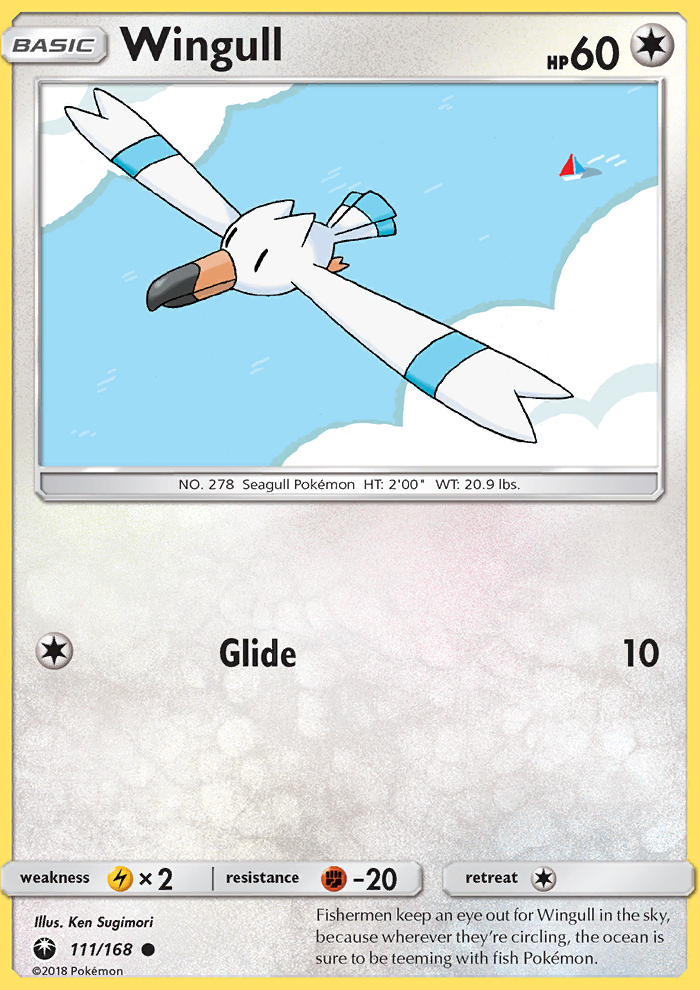
A Snapshot from Celestial Storm: Wingull’s Card Data in Context
- Name: Wingull
- Set: Celestial Storm (SM7)
- Rarity: Common
- Type: Colorless
- Stage: Basic
- HP: 60
- Attack: Glide — 10 damage for Colorless
- Weakness: Lightning ×2
- Resistance: Fighting −20
- Retreat Cost: 1
- Illustrator: Ken Sugimori
- Legal in formats: Expanded yes, Standard no
- Variants: Normal, Reverse, and Holo (Celestial Storm featured multiple print variants)
- Dex ID: 278
Wingull’s place in Celestial Storm is telling. As a colorless basic, it slots into decks that value flexible energy costs and early board presence. Glide is a simple, low-commitment attacker that can pressure opposing Basics in the opening turns, or become a filler option in decks that lean on other strategies. The card’s modest HP and single-attack design underscore the era’s emphasis on balance and accessibility—traits that reprint cycles tend to reinforce rather than erase, especially for common staples. Ken Sugimori’s art gives Wingull a breezy, approachable vibe that resonates with players who started in the Sun & Moon era and those who dip back in for budget-friendly staples 💎.
From a strategic standpoint, Wingull’s Colorless typing is a reminder of how energy mixing and splashability shape early-game tempo. In practice, a Wingull that’s easy to draw and cheap to play can help a deck accelerate its board state without pulling precious resources away from more powerful evolutions or Trainer-based engines. When reprint cycles reintroduce Wingull, they do so not as a blockbuster centerpiece but as a dependable, low-cost option that supports a broader spectrum of deck builds. This is especially true in Expanded, where older mechanics and card pools remain vibrant and relevant.
Reprint Cycles: How Availability Drives the Meta
Reprints affect more than price tags. They influence which decks are feasible for casual players and aspiring competitors. When a common card like Wingull reappears across sets, it tends to stabilize the supply chain for that class of card—basic Colorless Pokémon that players can draw into early on without risking a steep investment. This, in turn, lowers the barrier to entry for new players and keeps the metagame dynamic, as budget-conscious builders explore different routes to victory. By broadening access to widely playable basics, reprints keep the field competitive without pushing prices into the stratosphere 🥇.
Speaking of prices, Wingull’s market signals are instructive. Cardmarket data shows a general average around EUR 0.08 with short-term lows near EUR 0.02, while holo variants trend higher, often around EUR 0.20 or more. On TCGPlayer, the normal (non-holo) price leans around USD 0.05–0.20 for common copies, with highs approaching USD 1.49 in some cases and market prices hovering near USD 0.17. For collectors chasing a holo or reverse-holo Wingull, the spread can widen, but the overall picture remains one of affordable, accessible copies—precisely the kind of supply that reprint cycles tend to support. In other words, every reprint helps keep Wingull within reach for players who want to experiment with budget-friendly deck concepts or practice matchups without heavy financial risk 🔍.
Gameplay Implications: Budget Play, Deck Architecture, and the Collector’s Eye
In the grand scheme, Wingull is not a powerhouse—its 60 HP and 10-damage Glide won’t single-handedly swing a tournament. Yet the card’s value lies in its role as a flexible scorable source of early board pressure and as a testbed for budget strategies. When a new print re-joins the pool, players can assemble leaner, more diverse decks that still hit efficiently on opening turns, because they’re not forced to rely on scarce staples. The result is a healthier metagame where creativity can flourish, and where less-exotic forms of competition survive alongside the era’s marquee archetypes 🔥.
From an art and lore angle, Wingull’s Celestial Storm print, with Sugimori’s clean linework, evokes a breezy coastal vibe that fans remember fondly. The availability of common beach-breeze Pokémon during reprint cycles also mirrors the real-world scene: players re-assemble, practice, and trade, building communities around accessible cards that still have character and history. This is not just about numbers; it’s about the joy of collecting, trading, and fine-tuning a deck that’s affordable but still formidable in the hands of a sharp player 🎨.
Market Trends and Collector Insights: Keeping an Eye on the Wave
As reprints ripple through the market, it’s useful to track not only prices but also the card’s presence in standard-legal and expanded formats. Wingull’s standard status is False while expanded remains True, which means it remains a convenient entry point for players who enjoy the expanded format’s broader card pool. This dual reality—accessible in one format, limited in another—creates an interesting dynamic for collectors who value both playability and preservation of historical print runs. For those watching the market, fast shifts typically occur when a reprint coincides with competing staples in the same niche, or when a new deck archetype revitalizes interest in older common cards as practical budget choices ⚡.
On the collector side, Wingull’s status as a common with holo and reverse-holo variants keeps it appealing. The artistry of Ken Sugimori adds a layer of nostalgia that collectors often chase, even when the card’s gameplay value is modest. If you’re assembling a Celestial Storm-themed binder, or a broader Sun & Moon era collection, Wingull is a pleasant, budget-friendly anchor that echoes a beloved period of the TCG’s history. And as reprints continue, expect Wingull to surface in new printings with fresh artwork or foil treatments, inviting both new players and seasoned collectors to reel in a little more of the Celestial Storm wave 🌊.
Customizable Desk Mouse PadMore from our network
Wingull
Set: Celestial Storm | Card ID: sm7-111
Card Overview
- Category: Pokemon
- HP: 60
- Type: Colorless
- Stage: Basic
- Dex ID: 278
- Rarity: Common
- Regulation Mark: —
- Retreat Cost: 1
- Legal (Standard): No
- Legal (Expanded): Yes
Description
Attacks
| Name | Cost | Damage |
|---|---|---|
| Glide | Colorless | 10 |
Pricing (Cardmarket)
- Average: €0.08
- Low: €0.02
- Trend: €0.09
- 7-Day Avg: €0.06
- 30-Day Avg: €0.08
Support Our Decentralized Network
Donate 💠More from our network
- https://donation.digital-vault.xyz/donation/post/support-privacy-first-tools-help-keep-them-free-for-everyone/
- https://wiki.digital-vault.xyz/wiki/post/pokemon-tcg-stats-butterfree-vmax-card-id-swsh3-2/
- https://transparent-paper.shop/blog/post/stable-diffusion-xl-prompt-voidpunk-neon-noir-cyberpunk-glyphs-chainmail-texture-encrypted-motif-sunrise-palette/
- https://blog.crypto-articles.xyz/blog/post/nft-data-bmb-community-season-4-8248-from-bmb-community-airdrop-season-4-collection-on-magiceden/
- https://blog.crypto-articles.xyz/blog/post/nft-data-george-plays-clash-royale-758-from-gpcr-nft-collection-collection-on-magiceden/