
Image courtesy of Scryfall.com
Design Teases from a Delve-Driven Classic: What Un-cards Teach Us About Murderous Cut
Magic design isn’t just about raw numbers or dazzling spells; it’s a continual conversation between constraints and curiosity. In the case of Murderous Cut, an uncommon instant from Khans of Tarkir, the conversation hinges on a focused idea—the Delve mechanic—and how a single card can illuminate broader design theory. Un-cards, those experimental, sometimes bizarre offshoots of the game, aren’t merely novelty; they often act as thought experiments that push designers to reexamine what is possible within a familiar framework. 🧙♂️🔥
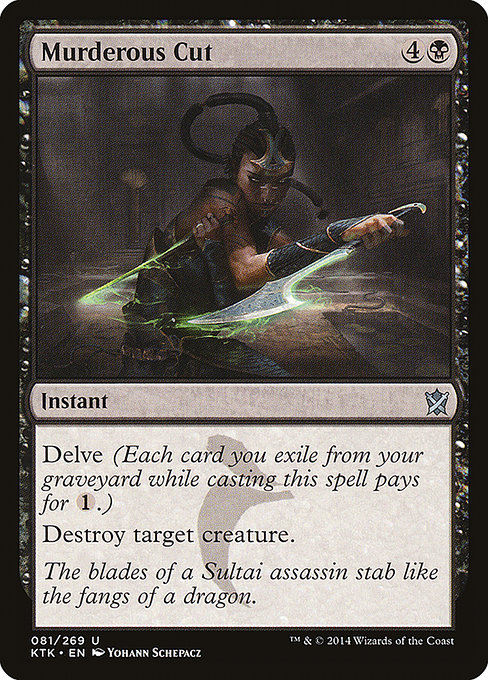
On its surface, Murderous Cut looks like a clean, efficient piece of removal: pay four mana plus black, exile a handful of cards from your graveyard with Delve, and destroy target creature. But the real intrigue lies in how the card balances a powerful effect with a flexible cost-reduction scheme. The Delve mechanic invites you to leverage your graveyard as a resource, turning a spent battlefield into a bargaining chip. The flavor text—“The blades of a Sultai assassin stab like the fangs of a dragon”—hints at a clan that prizes cunning resource management and surgical strikes rather than brute force. ⚔️
Delve as a Design Laboratory: Paying for Power with the Graveyard
Delve embodies a fundamental design principle: power is most compelling when it’s earned through meaningful decisions. Murderous Cut costs {4}{B} on the surface, but the actual mana outlay can drop dramatically as you exile cards from your graveyard. This creates a gray area where timing and resource allocation matter as much as the card’s immediate impact. The mechanic rewards players who plan ahead—setting up a tempo swing by converting unseen library cards into mana-taxed, fearsome removal. It’s a neat reminder that value can be dynamic, not static, and that clever economy often trumps raw force. 🧙♂️💎
Color Identity, Clans, and the Subtle Art of Thematic Coherence
Kept within a tight black color palette and a Sultai watermark, Murderous Cut is a prime example of how a design team communicates identity through resource-based removal. The Sultai clan—factionalized by black, blue, and green—thrives on graveyard interaction, card draw, and calculated attrition. By tying Delve to a classic “destroy” effect, the card reinforces the clan’s ethos: precise, surgical disruption that leverages what was once discarded. The card’s flavor text elevates the lore, turning a simple spell into a nod to the dragon-savvy predator archetype that lurks within Sultai strategy. This is design depth that celebrates theme without sacrificing utility. 🎨
Balance, Rarity, and the Value of Edge Cases
Rarity often acts as a ceiling for how far a card can push a given mechanic. Murderous Cut sits at uncommon, a choice that signals both reliability and a touch of spice. It’s a card you can tutor into a midrange or control shell, yet its Delve-powered discount invites hybrid, even riskier play patterns. For collectors and players, this balance translates into a delicate market signal: a foil—even in nonfoil—carries different margins, reflecting the card’s scarcity and the allure of its multi-layered design. This is where the data tells a story: the card’s foil price sits notably higher than its baseline, underscoring how appearance, rarity, and timing influence perception and value. 🧷💎
“In design, constraints are not prisons; they’re launchpads. Un-cards push us to test those edges, and familiar cards like Murderous Cut show how clever resource use can feel fresh even within a known sandbox.”
Looking at the artwork by Yohann Schepacz, the piece captures the hum and hush of the Sultai approach—shadowed blades, weighty purpose, and a sense that every move is a calculation. The visual language reinforces the flavor text and mechanical idea: power emerges from disciplined, shadowed precision rather than loud, showy effect. That alignment between art, lore, and mechanics is the heartbeat of good design. It’s also a reminder that even a simple removal spell can carry a resonance beyond its stat line when the creative brief is tight and thematically coherent. 🖼️
From a gameplay perspective, Murderous Cut has a place in a wider ecosystem where graveyard hate and tempo tools coexist. In formats where delve is a thing, a reactive, conditional removal spell helps shape early skirmishes and late-game transitions. The ability to exile your own cards to pay for a discounted cost creates a tension between “use now” and “save for later,” a tension that mirrors many strategic MTG conversations players have while debating which threats to answer and which to accelerate. This is precisely the sort of edge-case design that teaches us to value nuance—an ethos that un-cards push into the mainstream, even if not every experiment sticks. 🧰⚔️
As a collectible, the card’s print history and market presence offer another lens on design theory: a card that isn’t a marquee rare still demonstrates how a set’s architecture can support interesting choices without overshadowing higher-power staples. The Khans of Tarkir block itself was a study in mechanical cohesion—three clans, three color pairings, and three distinct strategies—yet Murderous Cut remains a quiet workhorse, a reminder that good design is often about the right tool at the right moment, not always the grandest effect. And in the hands of a player who plans three turns ahead, that “discounted” miracle can feel like a cinematic reveal—just the kind of moment that makes a card memorable. 🧙♂️🎲
Speaking of memorable moments, you might appreciate a small, practical aside. If you’re browsing accessories as you brew a new Commander deck or testing a delve-focused build, consider keeping your gear protected with style—like this Slim Glossy Phone Case for iPhone 16 Lexan PC. It’s a nod to the same design-conscious ethos: clean lines, sturdy material, and a look that won’t steal the show from your prized cards. A small way to celebrate the hobby we all adore. 🔥
Slim Glossy Phone Case for iPhone 16 Lexan PCMore from our network
- https://articles.zero-static.xyz/blog/post/osrs-storyline-analysis-unraveling-old-school-runescape-lore/
- https://blog.crypto-articles.xyz/blog/post/nft-data-frat-bro-3740-from-fratbros-collection-on-magiceden/
- https://crypto-acolytes.xyz/blog/post/nft-stats-shiddor-686-from-shiddors-collection/
- https://wiki.digital-vault.xyz/wiki/post/pokemon-tcg-stats-ledian_card-id-sm3-10/
- https://blog.rusty-articles.xyz/blog/post/deathloop-fan-theories-roundup-reveals-hidden-easter-eggs/
Murderous Cut
Delve (Each card you exile from your graveyard while casting this spell pays for {1}.)
Destroy target creature.
ID: b2dadff2-883f-4134-a881-be145cdcbd84
Oracle ID: c0ce7d5a-68fd-41f3-b5ba-a1a178cee9ec
Multiverse IDs: 386613
TCGPlayer ID: 92977
Cardmarket ID: 269328
Colors: B
Color Identity: B
Keywords: Delve
Rarity: Uncommon
Released: 2014-09-26
Artist: Yohann Schepacz
Frame: 2015
Border: black
EDHRec Rank: 6957
Penny Rank: 766
Set: Khans of Tarkir (ktk)
Collector #: 81
Legalities
- Standard — not_legal
- Future — not_legal
- Historic — legal
- Timeless — legal
- Gladiator — legal
- Pioneer — legal
- Modern — legal
- Legacy — legal
- Pauper — not_legal
- Vintage — legal
- Penny — not_legal
- Commander — legal
- Oathbreaker — legal
- Standardbrawl — not_legal
- Brawl — legal
- Alchemy — not_legal
- Paupercommander — not_legal
- Duel — legal
- Oldschool — not_legal
- Premodern — not_legal
- Predh — not_legal
Prices
- USD: 0.24
- USD_FOIL: 4.95
- EUR: 0.21
- EUR_FOIL: 3.65
- TIX: 0.03
More from our network
- https://blog.rusty-articles.xyz/blog/post/what-base-set-abra-teaches-about-early-pokemon-card-design/
- https://wiki.digital-vault.xyz/wiki/post/pokemon-tcg-stats-swanna-card-id-bw2-27/
- https://blog.crypto-articles.xyz/blog/post/nft-data-nuddies-2112-from-nuddies-collection-on-magiceden/
- https://wiki.digital-vault.xyz/wiki/post/pokemon-tcg-stats-magnezone-ex-card-id-sv01-065/
- https://articles.zero-static.xyz/blog/post/heavy-weighted-pressure-plate-commands-for-minecraft-120/