

Image courtesy of Scryfall.com
Un-cards and the Design Sandbox: Lessons from Aswan Jaguar
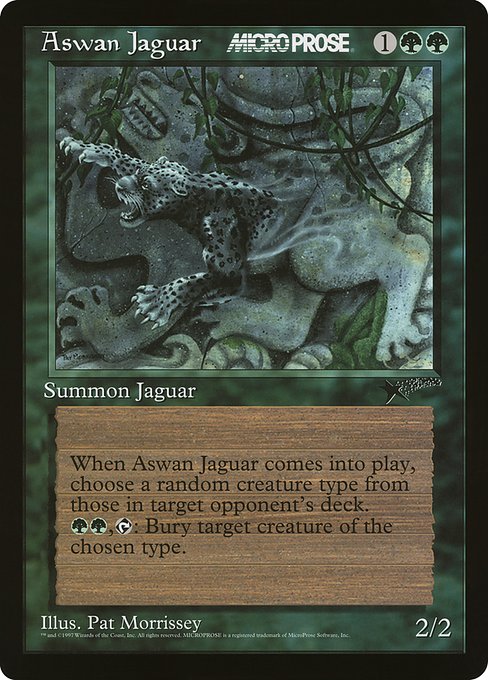
Magic: The Gathering designers have long flirted with the edge of the possible, using unorthodox concepts to stretch our understanding of how cards think, act, and mess with the table. Un-cards—those playful misfits from the broader MTG universe—exist not just to crack jokes, but to illuminate design theory itself 🧙♂️. They push us to ask: what happens when rules bend, when a card’s identity isn't just about power or mana but about player interaction, social contract, and imagination? Aswan Jaguar, a green, creature-core artifact of the MicroProse Promos era, becomes an exemplary case study in that philosophy 🔥💎.
First, consider the card’s core identity. Aswan Jaguar costs {1}{G}{G}, a lean three-mana commitment that fits comfortably into early-to-mid green acceleration. Its body—2/2 with a straightforward, non-legendary presence—belies a design twist that reverberates with un-set sensibilities. When it enters play, you choose a random creature type from those in target opponent’s deck. Then, for {G}{G}, tap: bury target creature of the chosen type. It’s a clever paradox: a stable, traditional stat line paired with a destabilizing, meta-aware ability. This pairing is precisely what un-cards teach us about design: power alone is not enough; the context, memory, and player expectations around that power matter just as much ⚔️🎲.
This is not merely a "funny" gadget. It’s a study in constraint-driven play: how a simple text box can refract the entire game state through the lens of type identity and deck composition.
The mechanic foregrounds a design theory idea: variety as a feature. By tying the effect to a creature type chosen from the opponent’s deck, the card forces both players to think in terms of taxonomy rather than the usual creature-by-creature calculus. Un-cards love to bend the way we categorize threats and answers, and Aswan Jaguar nudges you to scan an opposing deck for emergent patterns rather than simply counting the number of dragons or goblins in play. It’s the kind of playful, reflective interaction that makes design conversations richer—an invitation to discuss not just what a card does, but what a card makes you notice about your opponent’s strategy 🧙♂️🎨.
From a color-theory standpoint, green is the natural home for this card’s survival kit. Green’s historical emphasis on creature-centric play, large creatures, and graveyard-free removal sometimes makes it seem like the color of ramp and raw power. Yet Aswan Jaguar twists that expectation by making removal situational and knowledge-based: you’re not just destroying something; you’re displacing a piece of the puzzle from your opponent’s mind. The required mana—two green mana in addition to the initial cost—reaffirms that this play is about tempo and information more than brute force, a subtle nod to the strength of design that un-cards celebrate: the joy of clever, thought-provoking options rather than pure numbers 💎.
Let’s talk about the card’s provenance, because a designer should never ignore the artifact itself. Aswan Jaguar appears in a Memorabilia-set release—the MicroProse Promos (pmic) line—where oversize presentation and collectible quirks coexist with collectible rarity. This particular card is listed as common, nonfoil, and printed during a 1997 frame era. Its collector-value aura is inseparable from its teaching life: even as a playable memory, it reminds us that form factors, print runs, and historical context shape how a card teaches future designers about constraints, humor, and social interaction at the table 🧭. The fact that it’s an oversized promo further amplifies the sense that it’s a design classroom on a coffee-stained notebook page—an artifact that invites discussion about what “play” means when presentation diverges from the standard—an essential note for design theory enthusiasts 🔍.
In terms of practical play, Aswan Jaguar is unmistakably niche. It isn’t legal in modern formats, and its effect is unpredictable, not deterministic. Yet that unpredictability is precisely what makes it so informative. Un-cards teach us to design around uncertainty, to craft mechanics that reward or punish players for their awareness of the unknown. The card’s ability to bury a creature of a type drawn from the opponent’s deck can swing a game by taking out a pivotal threat that your opponent may have relied upon, while also creating an awkward moment when the type selected is rare or surprising. The humor isn’t just in the idea; it’s in the tension between expectation and outcome—the same tension that makes good design theory resonate in any format 🔥🎲.
Design-wise, Aswan Jaguar nudges designers toward a broader question: how do we quantify “fun” within a card’s impact? Un-cards suggest that players derive joy not only from winning but from clever setup, shared jokes, and the sense that the rules themselves can be bent to provoke storytelling at the table. This is the heart of design theory in a community-driven hobby: a card should spark discussion, memory, and a sense of wonder, even when it’s not the most efficient engine on the board. Aswan Jaguar demonstrates that a simple, green creature can carry design weight beyond stats—through its concept, its cultural footprint, and the way it invites players to narrate the game in real time 🧙♂️💎.
On a meta-screen level, the card’s place in a memorabilia set nudges collectors and players toward appreciating the broader ecosystem of card design. The interplay between gameplay ideas and the artifact’s historical footprint—promo status, print era, and the quirky “choose a type, bury a type” flavor—offers a blueprint for how design theory travels: through jokes that land, through mechanics that make you rethink categories, and through prints that become talking points for decades. If you’re curious about design as dialogue, Aswan Jaguar is a small but mighty ambassador, reminding us that the most enduring innovations in MTG often arrive from playful collision between the known and the ridiculous 🧠🧭.
For fans who want to keep the conversation going while they carry their daily gear, we’ve got a little cross-promotional tie-in. This MagSafe Card Holder Phone Case — Polycarbonate Glossy Matte is the perfect companion for long drafting sessions or casual play nights, blending sturdy design with a touch of modern polish. It’s a reminder that even while we debate the ethics of random deck-busting creature types, the real-world ritual of carrying cards—and the gadgets that surround them—continues to evolve with style and function.
MagSafe Card Holder Phone Case - Polycarbonate Glossy MatteMore from our network
- https://blog.crypto-articles.xyz/blog/post/nft-data-pirate-133-from-golden-pirates-collection-on-magiceden/
- https://wiki.digital-vault.xyz/wiki/post/pokemon-tcg-stats-misdreavus-card-id-p-a-038/
- https://blog.digital-vault.xyz/blog/post/creating-digital-paper-for-accurate-consistent-printing/
- https://articles.digital-vault.xyz/blog/post/how-to-use-cyan-stained-glass-for-bridges-in-minecraft/
- https://wiki.digital-vault.xyz/wiki/post/pokemon-tcg-stats-ho-oh-card-id-ecard3-149/
Aswan Jaguar
When Aswan Jaguar comes into play, choose a random creature type from those in target opponent's deck.
{G}{G}, {T}: Bury target creature of the chosen type.
ID: cf25a3a5-0e7d-43d1-a2e6-85a233eee3e4
Oracle ID: 9ab97610-76ad-4631-825e-8596dc9cfd4c
TCGPlayer ID: 21474
Cardmarket ID: 21302
Colors: G
Color Identity: G
Keywords:
Rarity: Common
Released: 1997-04-01
Artist: Pat Lewis
Frame: 1997
Border: black
Set: MicroProse Promos (pmic)
Collector #: 1
Legalities
- Standard — not_legal
- Future — not_legal
- Historic — not_legal
- Timeless — not_legal
- Gladiator — not_legal
- Pioneer — not_legal
- Modern — not_legal
- Legacy — not_legal
- Pauper — not_legal
- Vintage — not_legal
- Penny — not_legal
- Commander — not_legal
- Oathbreaker — not_legal
- Standardbrawl — not_legal
- Brawl — not_legal
- Alchemy — not_legal
- Paupercommander — not_legal
- Duel — not_legal
- Oldschool — not_legal
- Premodern — not_legal
- Predh — not_legal
Prices
- USD: 40.50
- EUR: 16.10
More from our network
- https://articles.zero-static.xyz/blog/post/duckletts-tcg-effect-across-past-generations/
- https://crypto-acolytes.xyz/blog/post/nft-stats-awaken-366-from-the-awakening-collection/
- https://crypto-acolytes.xyz/blog/post/nft-stats-bpw-1561-from-bonk-puppets-collection/
- https://blog.zero-static.xyz/blog/post/otaria-inspired-custom-mtg-cards-lore-mechanics-and-play/
- https://transparent-paper.shop/blog/post/deploying-your-first-saas-product-a-practical-guide/