
Image courtesy of TCGdex.net
Setting the Tempo: Treecko’s Tail Smash in Focus
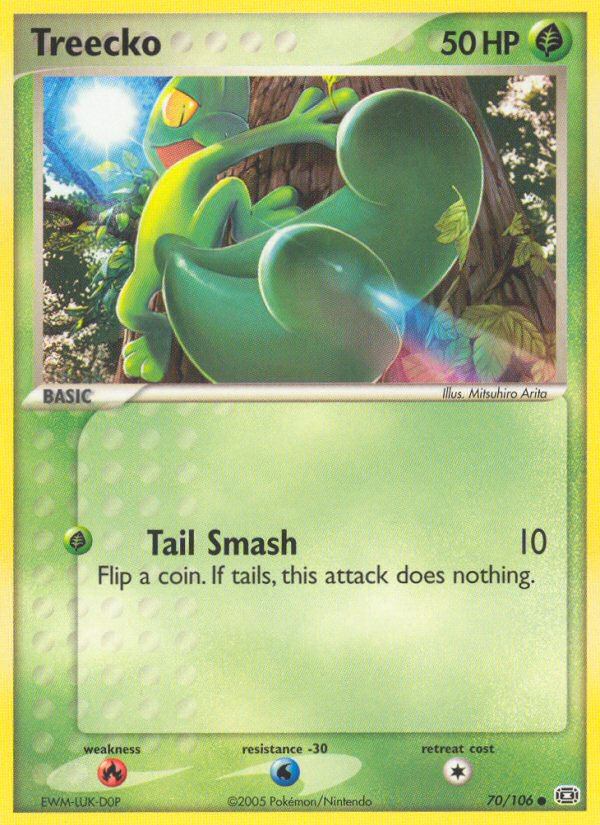
In the evergreen world of the Pokémon TCG, tempo is the invisible current that carries a match from opening turns to thrilling finishes. Treecko, a plain-looking Grass-type Basic from the Emerald-era ex9 set, embodies how tempo can hinge on a single, imperfect tool. Illustrated by Mitsuhiro Arita, this 50 HP sprout carries a simple, almost playful attack—Tail Smash—yet that simplicity hides a nuanced rhythm that players chase in every duel. Common in rarity, Treecko is often overlooked by collectors who seek power in big numbers, but serious players know that tempo is a kind of power all its own ⚡🔥.
Tail Smash costs a single Grass energy and deals 10 damage, a modest poke that’s rarely the centerpiece of a winning line. What elevates it is the coin-flip effect: if tails, the attack does nothing. That stark, binary outcome injects risk into every swing, forcing both players to weigh the value of a guaranteed little dent against the momentum of their broader setup. In a game where you’re often racing to evolve, attach energies, and threaten with stronger attackers, Tail Smash becomes a metronome—a reminder that speed can hinge on chance just as surely as on planning.
The tempo mechanic: risk, reward, and rhythm
Tempo in Pokémon TCG matches is all about predicting and shaping the pace. Treecko’s Tail Smash asks you to pick a tempo lane and ride it. On one hand, the attack’s low damage keeps early exchanges lightweight, allowing you to field additional Pokémon or begin your evolution plan without overcommitting. On the other hand, the coin flip injects variance: a successful hit accelerates your clock, while a miss might slow you down and invite aggressive responses from your opponent. The tension between consistent pressure and unpredictable outcomes is the heartbeat of tempo, and Treecko embodies that heartbeat in its most approachable form 💎🎴.
Strategically, Treecko shines when you’re assembling a broad plan around its evolution line. As a Basic Grass-type, it serves as a reliable starting point for energy attachment and bench-building. Players imagine evolving into Grovyle and eventually into Sceptile, turning a humble 50 HP into a corridor of speed and threat. While Treecko’s own attack isn’t the finish line, it’s the opening note of a tempo-driven symphony: you press a little damage, you search for the evolution line, you control the pace of the match, and you keep the momentum just out of reach for your opponent’s counterpunches 🔥🎨.
Matchups, weaknesses, and careful positioning
Knowing Treecko’s vulnerabilities helps you orchestrate tempo with discipline. Fire-type foes pressure Treecko hard, thanks to a ×2 weakness, which can tempt you to pivot to other attackers you’ve already prepared. Conversely, Water-type resistances soften some expected exchanges. The card’s modest stats demand smart positioning: you’re not trying to solo a tournament with Tail Smash, you’re using it to dictate tempo while you assemble a more formidable offensive line.
In practice, tempo-driven decks that include Treecko emphasize quick energy attachment to your bench and efficient searching for Grovyle and Sceptile’s accelerants. When you manage to accelerate evolution on a timely schedule, you transform a sequence of low-damage turns into a decisive climb toward mid-game threats. It’s a cerebral dance: you pull the strings, your opponent guesses your next move, and the coin’s luck—or lack thereof—plays a cameo in the drama. That dynamic is what makes classic Treecko a beloved, if understated, tempo tool ⚡🎮.
Collectors’ corner: art, print runs, and market vibes
The Emerald set (ex9) features a golden-era aesthetic that players remember fondly. Treecko’s art by Mitsuhiro Arita captures a nimble, curious starter that invites you to imagine the line’s evolution. The card’s rarity is listed as Common, and with 106 cards in the official count (107 total in the full print run), this little Pallet Town starter remains accessible for casual collectors while still holding nostalgia value. For those who chase holo variants, ex9 offered versions that carried the set logo or Gen-Con stamps, adding a desirable layer for holo enthusiasts—even if the base card remains Common.
Price data reflects the balance between rarity and nostalgia. Non-holo versions tend to sit at a few tenths of a dollar on modern marketplaces, while holo or reverse-holo prints can command tens of dollars, especially among devoted Emerald-era collectors who prize the old gloss and the Mitsuhiro Arita lineup. Recent market snippets show normal copies hovering modestly, while holo-forward prints capture the higher end of the spectrum anytime a collector’s mood aligns with nostalgia and condition 🔎💎.
Building around tempo: practical deck ideas
If you’re crafting a Treecko-centric or Treecko-inclusive deck today, think about tempo-forward lanes that leverage early setup, smooth energy attachment, and purposeful evolutions. Prioritize cards and strategies that help you search for Grovyle quickly, while keeping Treecko as a reliable battlefield presence to pressure opponents into suboptimal plays. Remember: Tail Smash is a catalyst, not the main event. The real value comes from the ability to pull ahead on tempo, then unleash a more powerful phase of your board as you bring Grovyle and Sceptile online. The result is a rhythm that can outpace brute force by outmaneuvering your opponent’s timing cues 🎴🪄.
And for players who adore the tactile thrill of a well-timed coin flip, Treecko offers a perfect playground to practice risk assessment. When do you gamble on Tail Smash, and when do you pivot to more reliable lines? Answering that question becomes a core skill in any tempo-driven matchup—and that’s what makes this little Grass-type so enduringly compelling in the hobby’s grand story 🌿⚡.
Rectangular Gaming Neon Mouse Pad 1.58mm ThickMore from our network
- https://moonstone-images.zero-static.xyz/2df43168.html
- https://crypto-acolytes.xyz/blog/post/hot-2017-hot-nft-stats/
- https://blog.crypto-articles.xyz/blog/post/birch-fence-redstone-door-design-tutorial/
- https://crypto-acolytes.xyz/blog/post/devil-2196-de-evils-nft-stats/
- https://transparent-paper.shop/blog/post/stable-diffusion-xl-prompt-cyberpunk-manga-sketch-neon-glow-liquid-glass-texture-eclipse-motif-dynamic-action/
Treecko
Set: Emerald | Card ID: ex9-70
Card Overview
- Category: Pokemon
- HP: 50
- Type: Grass
- Stage: Basic
- Dex ID: 252
- Rarity: Common
- Regulation Mark: —
- Retreat Cost:
- Legal (Standard): No
- Legal (Expanded): No
Description
Attacks
| Name | Cost | Damage |
|---|---|---|
| Tail Smash | Grass | 10 |
Pricing (Cardmarket)
- Average: €0.47
- Low: €0.02
- Trend: €0.61
- 7-Day Avg: €0.2
- 30-Day Avg: €0.41
Support Our Decentralized Network
Donate 💠More from our network
- https://moonstone-images.zero-static.xyz/2df43168.html
- https://crypto-acolytes.xyz/blog/post/hot-2017-hot-nft-stats/
- https://blog.crypto-articles.xyz/blog/post/birch-fence-redstone-door-design-tutorial/
- https://crypto-acolytes.xyz/blog/post/devil-2196-de-evils-nft-stats/
- https://transparent-paper.shop/blog/post/stable-diffusion-xl-prompt-cyberpunk-manga-sketch-neon-glow-liquid-glass-texture-eclipse-motif-dynamic-action/