
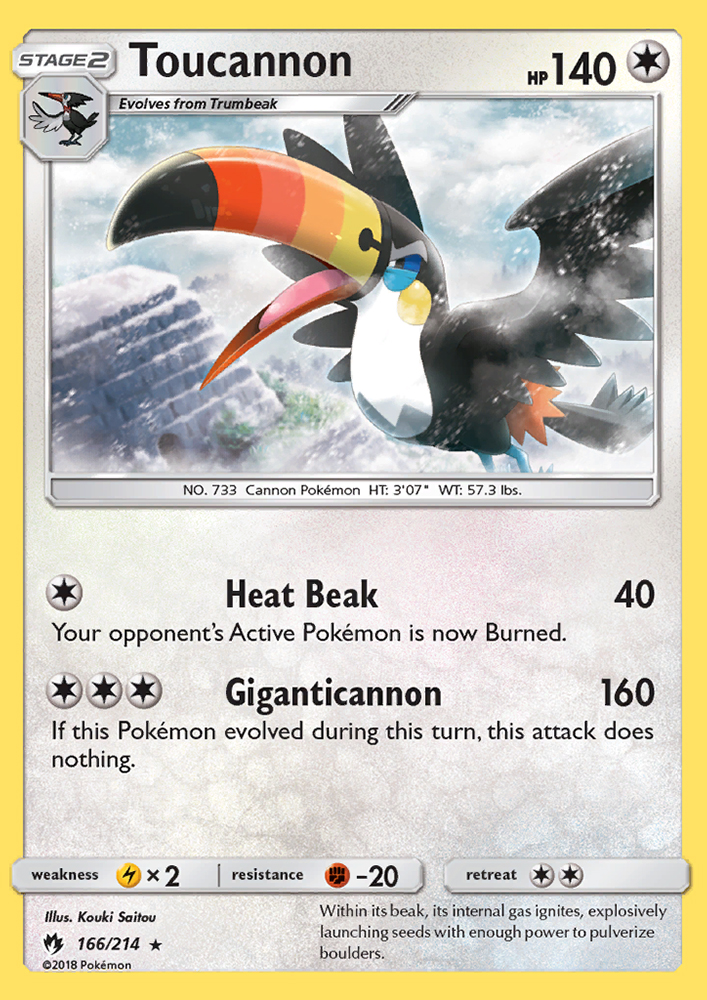
Image courtesy of TCGdex.net
Why win rates vary in deck builds for Toucannon
Lost Thunder gave players a sturdy Colorless option in the form of a stage-2 attacker who sits behind a simple, punishing clock. Toucannon (SM8-166), illustrated by Kouki Saitou, lands with 140 HP, a wrinkle-filled evolution path from Trumbeak, and a pair of attacks that reward patient planning as much as raw power. In Expanded formats, this card can be a stubborn wall in longer games, yet its effectiveness ebbs and flows with how a deck orchestrates evolution timing, energy attachment, and the tempo of the match. The two attacks tell two stories: a steady, early-game burn threat and a towering, late-game KO option—each with its own win-rate implications depending on the deck’s rhythm.
Two faces that shape performance: Heat Beak and Giganticannon
Heat Beak costs a single Colorless energy and burns the opponent’s Active Pokémon. The burn condition is a classic pressure tool—forcing the opponent to address the status and potentially buy turns for setup. In a deck that wants to slow the opposition or wear down threats through repeat pressure, Heat Beak shines as a reliable soft-locking engine. It’s not a one-shot KO move, but the incremental advantage it buys can tilt prize trades in your favor, especially when combined with other disruption or chip-damage strategies.
Giganticannon is the big payoff: 160 damage for three Colorless energy. It’s the kind of attack that can seal victories when you’ve built the board to support it. The caveat is crucial: if Toucannon evolved during the same turn you attempt this attack, Giganticannon does nothing. That gating clause forces careful sequencing. Players who want to land the 160-damage knockout must plan an evolution window that occurs earlier, or set up the threat across several turns so that the big hit lands on a clean turn—often pairing with other attackers or stall components that buy the time to amass enough Energy.
These two routes—Heat Beak’s ongoing pressure and Giganticannon’s dramatic finish—define a delicate win-rate curve. In decks that can weave Heat Beak into a continuous burn-and-board presence, Toucannon remains relevant longer, even if the Giganticannon moment is delayed. In contrast, decks that lean on a single high-damage swing must resist the temptation to push the evolution line too aggressively, because the turn you evolve into Toucannon can block your primary finisher if you’re not careful.
Key stats that influence win rate on the table
- HP 140 gives decent survivability against many attacks in Expanded, but it’s not a fortress. You’ll want to cushion hits with patience and careful energy management.
- Stage 2 evolution from Trumbeak means you need a prior setup, which can slow tempo in fast matchups. The longer you stall or stall-then-finish, the more likely you are to maximize Giganticannon’s payoff.
- Colorless typing provides flexibility in energy attachment, but you’ll still need three Energy cards to push Giganticannon past the threshold. In decks that struggle with energy consistency, Giganticannon can become a rockier payoff.
- Weakness to Lightning ×2 and resistance to Fighting −20 shape matchups. Toucannon tends to perform better when facing non-Lightning teams or when the battlefield control and spread strategy dampen opposing attackers with Lightning energy.
- Retreat cost 2 makes bench management important. You’ll want board control that minimizes wasted turns when you rotate attackers in and out of the active slot.
- Expanded legality only (Standard-rotations leave Toucannon out). This constrains the competitive field, often making its win-rate hinges more on the Expanded meta’s specific archetypes and their reliance on one-hit KO power or slow-burn strategies.
From a collector’s viewpoint, the card’s rare status, holo variants, and the illustration by Kouki Saitou add to its appeal. In practical terms, the card’s performance is tightly linked to how players leverage the evolution timing and the balance between early-chip Burn and late-game finish power. The tension between those choices is what makes Toucannon a fascinating puzzle in deck-building circles ⚡️.
Deck-building patterns that maximize or minimize its win rate
- Evolution timing discipline: Don’t rush the evolution if you want to deploy Giganticannon on a clean turn. Set up Trumbeak earlier, pick the right moment to evolve, and ensure you’re no longer constrained by the “attack-nothing if evolved this turn” clause when you most need the big 160 damage.
- Energy strategy flexibility: Because Giganticannon costs three Colorless energy, decks that can reliably attach multiple energies per turn (or accelerate energy from the deck) will consistently threaten to KO. In contrast, energy-scarce builds may rely more on Heat Beak timing and attrition rather than a single knockout swing.
- Support and draw options: Draw power and search effects that fetch Trumbeak, Toucannon, or necessary Energy become the engine that makes the timing work. A careful balance of draw and fetch can sustain tempo and enable the big finish without tipping into stalemate territory.
- Bench management and prize pressure: With a 2-retreat cost, you’ll want a healthy bench and careful play to minimize wasted turns. Utilizing other non-Active attackers for drawing or poking can keep you in control while you line up Giganticannon.
- Counterplay awareness: The Lightning weakness means you’ll want to plan around common Lightning threats in Expanded. A mid-range plan that mitigates those matchups and preserves Toucannon as a late-game finisher will yield steadier win rates than a straight sprint for a one-turn KO.
Market and collector notes
The card sits in a budget-friendly niche for players and collectors. Cardmarket data indicates an average price around €0.45 for standard (non-holo) copies, with lower entries near €0.10 and holo-variants achieving higher values—average holo ranges can vary, with weekly trends suggesting growth for certain holo print runs. On TCGPlayer, the non-holo market shows low prices around $0.20–$0.44, while holo variants can edge higher, reflecting availability and demand. For builders, this makes Toucannon an accessible option to experiment with in Expanded decks while still being a collectible staple for holo-conscious collectors.
Art, lore, and the Lost Thunder aesthetic
Lost Thunder shines in its colorful, pocket-monster world, and Toucannon captures a moment of careful plan and battlefield poise that fans recognize in the art by Kouki Saitou. The card’s look—bonelike beak, stout silhouette, and a dynamic battlefield presence—echoes the theme of calculated aggression and stubborn resilience that defines many late-game plays in the TCG. The ability to coax a burn onto the opponent while threading a powerful knockout turn resonates with the broader storytelling of Trainers who rely on patience, positioning, and a little spark of luck to swing the game in their favor 🎴🎨.
Custom Gaming Mouse Pad 9x7in Neoprene Stitched EdgesMore from our network
- https://crypto-acolytes.xyz/blog/post/dr3-handles-a-bright-35000-k-blue-beacon-at-19k-light-years/
- https://blog.crypto-articles.xyz/blog/post/nft-data-solgod-1886-from-solgods-collection-on-magiceden/
- https://wiki.digital-vault.xyz/wiki/post/pokemon-tcg-stats-ultra-ball-card-id-sm35-68/
- https://wiki.digital-vault.xyz/wiki/post/pokemon-tcg-stats-dratini-card-id-ex7-53/
- https://crypto-acolytes.xyz/blog/post/nft-stats-prock12-from-pump-rock-collection/
Toucannon
Set: Lost Thunder | Card ID: sm8-166
Card Overview
- Category: Pokemon
- HP: 140
- Type: Colorless
- Stage: Stage2
- Evolves From: Trumbeak
- Dex ID: 733
- Rarity: Rare
- Regulation Mark: —
- Retreat Cost: 2
- Legal (Standard): No
- Legal (Expanded): Yes
Description
Attacks
| Name | Cost | Damage |
|---|---|---|
| Heat Beak | Colorless | 40 |
| Giganticannon | Colorless, Colorless, Colorless | 160 |
Pricing (Cardmarket)
- Average: €0.45
- Low: €0.1
- Trend: €0.48
- 7-Day Avg: €0.51
- 30-Day Avg: €0.39
Support Our Decentralized Network
Donate 💠More from our network
- https://crypto-acolytes.xyz/blog/post/dr3-handles-a-bright-35000-k-blue-beacon-at-19k-light-years/
- https://blog.crypto-articles.xyz/blog/post/nft-data-solgod-1886-from-solgods-collection-on-magiceden/
- https://wiki.digital-vault.xyz/wiki/post/pokemon-tcg-stats-ultra-ball-card-id-sm35-68/
- https://wiki.digital-vault.xyz/wiki/post/pokemon-tcg-stats-dratini-card-id-ex7-53/
- https://crypto-acolytes.xyz/blog/post/nft-stats-prock12-from-pump-rock-collection/