
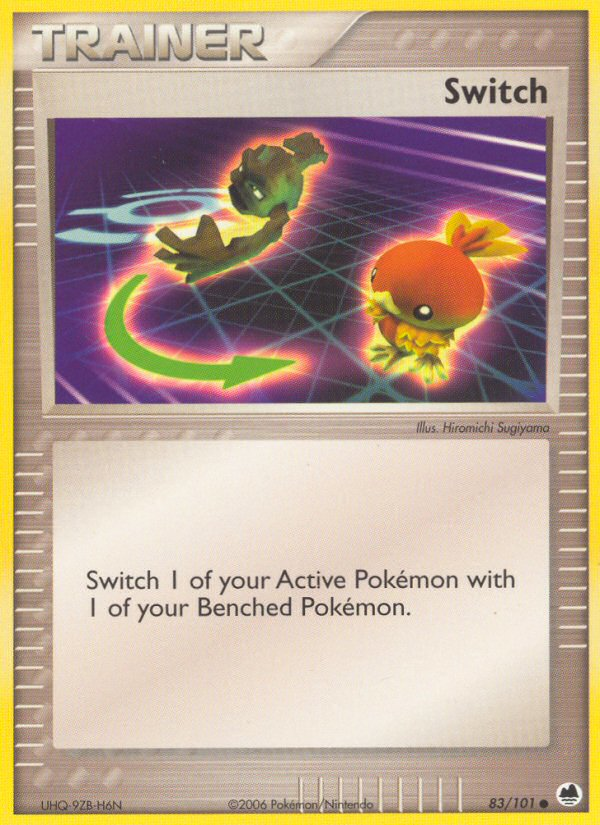
Image courtesy of TCGdex.net
Beyond the Right Card, a Timeless Turn: Why the Switch Stands Out in Pokémon TCG
Some Pokémon TCG cards become more than just tools on a board—they become design philosophies. The Switch card from Dragon Frontiers is one of those. As a Common Trainer Item illustrated by Hiromichi Sugiyama, Switch seems modest at first glance, yet it quietly reshapes tempo, decision-making, and even collector conversations. Its enduring appeal comes from a simple truth: sometimes the most powerful moves in a deck are the ones that give you options, not raw power ⚡. In a game where every choice matters, Switch offers a clean, reliable way to redraw the board’s possibilities without waiting for a hero moment to arrive.
Set, rarity, and an artist’s signature on a classic tactic
Dragon Frontiers, cataloged as ex15, is a set famous for turning the Pokémon TCG upside down with fast plays and memorable trainer-oriented strategies. Switch sits in the heart of that philosophy: a Trainer Card with the concise identity “Item” rather than a Pokémon or Supporter. Its rarity is Common, meaning it’s a staple you’re likely to pull from common packs or find in bulk boxes, which helps explain its enduring presence on desk drawers and binder pages alike. The art by Hiromichi Sugiyama captures a sense of motion and choice—two ideas that define not just this card but the era of early-2000s TCG design where players learned to juggle multiple threats while staying nimble on the bench. Sugiyama’s work across the set carries a tactile, slightly arcade-inspired energy that resonates with both veterans and newer collectors chasing nostalgia.
From a collection perspective, Switch is a reminder that not every cherished card has to be rare or shiny to hold value. Official card counts place Dragon Frontiers at 101 cards, and Switch’s common status makes it a frequent, accessible target for binder flips and casual trades. For the market-minded, the pricing data bowers a subtle lesson: in non-holo form, Switch is an affordable cornerstone card, while reverse-holo versions can command a modest premium. CardMarket and TCGPlayer figures show a landscape where a non-holo Switch often hovers in the fraction of a euro or dollar, but a reverse-holo can climb into more noticeable, though still approachable, territory. It’s a neat snapshot of how rarity and presentation shape value, even for a card that prizes utility over spectacle 🔎💎.
Gameplay strategy: flexibility as the ultimate upgrade
At its essence, Switch is about replacing a potentially awkward matchup with a cleaner, more promising board state. The card text—“Switch your Active Pokémon with one of your Benched Pokémon”—is deceptively simple, but the implications ripple through every deck under the Dragon Frontiers banner. In practice, you use Switch to evade dangerous single-turn misadventures and to preserve momentum when retreat costs threaten to stall your strategy. Imagine you’ve set up a robust bench with a few evolving threats, but your Active isn’t the right target to press advantage on the upcoming turn. A well-timed Switch pulls in a fresh attacker, or perhaps a tactical defender, without discarding resources or energizing an opponent’s plan. This is the kind of tempo play that doesn’t win matches in a single swing, but compounds pressure across multiple turns—a core reason why Switch remains a dependable inclusion in many budget and midrange decks 🔥.
Because Switch operates independently of energy costs or specific types, it scales across eras and formats where bench-building remains a consistent theme. You can pair it with a Stage 1 or Stage 2 Pokémon that benefits from being re-positioned into a favorable type matchup, or use it to sidestep a predicted attack that could knock out your Active and reset your tempo cost-effectively. In modern language, Switch embodies the concept of “board resilience”—the idea that you want to stay one step ahead, keeping the pathways open for your most promising threats while your opponent recalibrates. The card’s historical position in Dragon Frontiers as a common, well-distributed tool makes it a reliable partner in countless decklists, from quick-retreat tempo builds to more cunning, bench-advantage strategies 🎴🎮.
Collector and market perspectives: accessibility with a side of nostalgia
From a collector’s standpoint, Switch’s strength lies in its availability and the emotional resonance of Dragon Frontiers. The set’s art direction and the clean, practical utility of Trainer cards helped it endure as more than a single-rotation curiosity. While the card market emphasizes holo variants for certain staples, the non-holo Switch remains a reliable purchase for players expanding their collections without a heavy investment. The numbers from market trackers reflect a balanced picture: low entry costs paired with steady demand from players who value dependable tech slots in their decks. For many, Switch isn’t about chasing the rarest card but about preserving a workable toolkit that keeps their decks flexible across shifts in the meta. This blend of practicality and sentiment fuels its continued presence in both late-2000s nostalgia windows and contemporary budget builds ⚡💎.
Art, lore, and the enduring charm of a well-timed switch
Beyond the math and the lived-in deck building, Switch embodies a storytelling moment from Dragon Frontiers. Sugiyama’s illustration style—precise lines, a lively sense of action, and a focus on the moment a choice is made—echoes the thrill players feel when they decide to pivot mid-battle. The card’s narrative isn’t about a flashy attack; it’s about the audacity of changing your plan at the precise moment the board demands it. That storytelling thread—where a single decision reshapes the encounter—aligns with how fans remember Dragon Frontiers: a set that rewarded clever planning, timely responses, and the joy of a well-executed tactical reversal 🔥🎨.
As you rethink a binder fill or draft a new decklist, consider Switch not only for the effect it provides but for the culture it carries—the sense that the Pokémon TCG is a living game about choices, momentum, and the joy of getting one step ahead of your opponent. It’s a small card with a big impact, a reminder that in a field of big blows and grand combos, sometimes the most meaningful move is simply to switch the plan and keep fighting 💥🎴.
Foot-shaped mouse pad with wrist rest ergonomic memory foamMore from our network
- https://crypto-acolytes.xyz/blog/post/nft-stats-demian-1973-from-dems-empire-collection/
- https://wiki.digital-vault.xyz/wiki/post/pokemon-tcg-stats-rhyhorn-card-id-swsh1-97/
- https://articles.digital-vault.xyz/blog/post/diablo-iv-the-best-gear-upgrades-for-maximum-endgame-power/
- https://donation.digital-vault.xyz/donation/post/support-open-source-communities-driving-the-common-good/
- https://wiki.digital-vault.xyz/wiki/post/pokemon-tcg-stats-musharna-card-id-bw7-69/
Switch
Set: Dragon Frontiers | Card ID: ex15-83
Card Overview
- Category: Trainer
- HP:
- Type:
- Stage:
- Dex ID:
- Rarity: Common
- Regulation Mark: —
- Retreat Cost:
- Legal (Standard): No
- Legal (Expanded): No
Description
Pricing (Cardmarket)
- Average: €0.18
- Low: €0.02
- Trend: €0.28
- 7-Day Avg: €0.34
- 30-Day Avg: €0.31
Support Our Decentralized Network
Donate 💠More from our network
- https://crypto-acolytes.xyz/blog/post/nft-stats-demian-1973-from-dems-empire-collection/
- https://wiki.digital-vault.xyz/wiki/post/pokemon-tcg-stats-rhyhorn-card-id-swsh1-97/
- https://articles.digital-vault.xyz/blog/post/diablo-iv-the-best-gear-upgrades-for-maximum-endgame-power/
- https://donation.digital-vault.xyz/donation/post/support-open-source-communities-driving-the-common-good/
- https://wiki.digital-vault.xyz/wiki/post/pokemon-tcg-stats-musharna-card-id-bw7-69/