
Image courtesy of TCGdex.net
Tempo swings in the Pokémon TCG: how Stunfisk reshapes early-game pacing
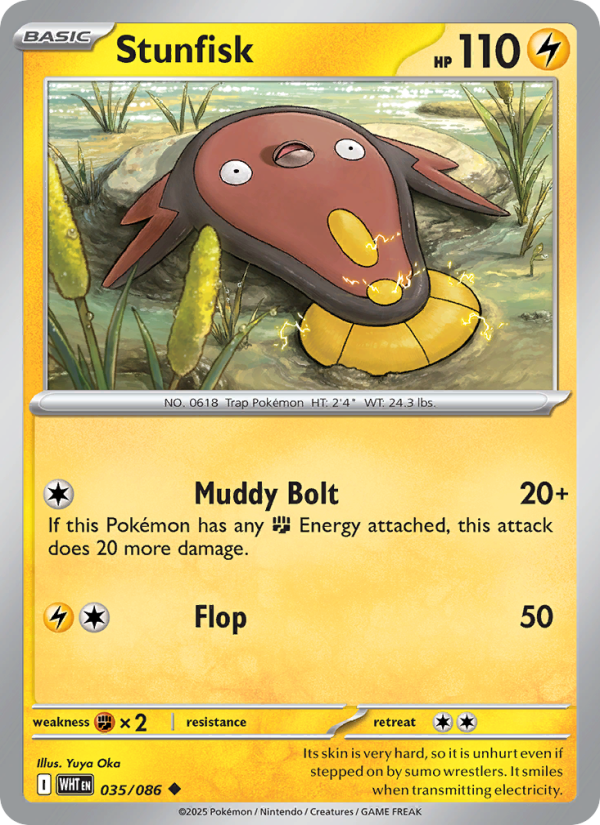
Tempo in the Pokémon Trading Card Game isn’t just about dealing damage—it’s a careful study of resource timing, energy management, and pressure that puts your opponent on the back foot. When a card’s ability or attack nudges the game’s rhythm in a new direction, it creates micro-turns where you can gain advantage, then hold onto it by forcing your opponent to answer. That’s exactly what Stunfisk from the White Flare set brings to the table in the SV10.5W collection. A basic Lightning-type Pokémon with sturdy 110 HP, it arrives with two practical options—Muddy Bolt and Flop—that shine precisely because of how they dictate tempo on different turns. ⚡
Muddy Bolt: a tempo engine that scales with energy choices
Stunfisk’s first attack, Muddy Bolt, costs Colorless energy and deals a base 20 damage. The real tempo shift arrives with its dynamic condition: If this Pokémon has any {F} Energy attached, this attack does 20 more damage. In practical terms, Muddy Bolt can start as a reliable, low-commitment pressure tool, while also offering a built-in incentive to accelerate or protect a Grass-energy attachment (represented as {F}) on the board. This creates a moving target for your opponent—do they allocate resources to stall your energy growth, or do they accept a rising threat that scales as you strip away their options?
- Early-game pressure: Muddy Bolt lets you threaten 40 damage if you’ve already attached any Grass energy, while still costing only a Colorless to launch. That eases you into a favorable board state without overcommitting.
- Tempo timing: If you keep Stunfisk alive, Muddy Bolt can swing dramatically once you connect an {F} Energy, turning a safe 20-damage poke into a more meaningful 40-point threat on a single turn.
- Resource balance: Because Muddy Bolt doesn’t demand a heavy energy commitment to start, you preserve Lightning energy for future turns or for the second attack, Flop, when you need a more direct KO line.
The conditional damage mechanic is what makes Stunfisk a fascinating tempo tool. It rewards thoughtful energy placement and careful sequencing—you’re rewarded for planning a turn ahead, anticipating your opponent’s answers, and choosing when to maximize the bite of Muddy Bolt versus the steadier punch of Flop. The set’s presentation of this card—as part of the White Flare collection, SV10.5W—underscores how one small conditional effect can ripple across your entire turn planning. 🎯
Flop: committing to momentum and matching pace
Flop, the second attack, costs Lightning and a Colorless energy and delivers 50 damage. This is a straightforward option that becomes a pivotal finisher when your opponent’s resources are stretched thin. The tempo dynamic here is about pacing: if Muddy Bolt has put your opponent on notice, Flop lets you press the advantage on a clean, energy-efficient turn. You’re trading a flexible, situational attack for a reliable payoff, and that exchange is at the heart of tempo-based decks. The retreat cost of 2 also encourages strategic planning—moving Stunfisk out to free up bench space for a follow-up attacker can be a decisive tempo swap in a tight match. 🔁
Put together, these two attacks create a nuanced tempo ladder. You can start with Muddy Bolt for light pressure, escalate to a higher-damage plan when you’ve got the right energy on board, and slot in Flop to close out on a decisive exchange. It’s a rhythm players can ride, especially in formats where speed matters and every decision compounds into a win-or-lose moment by the midgame.
White Flare and the collection lens
The SV10.5W sub-set, White Flare, features 86 official cards with a total of 173 in the broader SV10.5W block. Stunfisk sits as an Uncommon in this wave, a choice that reflects its role as a flexible tempo engine rather than a heavy-hitting finisher. Dex ID 618 pins it to the larger Pokédex, and the card’s basic, non-evolved status makes it a ready-to-deploy option in both Standard and Expanded formats (Regulation Mark I). While exact illustration credits aren’t listed in the data at hand, the card art typically showcases a playful utility Pokémon that embodies the kinetic charm of a creature that thrives on pace and position rather than brute force. 🖼️
Market visibility around SV10.5W Stunfisk appears accessible. CardMarket data points to an average price around €0.04 for non-holo copies, with a low of €0.02 and a gentle trend of €0.03. Foil or holo variants tend to fetch higher signals—avg holo around €0.11, with broader ranges showing €0.02 as a low and up to €0.21 for newer listings in some windows. For collectors and players alike, this makes Stunfisk a budget-friendly choice to prototype tempo-based play while keeping an eye on collector value as the meta shifts. The set’s dynamic balance of common-sense damage and conditional boosts keeps it a relevant pick even as new sets roll out. Updated price data tracked into late 2025 shows continued interest in the card’s playable flexibility. 🔎
“Tempo isn’t about stealing every turn; it’s about steering the game’s pace so your opponent can’t safely overextend.”
In practice, Stunfisk becomes a small but sharp instrument in the tempo toolkit. You’re not trying to overwhelm on one swing; you’re shaping the sequence, asking the opponent to respond to each energy placement, each attack choice, and each potential KO line that Muddy Bolt can unlock when the time is right. That quiet control—made tangible by a 110 HP basic with two efficient attacks—emboldens players to experiment with positioning and energy banks in ways that feel both tactical and a little bit cheeky. It’s a reminder that in Pokémon TCG, tempo is a long game of deliberate pacing, not a single explosive moment. ⚡🔥
Deck-building takeaways: turning tempo into a plan
- Prioritize early energy attachment lines that allow Muddy Bolt to threaten the 40-damage mark without overcommitting Lightning energy.
- Keep an eye on the timing of the Grass energy (the {F} symbol) to maximize Muddy Bolt’s conditional boost when it matters most.
- Use Flop as your clean follow-up to preserve momentum, especially when you anticipate the need to KO a mid-range threat quickly.
- Balance bench space and retreat costs to enable a smooth transition to a secondary attacker, sustaining tempo across multiple turns.
- Remember the Standard/Expanded legality and Regulation Mark I to ensure you’re building with cards that won’t surprise you at the tournament table.
More from our network
Stunfisk
Set: White Flare | Card ID: sv10.5w-035
Card Overview
- Category: Pokemon
- HP: 110
- Type: Lightning
- Stage: Basic
- Dex ID: 618
- Rarity: Uncommon
- Regulation Mark: I
- Retreat Cost: 2
- Legal (Standard): Yes
- Legal (Expanded): Yes
Description
Attacks
| Name | Cost | Damage |
|---|---|---|
| Muddy Bolt | Colorless | 20+ |
| Flop | Lightning, Colorless | 50 |
Pricing (Cardmarket)
- Average: €0.04
- Low: €0.02
- Trend: €0.03
- 7-Day Avg: €0.03
- 30-Day Avg: €0.04
Support Our Decentralized Network
Donate 💠More from our network
- https://blog.rusty-articles.xyz/blog/post/beginner-mistakes-to-avoid-in-castlevania-symphony-of-the-night/
- https://crypto-acolytes.xyz/blog/post/nft-stats-micuties-564-from-micuties-collection/
- https://articles.digital-vault.xyz/blog/post/top-5-swablu-boosting-cards-for-the-pokemon-tcg-meta/
- https://wiki.digital-vault.xyz/wiki/post/pokemon-tcg-stats-kleavor-card-id-swsh10-tg08/
- https://blog.zero-static.xyz/blog/post/storytelling-as-a-balancing-mechanism-for-territorial-aetherkite/