
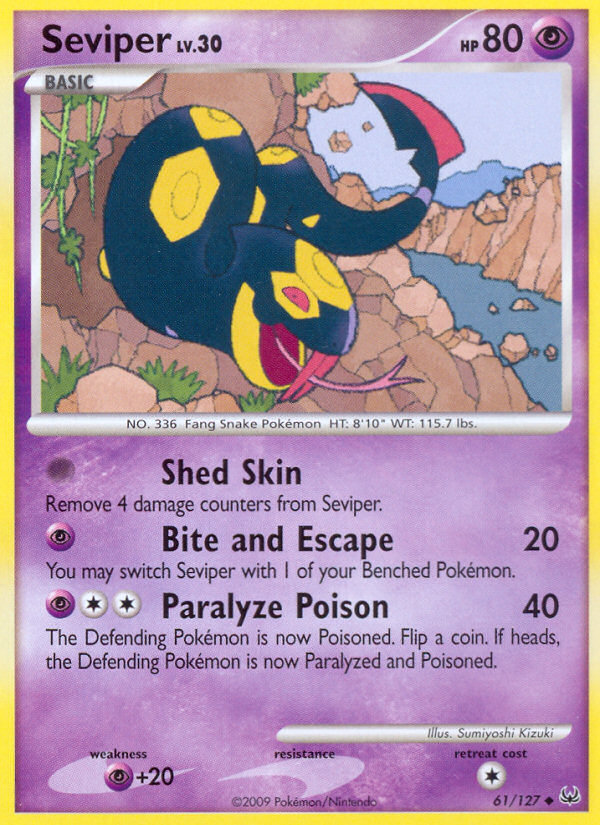
Image courtesy of TCGdex.net
Seviper in the Platinum Era: Design That Hisses with Function
When you think back to the Platinum era of the Pokémon TCG, Seviper stands out not only for its sharp silhouette but for the way its design aligns with the card’s gameplay quirks. This basic Psychic-type creature from the pl1 set embodies a blend of aesthetics and mechanics that feel purposeful rather than random. Painted by Sumiyoshi Kizuki, Seviper’s serpentine form and the tension in its pose hint at a creature built for ambush, escape, and a touch of mischief—the kind of Pokémon you’d want on a late-game clutch play. ⚡🎴
Design roots: lore, rivalry, and the art of the coil
Seviper’s visual language taps into a classic hunter-turned-polemic rival narrative within the Hoenn region’s ecosystem. In the Pokémon world, Seviper is famed for its venomous fangs and a tail that ends in a blade-like tip, a silhouette that telegraphs deadly precision. In the TCG, those traits translate into a color palette that leans into purples and emerald accents, a look that screams “danger in motion.” Sumiyoshi Kizuki’s crisp linework and dynamic snake-line posture capture not just a creature of the night but a deliberate predator—one who can linger in the shadows until the exact moment to strike. This is more than cute game text; it’s a design philosophy that invites you to read Seviper’s moves as extensions of its natural instincts. 🎨💎
The choice to place Seviper in a Psychic-type slot within Platinum’s card pool also nudges players to consider psychological warfare in practice. Psychic-type cards historically leant toward manipulation of energy, prediction, and subtle control—traits that fit Seviper’s ambush-and-evade strategy. The art and the flavor text (where present) reinforce the idea that Seviper’s strength isn’t raw power alone but how cunning and timing tilt the odds in a single, decisive moment.
Gameplay notes: how Seviper earns its keep in a deck
- Shed Skin—Remove 4 damage counters from Seviper. This is more than a little healing in a single move; it creates a survivability lane that can outlast threats from the bench. With 80 HP, that one ability can convert a risk into a steady, drawn-out back-and-forth that headaches unprepared opponents. 🛡️
- Bite and Escape—Cost: Psychic. This attack packs 20 damage and gives you the option to switch Seviper with a benched Pokémon. It’s the quintessential “sneak away from danger” mechanic that capitalizes on Seviper’s agility and edge-of-the-map presence. In practice, it can reset a momentum swing or reposition Seviper to threaten the next target without staying exposed. 🔁
- Paralyze Poison—Cost: Psychic, Colorless, Colorless. Deals 40 damage and, more importantly, poisons the Defending Pokémon. If the coin flip lands heads, you lock in both paralysis and poison. That pairing—the ticking poison with a potential paralysis—makes Seviper a menace even when raw damage isn’t spiking. It rewards careful timing, as you want to maximize the chance that a single turn’s status effect lingers while you set up the board. 🌀
Seviper’s type—Psychic—also shapes matchups. Its weakness to Psychic means you’ll often pair Seviper with teammates who can pressure non-Psychic lines or cover a trade when faced with stronger Psychic opponents. The retreat cost of 1 is a practical reminder that Seviper isn’t a slam-dunk wall, but a nimbler piece you move with purpose and patience. In a Platinum-era meta that favored tempo and clever sequencing, Seviper’s toolkit encourages players to hunt for the right moment to flip a duel in their favor. 🎮
Collector’s lens: rarity, variants, and value in the Platinum era
In the Platinum set (pl1), Seviper holds the Uncommon rarity. That designation places it in a sweet spot for collectors who want a distinctive piece without chasing the most elusive pulls. The card’s print run includes both standard and reverse-holo variants, with no first edition or holo versions in this slot—though the reverse holo option exists and tends to fetch a higher premium in today’s market. The 80 HP and distinctive Poison/Paralyze combo make Seviper a memorable silhouette on any display shelf, even when you’re not actively gaming it. 🪙
From a market perspective, Seviper (pl1-61) sits in an approachable price tier for vintage players and new collectors alike. CardMarket data around late 2025 shows an average in the range of a few tenths of a euro for common copies, with reverse holos commanding tighter spreads but higher peaks. On the digital front, TCGPlayer’s figures for non-holo Seviper hover in the couple of dollars at most for late-2020s reprints in active circulation, while reverse-holo versions trend higher—reflecting scarcity and collectible appeal in the eyes of players who chase the “shine” of a more dramatic card presentation. In short, Seviper is accessible, but with enough nostalgia and tactical charm to keep it in the conversation. 💎
Beyond prices, the card’s lack of current standard or expanded legality helps it stand out as a historical artifact—an emblem of a design philosophy that balanced creature combat with clever status effects. For long-time collectors, Seviper’s Platinum portrayal is a reminder of when the game emphasized intricate interplay of moves that reward timing and positioning as much as raw power. The artwork by Sumiyoshi Kizuki remains a highlight, with Seviper’s form respecting its roots while still delivering a modern sense of motion that translates beautifully to display pieces. 🎴
Art, lore, and the enduring appeal of a well-designed serpent
Sumiyoshi Kizuki’s Seviper is a study in how art elevates gameplay. The serpentine elegance, the poised tension in the creature’s body, and the precise line work all serve to make a card that feels alive on the table. Seviper’s design communicates a killer instinct that fits its move set: the healing trick of Shed Skin, the repositioning versatility of Bite and Escape, and the corrosive potential of Paralyze Poison—each attribute reinforced by the card’s aesthetic. When fans look at Seviper, they’re not just seeing a number on a card; they’re viewing a character whose design tells a story of shadow and striking action. 🎨🔥
From the Platinum table to today’s collectors’ shelves
While Seviper isn’t a current staple in modern competitive decks, its place in the Platinum era makes it a compelling centerpiece for a collection that celebrates the evolution of the TCG. The “not legal in standard or expanded” status keeps the card out of contemporary event play, but it also preserves a unique window into how creative teams translated Pokémon lore into tangible gameplay mechanics. For fans who relish a narrative approach to deck building, Seviper’s combination of healing, mobility, and status effects offers a playground of theoretical builds—especially when paired with other Poison-leaning or status-focused cards from its era. 🕹️
Rectangular Gaming Neon Mouse Pad 1.58mm ThickMore from our network
- https://articles.zero-static.xyz/blog/post/how-horizon-forbidden-west-stacks-up-against-elden-ring/
- https://crypto-acolytes.xyz/blog/post/the-same-old-gag-560-the-same-old-gag-nft-stats/
- https://blog.crypto-articles.xyz/blog/post/nft-data-jupitardio-916-from-jupitardios-collection-on-magiceden/
- https://crypto-acolytes.xyz/blog/post/nft-stats-bonkler-86-from-bonklers-collection/
- https://blog.crypto-articles.xyz/blog/post/nft-data-pudgybonk-560-from-pudgybonk-collection-on-magiceden/
Seviper
Set: Platinum | Card ID: pl1-61
Card Overview
- Category: Pokemon
- HP: 80
- Type: Psychic
- Stage: Basic
- Dex ID: 336
- Rarity: Uncommon
- Regulation Mark: —
- Retreat Cost: 1
- Legal (Standard): No
- Legal (Expanded): No
Description
Attacks
| Name | Cost | Damage |
|---|---|---|
| Shed Skin | ||
| Bite and Escape | Psychic | 20 |
| Paralyze Poison | Psychic, Colorless, Colorless | 40 |
Pricing (Cardmarket)
- Average: €0.4
- Low: €0.02
- Trend: €0.38
- 7-Day Avg: €0.31
- 30-Day Avg: €0.33
Support Our Decentralized Network
Donate 💠More from our network
- https://articles.zero-static.xyz/blog/post/how-horizon-forbidden-west-stacks-up-against-elden-ring/
- https://crypto-acolytes.xyz/blog/post/the-same-old-gag-560-the-same-old-gag-nft-stats/
- https://blog.crypto-articles.xyz/blog/post/nft-data-jupitardio-916-from-jupitardios-collection-on-magiceden/
- https://crypto-acolytes.xyz/blog/post/nft-stats-bonkler-86-from-bonklers-collection/
- https://blog.crypto-articles.xyz/blog/post/nft-data-pudgybonk-560-from-pudgybonk-collection-on-magiceden/