
Image courtesy of TCGdex.net
Regional Variations in Liepard Deployments
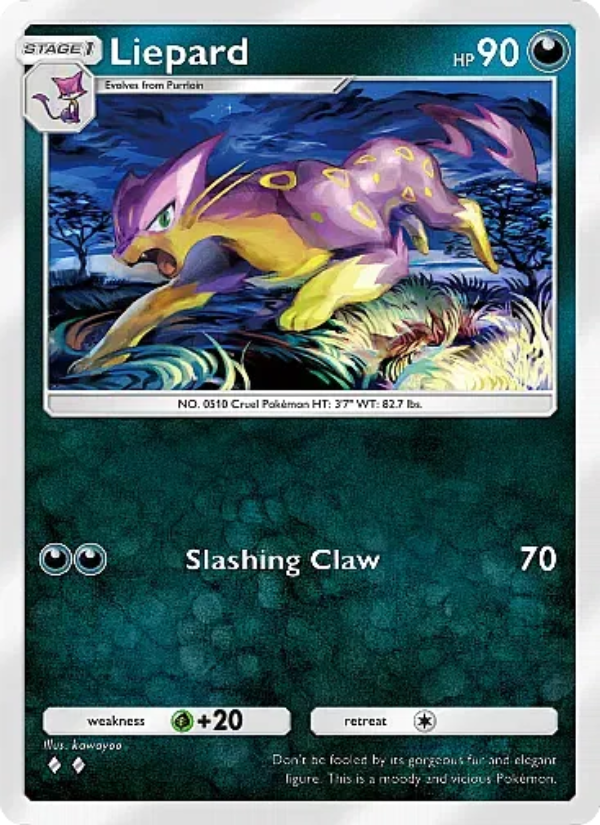
In the Pokemon TCG landscape, a single card can feel radically different depending on where you play. Liepard, a Dark-type Stage 1 evolving from Purrloin with 90 HP and a sleek, moody vibe, is a perfect case study. Its aesthetic allure—the elegant fur and poised silhouette—belies a practical truth: the regional meta, rotation status, and deck-building constraints shape how players value its Slashing Claw attack and its role in a lineup. The Eevee Grove version of Liepard, illustrated by kawayoo, embodies that tension between style and strategy. ⚡
On the surface, Liepard’s stats are clean but not overwhelming: 90 HP, a single solid attack, and a retreat cost of 1. The real nuance comes from its cost and its place within a deck that wants to pressure opponents while keeping energy economy in check. Slashing Claw requires Darkness and Darkness energy and deals 70 damage. That’s a respectable chunk in the early turns, especially when your brain is wired to convert tempo into prizes. Yet the energy requirement and Liepard’s susceptibility to Grass-type weaknesses invite regional considerations—how quickly a player can access two Darkness energies and what threats exist in the local meta. The flavor text—“Don’t be fooled by its gorgeous fur and elegant figure. This is a moody and vicious Pokémon.”—echoes a broader truth: appearances can mask a surprisingly aggressive tempo when the conditions are right. 🗺️
Card Snapshot: What Liepard Brings to the Table
- Name: Liepard (A3b-046)
- Set: Eevee Grove
- Type: Darkness
- Stage: Stage 1 (evolves from Purrloin)
- HP: 90
- Attack: Slashing Claw — 70 damage, cost: Darkness, Darkness
- Weakness: Grass (+20)
- Retreat: 1
- Rarity: Two Diamond
- Illustrator: kawayoo
- Legal status: As of 2025-11-14, not legal in Standard or Expanded formats
“This is a moody and vicious Pokémon.” The line captures Liepard’s paradox—graceful on the surface, relentless in play. In regional decks, that duality translates into taking calculated bites of aggression when the match demands it. 🔥
Different regions emphasize different pacing, draw engines, and energy acceleration. In places where quick two- and three-energy setups are feasible, Liepard can slot into early- to mid-game sequences, threatening 70 damage while your setup stabilizes. In more control-minded or slower rosters, Liepard might be a situational beater—used to pressure specific matchups rather than as a core attacker. The card’s two-Darkness cost, coupled with its 90 HP, makes it a candidate for decks that can reliably fetch two Darkness energies by turn two or three, or for players who favor energy acceleration or special conditions that accelerate Dark-type lines. Regions with abundant grass-type threats or with metagames reliant on attrition may see Liepard as a tactical pivot rather than a cornerstone. 🔄
Another factor shaping regional usage is the broader legal landscape of the format. Liepard’s appearance in Eevee Grove and its current non-legal status in Standard and Expanded lines up with a nuanced reality: in some regions, players must build around a card’s availability window and the surrounding card pool. When a card is not legal in the main formats, regional labs and tour organizers may treat it as a nostalgic or niche tech rather than a staple. This dynamic invites players to explore how a single attacker can shift into or out of prominence as the format evolves. 🎴
Why this card still catches the eye of collectors and players
The allure isn’t only in raw power—it’s in the artistry and the story Liepard carries. As a member of the Eevee Grove set, Liepard sits among a family of evolutions that resonate with players who love the idea that a poiseful creature can strike with surprising ferocity. The rarity, “Two Diamond,” signals that Liepard is a delicately printed gem in a set full of rarities and variants. For collectors, the combination of rarity, holo variants, and the evolving legality in different regions adds layers to the chase. And for players who lean into theme decks or lore-building builds, Liepard’s flavor text provides a narrative hook that’s easy to weave into a match-day storyboard. 💎
From a gameplay lens, Liepard teaches a valuable lesson: the strength of a card isn’t just in its numbers, but in its context. The right timing—two Darkness energies, a moment of space in your bench, and a favorable matchup—can unlock the full potential of Slashing Claw. In regions with robust darkness-focused archetypes, Liepard can act as a bridge between early-game pressure and late-game finishers, especially when paired with follow-up threats that capitalize on the energy you’ve already invested. In other regions, its role may be more as a tempo blip—a reminder that every card can alter the micro-dynamics of a match. ⚡🎮
While Liepard’s official competitive footprint may vary by region and format, its presence in Eevee Grove invites players to appreciate the card beyond raw stats. The silhouette, the lore, and the clever energy math all come together to shape how tournaments in different zones approach this moody feline. For fans who collect both the art and the tactical setups, Liepard remains a stylish, strategic piece of the broader Pokémon TCG tapestry. 🎨
Slim Lexan Phone Case Glossy Ultra-ThinMore from our network
- https://blog.digital-vault.xyz/blog/post/exporting-assets-efficiently-a-practical-workflow-guide/
- https://blog.crypto-articles.xyz/blog/post/nft-data-lil-sweeneys-1605-from-lil-sweeneys-collection-on-magiceden/
- https://blog.crypto-articles.xyz/blog/post/nft-data-himalaya-824-from-himalaya-collection-on-magiceden/
- https://transparent-paper.shop/blog/post/stable-diffusion-xl-prompt-glitch-art-samurai-romanticism-dramatic-lighting-gold-foil-accents-rust-texture/
- https://transparent-paper.shop/blog/post/stable-diffusion-xl-prompt-holographic-shaman-ornate-filigree-plasma-storm-midnight-blue-ash-black-noir/
Liepard
Set: Eevee Grove | Card ID: A3b-046
Card Overview
- Category: Pokemon
- HP: 90
- Type: Darkness
- Stage: Stage1
- Evolves From: Purrloin
- Dex ID:
- Rarity: Two Diamond
- Regulation Mark: —
- Retreat Cost: 1
- Legal (Standard): No
- Legal (Expanded): No
Description
Don't be fooled by its gorgeous fur and elegant figure. This is a moody and vicious Pokémon.
Attacks
| Name | Cost | Damage |
|---|---|---|
| Slashing Claw | Darkness, Darkness | 70 |
Support Our Decentralized Network
Donate 💠More from our network
- https://blog.digital-vault.xyz/blog/post/exporting-assets-efficiently-a-practical-workflow-guide/
- https://blog.crypto-articles.xyz/blog/post/nft-data-lil-sweeneys-1605-from-lil-sweeneys-collection-on-magiceden/
- https://blog.crypto-articles.xyz/blog/post/nft-data-himalaya-824-from-himalaya-collection-on-magiceden/
- https://transparent-paper.shop/blog/post/stable-diffusion-xl-prompt-glitch-art-samurai-romanticism-dramatic-lighting-gold-foil-accents-rust-texture/
- https://transparent-paper.shop/blog/post/stable-diffusion-xl-prompt-holographic-shaman-ornate-filigree-plasma-storm-midnight-blue-ash-black-noir/