
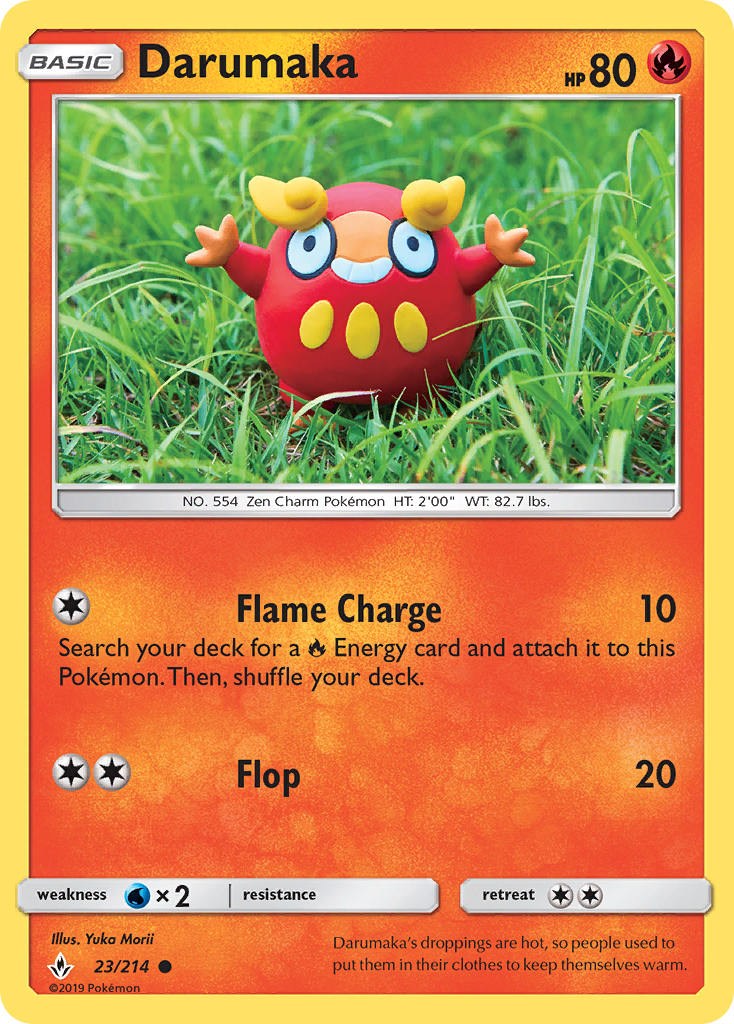
Image courtesy of TCGdex.net
Understanding How PSA vs BGS Grading Affects Darumaka's Value
For Pokémon TCG fans, the thrill of a card isn’t only about how it plays on the table—it's also about the stories and conditions that surround its value in the market. When Darumaka from Unbroken Bonds (SM10) crosses a grading table, the label on the slab can swing its worth far more than most players expect. This little Fire-type, with 80 HP and two punchy attacks, sits in a curious spot: gameplay utility meets collector curiosity, and grading differences between PSA and BGS can reshape its price trajectory in surprising ways ⚡🔥.
Darumaka’s basic status makes it approachable for players building decks, yet its holo and reverse-holo variants attract collectors who chase a little more shine. The card’s art—courtesy of Yuka Morii—adds charm to its surface, especially when the light catches the holo finish. In the modern market, a graded copy can be worth more than a raw copy, particularly if the grade pushes into the top tier. But the precise value hinges on the grading service and the slab’s internal judgments. PSA and BGS operate on different philosophies, and those differences ripple through price formation in the secondary market.
Card snapshot: a quick look at Darumaka SM10-23
- Set: Unbroken Bonds (SM10)
- Card name: Darumaka
- Rarity: Common
- HP: 80
- Type: Fire
- Stage: Basic
- Attacks: Flame Charge (Colorless) – Search your deck for a Fire Energy and attach it to this Pokémon; then shuffle your deck. 10 damage. Flop (Colorless, Colorless) – 20 damage
- Weakness: Water ×2
- Retreat: 2
- Illustrator: Yuka Morii
- Variants: Normal, Holo, and Reverse variants exist; holo versions carry the extra flash that collectors often prize
- Format legality: Legal in Expanded, not in Standard (as of recent rotations)
In practice, these stats tell a simple story: a common card can still fetch a premium when the grade and surface finish align perfectly. The holo variant, in particular, can become a centerpiece for a collection if the surface mirrors the light with minimal scratches and the corners remain sharp. That balance between surface quality and edge integrity is exactly where PSA and BGS diverge in evaluation.
What makes PSA 10s different from BGS 9.5 or 9 for this card?
- Grading philosophy: PSA grades on a single, overarching 1–10 scale, emphasizing overall mint condition and corners, edges, surface, and centering. BGS, by contrast, uses a four-subgrade system (Centering, Edges, Corners, Surface) plus an overall numeric grade. A BGS 9.5 with all subgrades at 9.5 or 10 can look exceptional, but any subpar area can drag the overall grade down even if the card looks pristine in hand.
- Subgrades matter: For holo and reverse-holo Darumaka copies, surface and centering often become the decisive factors. A BGS 9.5 with high subgrades signals a near-flawless look, which collectors prize, yet a single weak subgrade can keep it from a perfect 10. PSA 10s, while simpler to interpret, can lack the nuanced signal subgrades provide to serious graders.
- Population and market perception: PSA typically has a larger population of graded modern cards in the market, which can influence liquidity and resale speed. BGS holders, with their distinct subgrades and thicker slabs, appeal to collectors who value the detailed condition breakdown. That combination can create different demand curves for the same Darumaka copy depending on the label.
- Aesthetics and trust: Some buyers instinctively trust the PSA label for modern cards due to broad market familiarity, while others seek the BGS brand for the precision of subgrades and the visible purity of a “GEM MINT 9.5/10” presentation. Neither is inherently superior—it's about buyer psychology and the specific card in question.
Market data across the digital marketplaces reinforces the idea that grading elevates value, but the extent varies with edition, finish, and grade level. For ungraded Darumaka from this set, prices typically linger in the low sub-dollar to dollar range on many platforms. The holo versions can fetch more, especially when a copy hits a PSA 10 or a high-grade BGS slab. CardMarket and TCGPlayer data show a broad spectrum: ordinary copies trading near a few cents to a few dollars, while holo variants with strong grades can spike in price, sometimes reaching noticeably higher figures depending on demand, supply, and the current collector mood. Always consider the specific card variant (normal vs holo vs reverse holo) and the grade when evaluating value. 🔎💎
Practical tips for collectors and players alike
- Assess the card’s condition before submitting: Look for corner wear, creases, edge chipping, and surface scratches—especially on holo surfaces where micro-scratches show easily.
- Choose the right grade target: If you’re chasing a high resale, PSA 10 or BGS 9.5+ with strong subgrades often yields better returns than a mid-grade copy. For hobbyists seeking display value, a well-graded BGS 9.5 can be a beautiful centerpiece.
- Factor in submission costs and timelines: Grading fees, turnaround times, and shipping insurance vary by service. Plan for a total cost that makes sense for the card’s potential upside.
- Shop smart with price history: Use the price history from CardMarket and TCGPlayer to gauge whether a grade upgrade is worth the investment for this particular Darumaka copy. The common nature of the card means you’re paying more for the grade and finish than for raw power on the table.
- Consider the edition and finish: Holo versions typically command higher premiums than normal non-holo copies, and reverse holos often pull different values again. The art and holo reflectivity can influence perceived value beyond raw stats.
In the end, the choice between PSA and BGS for your Darumaka isn’t a binary “better or worse”—it’s about aligning your goals with market realities. If you’re aiming for broad market appeal and liquidity, PSA 10s can be a reliable route. If you value granular quality signals and a collector-centric slab, a high-subgrade BGS copy can shine in a curated collection. Either way, the appeal of Darumaka—from its cheerful design to its fiery resilience—remains a bright ember in the ongoing story of Unbroken Bonds.
Phone Stand Travel Desk Decor for SmartphonesMore from our network
- https://donation.digital-vault.xyz/donation/post/support-digital-equity-and-bridge-the-digital-divide/
- https://crypto-acolytes.xyz/blog/post/pfpepe-145-pfpepe-nft-stats/
- https://transparent-paper.shop/blog/post/how-to-add-depth-and-texture-to-digital-scrapbooks/
- https://wiki.digital-vault.xyz/wiki/post/pokemon-tcg-stats-pikipek-card-id-smp-sm07/
- https://crypto-acolytes.xyz/blog/post/solrock-10-solrocks-nft-stats/
Darumaka
Set: Unbroken Bonds | Card ID: sm10-23
Card Overview
- Category: Pokemon
- HP: 80
- Type: Fire
- Stage: Basic
- Dex ID: 554
- Rarity: Common
- Regulation Mark: —
- Retreat Cost: 2
- Legal (Standard): No
- Legal (Expanded): Yes
Description
Attacks
| Name | Cost | Damage |
|---|---|---|
| Flame Charge | Colorless | 10 |
| Flop | Colorless, Colorless | 20 |
Pricing (Cardmarket)
- Average: €0.1
- Low: €0.02
- Trend: €0.15
- 7-Day Avg: €0.12
- 30-Day Avg: €0.12
Support Our Decentralized Network
Donate 💠More from our network
- https://donation.digital-vault.xyz/donation/post/support-digital-equity-and-bridge-the-digital-divide/
- https://crypto-acolytes.xyz/blog/post/pfpepe-145-pfpepe-nft-stats/
- https://transparent-paper.shop/blog/post/how-to-add-depth-and-texture-to-digital-scrapbooks/
- https://wiki.digital-vault.xyz/wiki/post/pokemon-tcg-stats-pikipek-card-id-smp-sm07/
- https://crypto-acolytes.xyz/blog/post/solrock-10-solrocks-nft-stats/