
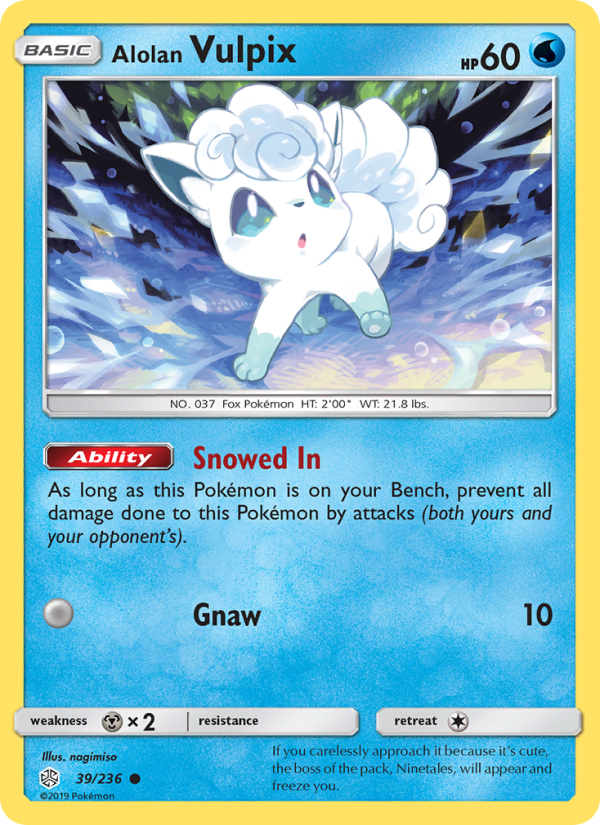
Image courtesy of TCGdex.net
Grading the Tiny Snowflake: Why PSA and BGS Value Alolan Vulpix Differ
For Pokémon TCG fans, Alolan Vulpix from the Cosmic Eclipse set is a charming reminder of the glittering, wintry world of Alola. This Water-type Basic Pokémon wears a holo foil that catches light like freshly fallen snow, and its ability Snowed In can matter in bench-based strategies in older play formats. But as soon as you glimpse the price tags and the graded labels, the question emerges: why do PSA and BGS grades diverge in value for the same card? The short answer is that grading services measure and present card quality differently, and collectors weigh those distinctions in distinct ways depending on the card’s rarity, surface treatment, and playability.
Let’s start with the card’s basics. Alolan Vulpix (SM12) is a Common holo from the Cosmic Eclipse set, illustrated by Nagimiso. It is a Basic Pokémon with 60 HP, a single attack Gnaw dealing 10 damage, and a single protective ability Snowed In that prevents all damage to it while on the bench. Its only weakness is Metal ×2, and it retreats for 1 energy. In terms of gameplay, this little fox isn’t a powerhouse, but its surface-level appeal—glittering holo foil, adorable artwork—lends itself to premium grading when the card is in pristine shape. And that is where grading comes into play for value.
Two grading philosophies, one shared goal
PSA operates on a 1–10 scale with a long history in the hobby. The grade reflects overall quality, but many buyers also pay attention to the four subcategories: Centering, Corners, Edges, and Surface. Subgrades can be shown or omitted, and a PSA 10 simply means an exceptionally clean card on all fronts according to PSA’s standard interpretation. This consistency and broad recognition drive premium pricing for PSA 10s, especially on modern and near-modern staples that have large populations and active markets.
Behold BGS, a rival that stacks subgrades like a deck of tactical notes. A BGS grade uses four separate scores for Centering, Corners, Edges, and Surface, all culminating in a single overall grade. A BGS 9.5 or 10 is often treated as the gold standard, because the subgrades give you granular visibility into which facets of a card are perfect and which aren’t. Collectors frequently discuss “Gem Mint” 9.5s or “Pristine” 10s, where a perfect overall grade with near-perfect sub-scores signals exceptional preservation—especially important for holo cards where surface gloss and smudges can make or break a high mark.
So, what makes Alolan Vulpix special in this tug-of-war? The holo surface can magnify imperfections—micro-scratches, scuffs, or edge whitening from handling—more than a standard non-holo print. A PSA 10 might be appealing for its broad market trust, but a BGS 9.5 with perfect subgrades can signal that the card’s integrity is truly exemplary across more nuanced criteria. The result is a price delta that reflects not just the grade but the market’s faith in what that grade communicates about the card’s condition and presentation.
Why the value gap shows up on this card
Alolan Vulpix, SM12, is a picture-perfect example of how population and rarity interact with grading. It’s a Common holo, not a rare chase card, so raw copies sit in a relatively modest price band. Market data from TCGPlayer shows a non-holo baseline that’s often in the low single digits, while holo versions can edge higher, with market realities peaking around the $1–$10 range depending on condition and availability.
- Cardmarket (EUR): avg around €0.21 for standard copies; holo variants show a broader spread (avg-holo around €0.67 in recent data, with low as €0.10 and strong upside when supply tight).
- TCGplayer (USD): non-holo normal copies show low prices (as low as $0.10–$0.35), while holo copies can flirt with higher values (marketPrice around $1.06, with high prices reaching $10 for standout examples).
When PSA 10s and BGS 9.5/10s are offered, the premium often reflects not just the grade itself but how the market perceives that grade’s reliability and the card’s holo surface quality. In practice, you might see a PSA 10 commanding a larger premium relative to raw than a BGS 9.5 with a similar surface score—but that is not a universal rule. Buyer preference, the specific subgrades, and the card’s eye appeal all weave into the final price.
“A grade is a promise about a card’s future, not a guarantee of its past.”
For collectors evaluating Alolan Vulpix, it’s helpful to check whether the grade comes with subgrades and what they are. A BGS 9.5 with Surface 9.5 and Centering 9.5 might still read as “Gem Mint” to many, while a PSA 9 with near-perfect centering could appeal to different buyers who prioritize a clean, global grade without sub-score details. And for a card that isn’t widely used in modern standard play, the aesthetic value—the holo shine, the art by Nagimiso, the nostalgia attached to Cosmic Eclipse—often tips the scales toward collectors who prize condition and presentation as much as power on the battlefield.
Practical guidance for buyers and collectors
- Always inspect centering and surface first. Holo surfaces are susceptible to micro-scratches that can derail a perfect grade.
- Review the subgrades if available. They tell you where the card shines and where it struggles, which helps compare PSA and BGS offerings.
- Consider the card’s format legality in play. This Alolan Vulpix is expanded legal but not standard, which can influence which buyers are shopping for it and how much premium they’re willing to pay.
- Factor in the set’s popularity. Cosmic Eclipse has a strong footprint among collectors, which can magnify the value impact of a flawless grade.
Whether you’re chasing nostalgia, showcasing a pristine holo, or building a collection with carefully curated graded copies, Alolan Vulpix remains a charming, accessible entry point into the world of graded Pokémon cards. Its small footprint and big personality make it a favorite for display, trade, and strategic buying—especially in the nuanced arena of PSA versus BGS values ⚡🔥💎.
Product note: for fans who want a physical centerpiece that pairs nicely with a desk or shelf, consider this Neoprene Mouse Pad Round or Rectangular One-Sided Print — a tasteful, durable companion to a well-curated collection. Neoprene Mouse Pad Round or Rectangular One-Sided Print
More from our network
- https://blog.digital-vault.xyz/blog/post/buyouts-and-small-set-cards-metamorphosis-in-mtg-finance/
- https://articles.zero-static.xyz/blog/post/wardscale-dragon-mastering-mid-game-tempo-in-mtg/
- https://amber-images.zero-static.xyz/d72f5f6f.html
- https://crypto-acolytes.xyz/blog/post/nft-stats-ape-1373-from-entropy-acolytes-collection/
- https://transparent-paper.shop/blog/post/mastering-realistic-creases-in-multi-layer-paper-design/
Alolan Vulpix
Set: Cosmic Eclipse | Card ID: sm12-39
Card Overview
- Category: Pokemon
- HP: 60
- Type: Water
- Stage: Basic
- Dex ID: 37
- Rarity: Common
- Regulation Mark: —
- Retreat Cost: 1
- Legal (Standard): No
- Legal (Expanded): Yes
Description
Abilities
-
Snowed In — Ability
As long as this Pokémon is on your Bench, prevent all damage done to this Pokémon by attacks (both yours and your opponent’s).
Attacks
| Name | Cost | Damage |
|---|---|---|
| Gnaw | 10 |
Pricing (Cardmarket)
- Average: €0.21
- Low: €0.02
- Trend: €0.17
- 7-Day Avg: €0.18
- 30-Day Avg: €0.19
Support Our Decentralized Network
Donate 💠More from our network
- https://blog.digital-vault.xyz/blog/post/buyouts-and-small-set-cards-metamorphosis-in-mtg-finance/
- https://articles.zero-static.xyz/blog/post/wardscale-dragon-mastering-mid-game-tempo-in-mtg/
- https://amber-images.zero-static.xyz/d72f5f6f.html
- https://crypto-acolytes.xyz/blog/post/nft-stats-ape-1373-from-entropy-acolytes-collection/
- https://transparent-paper.shop/blog/post/mastering-realistic-creases-in-multi-layer-paper-design/