
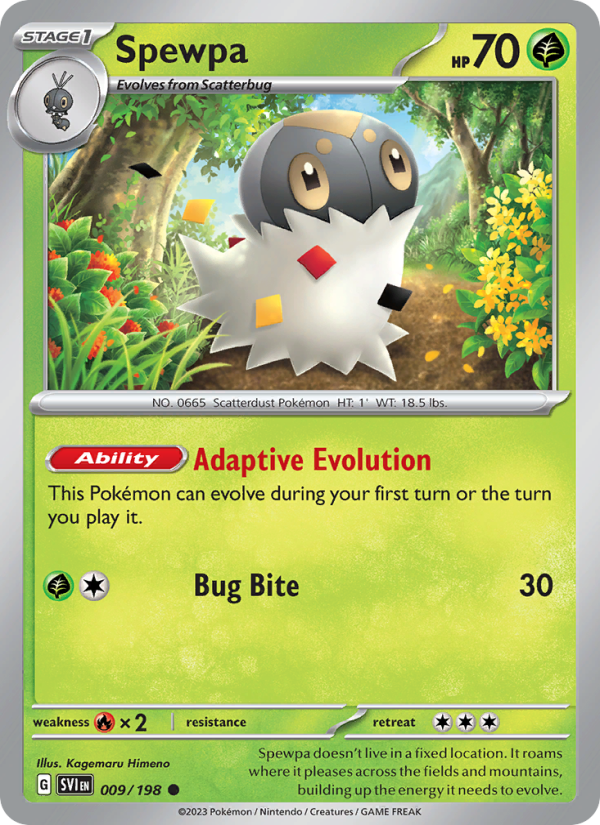
Image courtesy of TCGdex.net
Understanding Why PSA and BGS Grading Differ on Spewpa Cards
When collectors compare PSA and Beckett Grading Services (BGS) grades for a Spewpa from Scarlet & Violet, they often notice a gap in valuation that isn’t simply about the card’s condition. Spewpa, a Grass-type Pokémon with 70 HP, sits at a common rarity in the SV01 set, but the way PSA and BGS evaluate that card can lead to divergent market signals. The discrepancy isn’t just about a number—it's about how each service interprets centering, surface flaws, and even the perceived eye appeal of a seemingly modest card. And for a card that appreciated to life with a memorable ability like Adaptive Evolution, that distinction can feel surprisingly meaningful to players and collectors alike ⚡🔥.
Spewpa’s journey from Scatterbug to its own Stage 1 evolution in a modern set adds a narrative layer to why collectors pursue graded copies. The card’s artwork by Kagemaru Himeno—soft greens, a gentle stance, and a focus on the little insect’s progress—invites closer inspection. Yet the physical surface and edge quality still battle the market’s eye for pristine presentation. A PSA 10 or a BGS 9.5 can both signal rarity, but the way each service weighs subcriteria and aesthetic nuance will tint the final valuation differently. The result is a dynamic where a card that may appear similar to an ungraded copy can fetch noticeably different prices depending on the grading brand’s verdict ◈.
Card snapshot: Spewpa SV01-009
- Set: Scarlet & Violet (SV01)
- Card number: SV01-009
- Illustrator: Kagemaru Himeno
- Type: Grass
- HP: 70
- Stage: Stage 1 (evolves from Scatterbug)
- Rarity: Common
- Attack: Bug Bite — 30
- Ability: Adaptive Evolution (This Pokémon can evolve during your first turn or the turn you play it.)
- Retreat: 3
- Regulation: G
- Prices: CardMarket average around €0.04; holo versions around €0.11 (non-holo SV01 card is typically the baseline, with holo variants commanding a premium when present in a collection).
- Notes: The SV01 print count highlights a broad production window, which can impact supply and, by extension, grade-driven price shifts.
Understanding these specifics helps frame why a PSA 9 might land differently from a BGS 9.5 or 10 on the same card. The Spewpa card’s simplicity—non-holo, straightforward edges, and a clean center—can yield strong fundamentals for both services. Yet surface texture, whitening on corners, or subtle misalignment under magnification can tip the scales in one system and not the other. For a collector analyzing value trends, the card’s grade becomes a lens into broader market psychology: what buyers prize (and what they’re willing to pay) can hinge as much on the grading brand’s narrative as on the card’s physical condition.
PSA vs. BGS: key differences in practice
- Grading scale and approach: PSA uses a 1–10 scale with a single overall grade, reflecting a composite view of the card’s condition. BGS adds a quartet of subgrades—Centering, Corners, Edges, and Surface—before delivering an overall numeric grade. The overall BGS grade often intertwines with these subgrades, and many collectors interpret subgrades as a reliability gauge for each facet of the card’s condition.
- Subgrades and eye appeal: Because BGS assigns numeric marks to each category, a card with excellent centering and surface but minor corner wear may still receive a lower overall grade if any subcategory falters. PSA tends to present a single, holistic verdict, which can feel more streamlined but sometimes less informative about which features drove the rating.
- Market perception: In practice, PSA 10s have long been considered a universal standard for top-tier mint condition, while BGS 9.5 or 10 (with strong subgrades) can carry a distinct appeal for buyers who value the granularity of subgrades. For Spewpa, a card that sits near the lower end of the price spectrum, the uplift from a high PSA or high-BGS grade may be modest—yet it can still be meaningful to finishers who chase a “minty” display piece.
- Pricing realities: Modern, common cards like Spewpa SV01-009 tend to live in a price corridor where even a few-market-friendly shuffles in grade can swing value by a few tenths of a euro or a couple of dollars at the most. The data from CardMarket illustrates that the base value is modest; however, graded examples can attract premium if they achieve pristine presentation, especially under light usage for display rather than play.
“Grading is as much about the story you tell with a card as the card itself.”
That sentiment resonates for Spewpa: a charming, approachable Pokémon whose value is amplified when perched under glass with clean edges and true color. Collectors who balance gameplay potential—Adaptive Evolution enabling an early evolution turn—or a purely aesthetic appreciation of Himeno’s illustration will weigh grade outcomes against the card’s narrative and set-specific demand. The holistic picture includes not just rarity, but the evolution line’s place in the player’s deck, the card’s accessibility in modern formats, and the ongoing story of Scarlet & Violet’s evolving card ecosystem ⚡🎴.
Practical tips for graders and collectors
- When evaluating Spewpa SV01-009, examine centering first. A perfectly centered card often contributes more to a high-level grade than minor surface issues in a low-visibility area.
- Inspect the surface for micro-scratches or gloss defects that can disrupt a subgrade, even if the print appears clean from a distance.
- For those chasing BGS grades, remember that strong subgrades matter. A high Centering and Surface with only minor Corner wear can lift the overall impression, potentially influencing a better final grade.
- Factor in market context: even small grade uplift on a Common Spewpa can be overshadowed by base card price. Weigh the cost of grading against potential resale uplift.
- Preserve eye appeal with careful handling and a gentle display setup. The Spewpa’s soft color palette benefits from a clean, glare-free presentation.
In the end, the difference between PSA and BGS valuations comes down to how the hobby defines mint—and how much weight collectors place on subgrades and label trust. For a card like Spewpa, the narrative is as important as the numerical verdict: a little Grass-type that begins the journey from Scatterbug to a bigger stage in the Scarlet & Violet saga, and a card that can shine in a neat display as much as it does in a strategic deck ⚡💎.
Neon Card Holder Phone Case with MagSafe Impact-ResistantMore from our network
- https://crypto-acolytes.xyz/blog/post/nft-stats-happi-pills-1024-from-happi-pill-collection/
- https://blog.digital-vault.xyz/blog/post/comparing-octillery-base-stats-across-generations/
- https://wiki.digital-vault.xyz/wiki/post/pokemon-tcg-stats-radio-tower-card-id-neo4-95/
- https://crypto-articles.xyz/tmppkrxzl8e/f3f7c2fe.html
- https://wiki.digital-vault.xyz/wiki/post/pokemon-tcg-stats-slowpoke-card-id-ecard2-108/
Spewpa
Set: Scarlet & Violet | Card ID: sv01-009
Card Overview
- Category: Pokemon
- HP: 70
- Type: Grass
- Stage: Stage1
- Evolves From: Scatterbug
- Dex ID: 665
- Rarity: Common
- Regulation Mark: G
- Retreat Cost: 3
- Legal (Standard): Yes
- Legal (Expanded): Yes
Description
Abilities
-
Adaptive Evolution — Ability
This Pokémon can evolve during your first turn or the turn you play it.
Attacks
| Name | Cost | Damage |
|---|---|---|
| Bug Bite | Grass, Colorless | 30 |
Pricing (Cardmarket)
- Average: €0.04
- Low: €0.02
- Trend: €0.03
- 7-Day Avg: €0.04
- 30-Day Avg: €0.04
Support Our Decentralized Network
Donate 💠More from our network
- https://crypto-acolytes.xyz/blog/post/nft-stats-happi-pills-1024-from-happi-pill-collection/
- https://blog.digital-vault.xyz/blog/post/comparing-octillery-base-stats-across-generations/
- https://wiki.digital-vault.xyz/wiki/post/pokemon-tcg-stats-radio-tower-card-id-neo4-95/
- https://crypto-articles.xyz/tmppkrxzl8e/f3f7c2fe.html
- https://wiki.digital-vault.xyz/wiki/post/pokemon-tcg-stats-slowpoke-card-id-ecard2-108/