
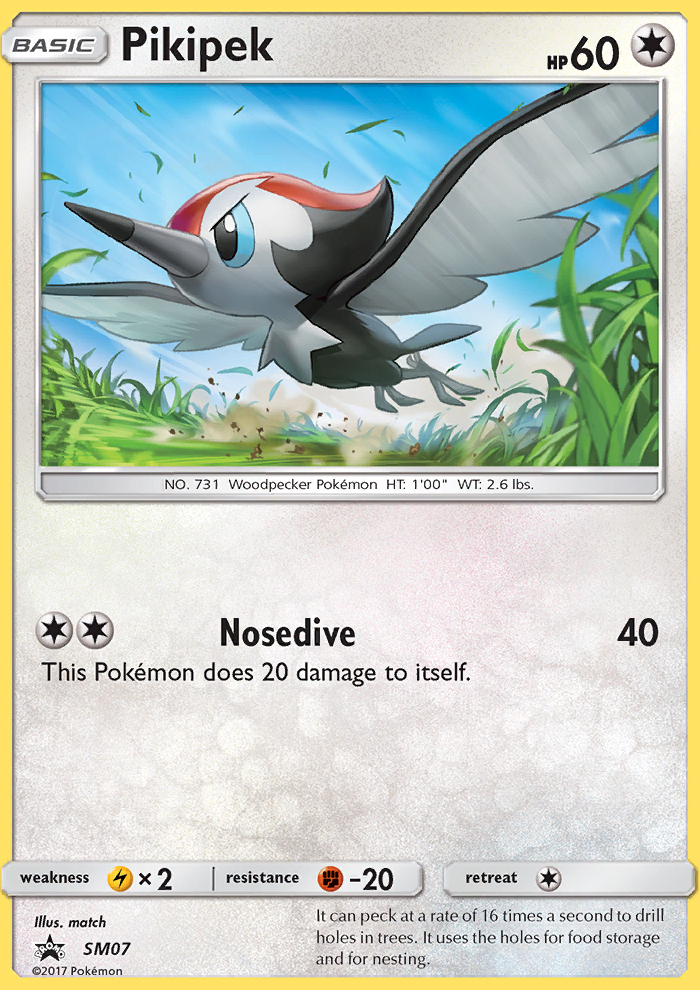
Image courtesy of TCGdex.net
Why PSA and BGS values diverge for Pikipek: a closer look at grading formulas and market realities
Pokémon TCG collectors often chase the thrill of a pristine card, but the thrill can fade when a card’s value differs depending on the grader. The Pikipek card from the SM Black Star Promos line (SMP, SM07) offers a compelling case study: a Rare Basic Colorless Pokémon with 60 HP, a quirky attacking move, and a holo variant that excites players and collectors alike. When you compare PSA and BGS grades for this card, you may notice price gaps that aren’t just about a higher or lower number—they reflect distinct grading philosophies, subgrade breakdowns, and market dynamics. ⚡🔥
Let’s ground the discussion in the card’s specifics. Pikipek from SM07 is a Basic Colorless Pokémon with 60 HP, illustrated by Match. Its lone attack, Nosedive, costs two Colorless and deals 40 damage to the Defending Pokémon while also harming Pikipek itself. The card’s weakness is Lightning ×2, it resists Fighting (−20), and it retreats for 1 Energy. Holo variants, promos, and the rarity tag (Rare) contribute to its collectability beyond pure gameplay. The set is SM Black Star Promos, a print-line with a limited feel that appeals to promo-hungry collectors. In terms of presentation, the holo versions can show surface issues or centering quirks that both graders weigh, sometimes differently.
- Set: SM Black Star Promos (SMP)
- Rarity: Rare
- Type/Stage: Colorless, Basic
- HP: 60
- Attack: Nosedive — Cost: Colorless, Colorless; Effect: This Pokémon does 20 damage to itself; Damage: 40
- Weakness/Resistance: Lightning ×2 / Fighting −20
- Retreat: 1
- Illustrator: Match
- Variants: holo, normal, reverse; First Edition: False
From a gameplay vantage point, Pikipek’s 60 HP and single modest attack place it in the nostalgia-and-collection camp more than the deck-building spotlight. Yet the card’s value is tightly tied to its holo presentation, print-run scarcity, and the reverence fans hold for the SM Black Star Promos era. These practical realities color how PSA and BGS assign value, even before you look at subgrade detail.
Two different grading logics: how PSA and BGS decide a card’s fate
PSA uses a single, holistic 1–10 grade for the card as a whole. It’s a broad signal for the market: “this copy is near mint, or not, and how likely is it to pass in a collector’s portfolio?” BGS, by contrast, employs a four-factor subgrade approach—Centering, Edges, Corners, and Surface—plus an overall grade that often carries a different weight from PSA’s single score. A Pikipek holo from SMP could earn a PSA 9 or 9.5, while the same card might receive a BGS 9.5 with 9/9/9.5/9.5 subgrades, or even a pristine 10 in one or more categories. The practical upshot is that two buyers evaluating the same card can agree on the general condition, yet disagree on “which graded version” feels right to them or their market channel. This is a big reason why prices diverge between PSA-graded copies and BGS-graded copies in the wild. 🎴💎
Another factor is how each service handles promo and holo condition nuances. The Pikipek SM07 holo variant, with its glossy foil and potential print artifacts, may push Surface or Edges into marginal trouble zones for graders. PSA’s overall 9 or 10 rating is influenced by overall appearance to the naked eye; BGS’s subgrades can highlight a near-perfect card that still has a tiny edge or centering imperfection, affecting the composite grade or even how a seller prices it in a sale. These differences ripple into market value, since many collectors seek consistency and a standardized benchmark when purchasing a high-value holo promo. ⚡
Beyond grading mechanics, population data (how many copies exist in PSA-graded or BGS-graded form) and brand perception matter a great deal. PSA’s name recognition often makes its 9s and 10s highly liquid for buyers who trust that a PSA grade is widely accepted in trade and commerce. BGS, with its well-known subgrades, tempts collectors who value a granular sense of where a tape-like center or a corner crease sits on a card, even if the overall grade is the same. In short, the Pikipek SM07 is a microcosm of a larger tension in the TCG marketplace: different grading philosophies, different collectors, and different routes to value. 🔥
Practical takeaways for collectors and investors
For Pikipek and other promo holo cards, here are actionable ideas to navigate PSA vs BGS values:
- Inspect subgrades: If you’re eyeing a BGS grade, look at the individual subgrades. A BGS 9.5 with pristine centering but a minor surface issue might still be more appealing than a PSA 9 with less favorable appearance, depending on your market. 💎
- Assess market channels: PSA cards tend to fetch strong prices on mainstream marketplaces with broad audience reach. BGS’s detailed subgrades can unlock niche demand among top-tier collectors who prize precision. ⚡
- Consider promo rarity and holo condition: Holos from promotional sets often command premium if the holo surface is clean and centering tight. Small scans of the holo pattern and any surface gloss anomalies can swing a sale. 🎴
- Balance gameplay value with aesthetics: A Pikipek’s in-game relevance is minimal, but its card art, holo shine, and promoter pedigree can drive emotional value just as hard as numeric grades do. 🎨
- Stay aware of print-run nuance: Promo prints sometimes have less stringent centering tolerances or print quirks—this can tilt a grader’s decision and, by extension, the price you could command. 🛡️
In terms of timing, the market has shown a tendency to reward pristine holo promos with a combination of high subgrades and clean surfaces. If you’re pursuing Pikipek for a long-term hold, you may want to track both PSA and BGS listings to spot buyer preferences in your region or on your chosen platform. The right copy can leverage a combination of rarity, presentation, and grading nuance to deliver a compelling value proposition to collectors and investors alike. 🎮
As you weigh your next Pikipek acquisition, remember that the art, the print run, and the grading story all co-author the final price. The card’s tiny frame—just 60 HP, a self-damaging attack, and a Rare holo with a tiny silhouette of a bird—hides a surprisingly rich narrative about how grading, perception, and market dynamics intersect in Pokémon TCG collecting. 🔥
Neon Card Holder Phone Case MagSafe — 1 Card Slot (Polycarbonate)More from our network
- https://transparent-paper.shop/blog/post/stable-diffusion-xl-prompt-cyberpunk-neon-noir-titanium-metal-ruby-red-glow-futuristic-guardian/
- https://blog.digital-vault.xyz/blog/post/create-a-digital-product-that-solves-real-problems/
- https://crypto-acolytes.xyz/blog/post/lnl-2507-long-neck-legends-nft-stats/
- https://transparent-paper.shop/blog/post/stable-diffusion-xl-prompt-holographic-renaissance-painting-baroque-chiaroscuro-calligraphy-ink-texture-chrome-metallic-fire-orange-glow/
- https://wiki.digital-vault.xyz/wiki/post/pokemon-tcg-stats-rotom-card-id-swsh12-053/
Pikipek
Set: SM Black Star Promos | Card ID: smp-SM07
Card Overview
- Category: Pokemon
- HP: 60
- Type: Colorless
- Stage: Basic
- Dex ID: 731
- Rarity: Rare
- Regulation Mark: —
- Retreat Cost: 1
- Legal (Standard): No
- Legal (Expanded): Yes
Description
Attacks
| Name | Cost | Damage |
|---|---|---|
| Nosedive | Colorless, Colorless | 40 |
Support Our Decentralized Network
Donate 💠More from our network
- https://transparent-paper.shop/blog/post/stable-diffusion-xl-prompt-cyberpunk-neon-noir-titanium-metal-ruby-red-glow-futuristic-guardian/
- https://blog.digital-vault.xyz/blog/post/create-a-digital-product-that-solves-real-problems/
- https://crypto-acolytes.xyz/blog/post/lnl-2507-long-neck-legends-nft-stats/
- https://transparent-paper.shop/blog/post/stable-diffusion-xl-prompt-holographic-renaissance-painting-baroque-chiaroscuro-calligraphy-ink-texture-chrome-metallic-fire-orange-glow/
- https://wiki.digital-vault.xyz/wiki/post/pokemon-tcg-stats-rotom-card-id-swsh12-053/