
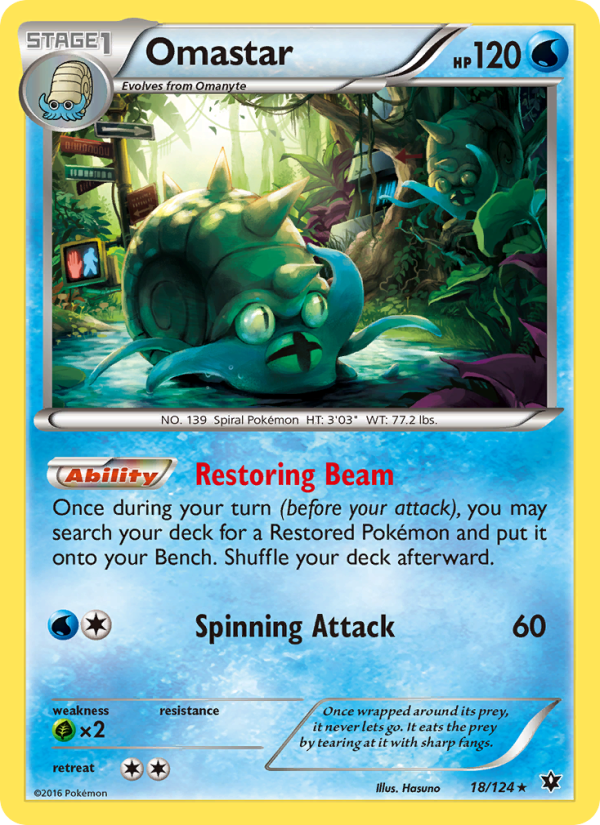
Image courtesy of TCGdex.net
Why Omastar Shines in Community Decklists
In the ever-evolving landscape of Pokémon TCG strategies, certain cards become fan favorites not just for power on the table but for their storytelling and how they fit into a broader game plan. Omastar from the XY Fates Collide set—Stylishly illustrated by Hasuno and sporting the rare holo treatment—has earned a conspicuous spot in many community decklists. This Rare Water-type Stage 1, evolving from Omanyte, brings a mix of tempo, resilience, and nostalgia that resonates with both veteran players and newer competitors. ⚡
At first glance, Omastar’s numeric profile is solid but not flashy: 120 HP, a Phase 1 evolution, and a single, dependable attack—Spinning Attack for 60 damage (Water and a Colorless energy). But the real gem is its Restoring Beam ability: “Once during your turn (before your attack), you may search your deck for a Restored Pokémon and put it onto your Bench. Shuffle your deck afterward.” This effect is the kind of strategic quirk that players build around. It isn’t about exploding with a single big hit; it’s about controlled tempo, bench pressure, and carving out a path to mid- to late-game threats. The interplay between Omastar and a deck that relies on Restored Pokémon cards can create a repeatable engine—one that rewards smart deck-thinning and timing. 💎
Beyond the ability, Omastar’s role as a Water-type attacker with a respectable 120 HP makes it a reliable frontline in Expanded format decks. Its Spinning Attack cost—Water plus Colorless—provides flexible energy requirements that can be met with a variety of Water-leaning build-outs. The card’s weakness to Grass ×2 keeps players mindful of matchups against Grass-heavy lists, but in the current Expanded ecosystem, Omastar often finds itself paired with deck-supporting Pokémon and Trainers that smooth water-typed draws and recovery. The retreat cost of 2 isn’t prohibitive, allowing Omastar to disengage without draining too many resources when the tempo shifts. 🔥
Key reasons Omastar appears in community lists
- Tempo through Restoring Beam — The ability to fetch a Restored Pokémon from the deck and place it on the Bench accelerates setup and creates renewed threats across turns. It’s a distinctive engine that rewards planning several moves ahead.
- Reliable mid-game presence — With 120 HP and a respectable Attack, Omastar can pressure opponent’s boards while you assemble your Restored Pokémon line on the bench. This balance of offense and resilience is highly valued in community-curated builds. 🎴
- Collector appeal — The XY5-era holo rares, especially from Fates Collide, are popular with fans who appreciate the art style and the nostalgia of early-2000s fossil-fielding. Hasuno’s artwork adds a layer of visual appeal that resonates with collectors. 🎨
- Expanded-legal flexibility — While Omastar isn’t Standard-legal, its Expanded playability opens doors for players exploring non-Standard formats and online leagues that celebrate older sets and hybrid archetypes. This breadth invites a wider group of players to experiment with fossil and water-themed shells. 💮
- Market accessibility — As a Rare holo from a popular set, Omastar remains accessible for budget to mid-range collectors. Recent market snapshots show a spectrum of prices across non-holo and holo copies, offering clear entry points for players balancing collection goals with deck-building ambitions. 🔎
“In my Expanded lists, Omastar acts like a bridge between my early bench setup and late-game pressure. The Restoring Beam engine lets me pivot without losing tempo.”
Collector insights and market trends
From a collecting perspective, Omastar sits on a stable rung of the Rare ladder. CardMarket data indicates the non-holo copy trends around a few tenths of a euro per copy on average, while holo versions pull higher, with average values hovering near the 1.5 EUR mark in recent listings. In the U.S. market, TCGPlayer reports a broad spectrum for normal copies around the few-cent to low-dollar range, with holo and reverse-holo copies typically pricing up as the card’s nostalgia factor and play potential are acknowledged by buyers and collectors alike. This mix makes Omastar a practical purchase for players who want a playable card with collectible appeal, without requiring a blockbuster budget. 💎
Artistically, the Hasuno illustration on the XY10 Fates Collide Omastar captures the fossil’s archetypal oceanic aura—an aesthetic that fans often cite as a draw in community forums and collector’s shop talk. The card’s place in the Fates Collide set, with its own distinct logo treatment and card count, enhances its identity as part of a cohesive fossil-and-water subtheme within the Expanded ecosystem. The holo variant, in particular, remains a highlight for binders and display shelves, combining gameplay utility with a glossy reminder of the fossil era in the palette of a modern TCG collection. 🎨
Gameplay tips for building around Omastar
When integrating Omastar into a community decklist, think of it as the engine that can chain into a resilient bench state. Build your mana curve so that you can reliably reach Water energy activation for Spinning Attack while preparing to trigger Restoring Beam. Pair Omastar with supportive Trainers and other Water-types that can help you manage your Bench, fetch additional draw power, or accelerate damage output. Consider matchups where the Grass-type threat is present and plan a plan-B bench strategy to mitigate those weaknesses. This approach allows Omastar to function as a steady contributor rather than a one-off attacker. ⚡🎮
For collectors and players alike, Omastar’s place in a community deck is a reminder that strategy in Pokémon TCG isn’t only about the biggest hit—it’s about the choreography of turn-by-turn tempo, card-advantage cycles, and the satisfying moment when a Restored Pokémon steps onto the battlefield to swing the momentum your way.
Curious minds can explore more about related design philosophies and battlefield dynamics through the networked article paths below, which explore design textures, prompt aesthetics, NFT and gaming intersections, mana and strategy, and connections between modern and classic Pokémon experiences. 🔗
Slim Glossy iPhone 16 Case - High Detail DesignMore from our network
- https://transparent-paper.shop/blog/post/crafting-procreate-texture-brushes-a-designers-guide/
- https://transparent-paper.shop/blog/post/stable-diffusion-xl-prompt-kaiju-holographic-iridescent-glyphs-retro-futurism-cinematic-grain-snow-textures/
- https://crypto-acolytes.xyz/blog/post/nft-stats-topu-inc-2453-from-topu-inc-collection/
- https://blog.zero-static.xyz/blog/post/maximizing-mana-efficiency-with-deathcap-marionette/
- https://articles.digital-vault.xyz/blog/post/pokemon-scarlet-and-violet-hidden-connections-to-other-games/
Omastar
Set: Fates Collide | Card ID: xy10-18
Card Overview
- Category: Pokemon
- HP: 120
- Type: Water
- Stage: Stage1
- Evolves From: Omanyte
- Dex ID: 139
- Rarity: Rare
- Regulation Mark: —
- Retreat Cost: 2
- Legal (Standard): No
- Legal (Expanded): Yes
Description
Abilities
-
Restoring Beam — Ability
Once during your turn (before your attack), you may search your deck for a Restored Pokémon and put it onto your Bench. Shuffle your deck afterward.
Attacks
| Name | Cost | Damage |
|---|---|---|
| Spinning Attack | Water, Colorless | 60 |
Pricing (Cardmarket)
- Average: €0.78
- Low: €0.03
- Trend: €0.77
- 7-Day Avg: €0.56
- 30-Day Avg: €0.54
Support Our Decentralized Network
Donate 💠More from our network
- https://transparent-paper.shop/blog/post/crafting-procreate-texture-brushes-a-designers-guide/
- https://transparent-paper.shop/blog/post/stable-diffusion-xl-prompt-kaiju-holographic-iridescent-glyphs-retro-futurism-cinematic-grain-snow-textures/
- https://crypto-acolytes.xyz/blog/post/nft-stats-topu-inc-2453-from-topu-inc-collection/
- https://blog.zero-static.xyz/blog/post/maximizing-mana-efficiency-with-deathcap-marionette/
- https://articles.digital-vault.xyz/blog/post/pokemon-scarlet-and-violet-hidden-connections-to-other-games/