
Image courtesy of TCGdex.net
Regional Variations in Machamp Decks Across the Pokémon TCG
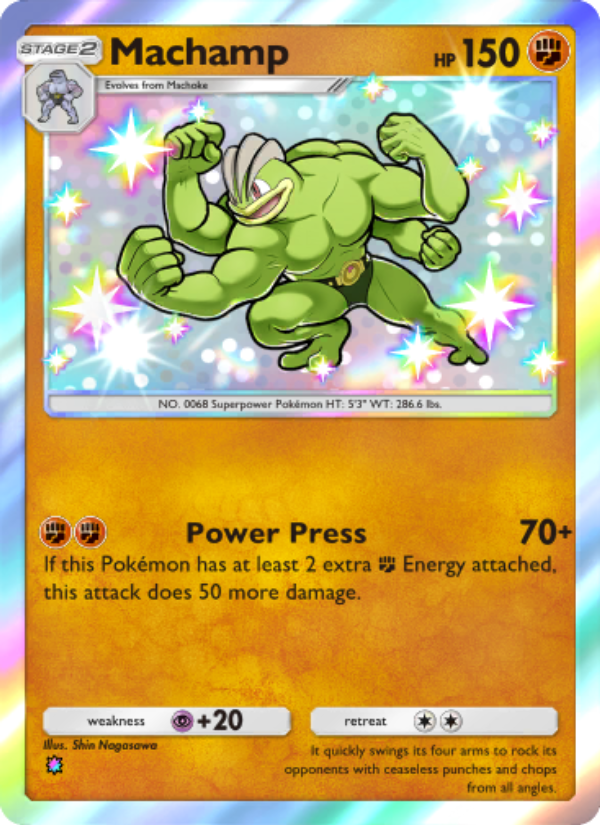
In the Pokémon Trading Card Game, a single card can become a regional storyteller, whispered about in tournament halls and debated in fan forums. Machamp, hailing from the Celestial Guardians set as A3-225 and illustrated by Shin Nagasawa, is a perfect case study for why regions use the same card in strikingly different ways. The card’s power is easy to grasp on paper—a Stage 2 Fighting type with 150 HP, a no-nonsense retreat cost, and an attack that can blow past defenses when energy is right. Yet the real intrigue comes from how players around the world tailor Machamp to their local meta, format, and even the availability of supporting cards. ⚡🔥
A quick snapshot helps frame the discussion. Machamp is a Stage 2 evolution from Machoke, of the Fighting type, boasting 150 HP and a single primary attack, Power Press. Its cost is two Fighting Energy, dealing 70 base damage, with the potential to roar to 120 or more if Machamp has at least two extra Fighting Energy attached—a rule that rewards aggressive energy attachment and careful timing. Its listed weakness to Psychic (+20) keeps Machamp in a classic rock-paper-scissors triad: it races past many basics but hesitates before psychic control strategies. The set also marks Machamp as a holo-worthy, One Shiny rarity card, a magnet for collectors who chase the gloss of holo art and the sheen of high-tier print runs. The design is pure Shin Nagasawa—four-armed intensity that communicates both speed and raw power, reinforced by a bold flavor text about ceaseless punches.
So why do regions diverge in their Machamp builds? The answer rests on how tournament formats and local card pools shape deck construction. In some regions, Standard-legal formats and rotating sets push players toward a streamlined, midrange plan where Stage 2s must arrive quickly to exploit Power Press while the opponent’s board is still in flux. In others, Expanded or non-rotating formats—where older sets remain legal—players can lean into a larger toolbox: extra Trainers, alternative Energy accelerants, and support Pokémon that smooth the path to Machamp’s big payoff. The result is a regional dance: some areas push Machamp into a tempo-heavy archetype that accelerates energy attachments early, while others favor a more methodical approach that stretches the turn count and leverages Machamp’s late-game punch with reliable Power Press outcomes. 🎯
- Energy acceleration cousinries: Regions with access to robust energy acceleration often see Machamp exploited as a late-game closer. When two extra Fighting Energies can be attached parallel to the attack costs, Power Press can suddenly leap from solid to devastating, forcing opponents to respect Machamp’s implied ceiling. This leads to a deck profile that runs multiple energy-doubling options and energy-dense support Pokémon that help Machamp hit that critical power spike promptly. ⚡
- Evolves timing and risk: Because Machamp is a Stage 2, it requires Machoke to have already joined the battlefield, which adds a tempo cost. Regions that lean into rapid setup—using booster-friendly, fast-evolving lines—tend to reward Machamp with a punchy two- or three-card commitment rather than slow, grindy matches. Conversely, metas that tolerate longer games can let Machamp mature on the bench and still land the knockout blow when the moment is right. 💎
- Mood of the field: Psychic-type threats and control-strategy prevails in some regions more than others. Given Machamp’s Psychic weakness, regions with fierce Psychic staples push players to diversify their matchups with either disruption tools or alternate attackers, ensuring Machamp’s Power Press is never a one-hit wonder. 🎴
The holo and “One Shiny” status of this Machamp can influence regional pick rates. In areas with a thriving collector community, holo Machamps from Celestial Guardians often surface in side events and early-release tournaments, nudging player interests toward particular print runs and variants. Collector culture, in turn, nudges card choices in non-rotating or special-format events where binder appeal matters as much as battlefield value. 🔥 Local shops and leagues shape which Machamp variants players can reliably obtain. Regions with ready access to this holo A3-225 print—or to compatible Machamp lineups—tend to experiment with a more aggressive lot of Power Press lines, while areas with limited copies might favor a leaner version or prioritize other Stage 2 attackers with comparable power. 🏪
Let’s consider the playstyle silhouette this Machamp invites. Its Power Press is a study in energy budgeting. On the turn you attach two extra Fighting Energy, the attack climbs from a respectable 70 to a threatening 120—and beyond, if you extend energy paths further. That dynamic rewards careful attack sequencing: the opponent must manage Defense and recoveries while you balance the risk of pushing extra Energy attachments against the benefit of a guaranteed late-game KO. Regions that prize swift board damage often pair Machamp with accelerants and quick-response Trainers that keep the board pressure high, turning Machamp into a capital-G GUNT, a reliable finisher that can finish games in a single, well-timed strike. ⚔️
From a collector’s lens, Celestial Guardians’ Machamp is a banner card. Its rarity and its art by Shin Nagasawa make it a sought-after piece for binders and display shelves alike. The card’s holo variant, paired with a 150 HP line and a dramatic four-armed silhouette, embodies the era’s flavor while reminding players that raw power—when properly fueled—can outpace even the most intricate control strategies. Regions that celebrate holo chase often treat Machamp as more than a battlefield tool; it’s a symbol of a moment when a well-timed Power Press made history on a regional stage. 🎨
As you plan your own Machamp deck for a regional event, think about how your local meta treats speed, energy management, and the prevalence of Psychic threats. A region that prizes pressurized aggression will reward a Machamp that arrives fast, with efficient energy use and a streamlined support cast. A more patient meta will favor Machamp in a longer game, where the evolving Machoke transition is a strategic tempo move rather than a speed bump. Either way, the Celestial Guardians’ Machamp offers a textbook look at how a single card—rooted in classic Fighting-type power—can be molded to fit a region’s unique rhythm. ⚡🎮
Curious to try a desktop companion while you test Machamp? The Neon Gaming Mouse Pad with stitched edges makes for a stylish, practical desk mate as you draft, test, and play through regional meta shifts. It’s a small touch, but in the world of TCG planning, every detail—from card choice to play space—matters. Neon Gaming Mouse Pad 9x7 Custom Neoprene Stitched Edges ⚙️
More from our network
Machamp
Set: Celestial Guardians | Card ID: A3-225
Card Overview
- Category: Pokemon
- HP: 150
- Type: Fighting
- Stage: Stage2
- Evolves From: Machoke
- Dex ID:
- Rarity: One Shiny
- Regulation Mark: —
- Retreat Cost: 2
- Legal (Standard): No
- Legal (Expanded): No
Description
It quickly swings its four arms to rock its opponents with ceaseless punches and chops from all angles.
Attacks
| Name | Cost | Damage |
|---|---|---|
| Power Press | Fighting, Fighting | 70+ |
Support Our Decentralized Network
Donate 💠More from our network
- https://wiki.digital-vault.xyz/wiki/post/pokemon-tcg-stats-regice-card-id-sm7-45/
- https://blog.crypto-articles.xyz/blog/post/nft-data-chomik-187-from-chomiks-collection-on-magiceden/
- https://blog.rusty-articles.xyz/blog/post/harper-lees-early-writings-hint-at-a-brilliant-voice-family-says/
- https://blog.digital-vault.xyz/blog/post/how-to-reduce-server-load-intelligently/
- https://crypto-acolytes.xyz/blog/post/retro-shooters-that-shaped-modern-fps/