
Image courtesy of TCGdex.net
Strategic value in both tempo-focused and control-driven Pokémon TCG decks
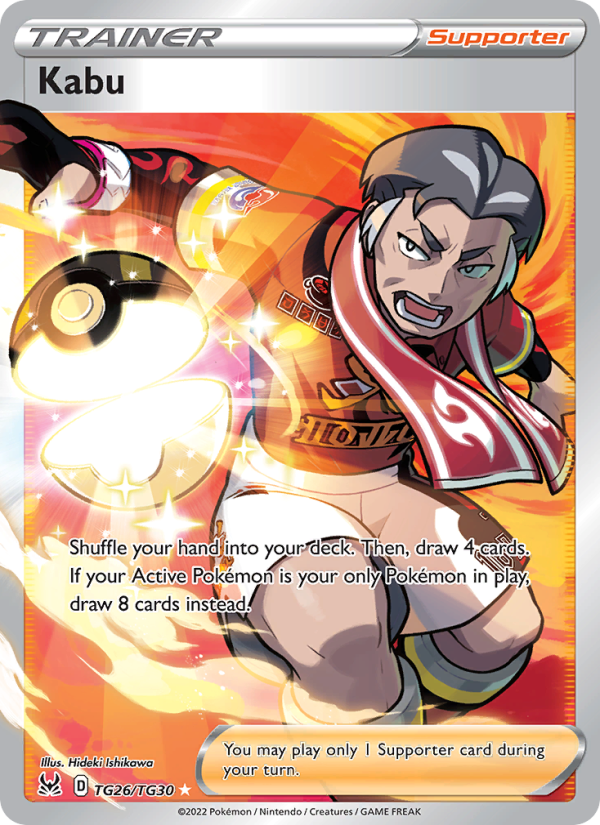
In the bustling ecosystem of the Pokémon TCG, a card that can reshape your hand and replenish your resources at the right moment is a golden asset. Kabu—a holo Ultra Rare Supporter from the Lost Origin set (swsh11, TG26)—delivers exactly that kind of flexibility. Its text, modest in appearance at first glance, unlocks a playground of tempo and resilience: Shuffle your hand into your deck. Then, draw 4 cards. If your Active Pokémon is your only Pokémon in play, draw 8 cards instead. This simple effect becomes a powerful engine when you pair it with the right deck architecture. ⚡🔥
Named with a nod to the Fire Gym Leader of the Galar region, Kabu evokes a strategic mindset: recalibrate, reset, and strike again. The holo treatment in Lost Origin makes it not only a utility piece for faced-paced strategies but also a collectible jewel for fans who appreciate the intersection of gameplay and lore. The card’s rarity—Ultra Rare—signals its relative scarcity and potential appeal to players who enjoy stacking a few prized trainer staples into their expanded decks. 🎴
Why it shines in aggressive (aggro) builds
- Resource reset on demand: Aggro decks hinge on clocking damage and maintaining pressure. When your hand brims with dead draws or you’re staring at a brick, Kabu lets you shuffle away clutter and redraw a fresh set of options, often yielding the exact attacker or trainer you need to keep the tempo going.
- 8-card draw potential in one-Pokémon scenarios: In some lean, single-attacker archetypes, your Active Pokémon is indeed your lone soldier. In those moments, Kabu’s line—draw 8—becomes a robust engine, helping you recover from a tight start and push forward with a more reliable follow-up turn.
- Consistency in uncertain matchups: Aggro mirrors frequently hinge on sequence and resource availability. The ability to shuffle your hand into the deck and draw anew adds a layer of strategic resilience—enabling you to weather a setback and reestablish momentum with the right set of Pokémon and tools.
Why it shines in control-oriented decks
- Refreshing your hand after disruption: Control strategies often weather a volley of disruption—removal, hand disruption, and tempo shifts. Kabu buys you a clean slate, letting you rebuild with purpose rather than guessing at what you’ll top-deck next.
- Steady, consistent draw under pressure: Even when you’re behind on the battlefield, drawing 4 (or 8 in the single-Pokémon scenario) helps you stabilize and return to a controlled game plan. This is especially valuable in Expanded formats where a broader toolkit increases the chances you’ll find the exact answer you need to stem the tide.
- Synergy with broader draw ecosystems: Kabu complements other draw engines common in control lists—supporters, item searches, and Stadiums—creating a rhythm where you can cycle back into your core control suite rather than flailing for the next piece.
Practical tips for maximizing Kabu in your 60-card build
- Play it with intention: Because Kabu is a Supporter, you’ll want it to pay off when your hand contains enough live options. Avoid unnecessary shuffles if you already hold the exact combo pieces you need. Use Kabu when you’re ready to draw into targeted threats or crucial disruption tools.
- Balance with other draw-power: In aggro, you might pair Kabu with fast draw engines to keep a steady hand size while pushing early damage. In control, stack Kabu alongside other draw cards to ensure you can refill quickly after spending a full hand to answer the board.
- Plan around the expansion of available Pokémon: Remember that the draw effect scales with the number of Active Pokémon. If you’re leaning into multiple attackers, you’ll often sketch a safer draw of 4. If you’re leaning into a one-Pokémon powerhouse, you unlock the more generous 8-card draw, which can turn a brick into a burst of strategy solver on a single turn.
- Format awareness: Kabu is Expanded-legal and not standard-legal in all rotations, so keep an eye on the regulation marks and your local tournament rules. The card’s holo identity adds flair to your binder and your table talk. 🃏
Card data snapshot and market context
Lost Origin introduced Kabu as a Trainer—Supporter with the following core details: category Trainer; id swsh11-TG26; rarity Ultra Rare; set Lost Origin; holo variant; regulation mark D; Expansion legality in Expanded. The card’s effect—shuffle your hand into your deck, then draw 4 (or 8 if your Active Pokémon is the only Pokémon in play)—is the heart of its strategic value. The holo treatment enhances its visual appeal on the table and in your binder, making it a favorite among collectors who value both playability and aesthetics.
Market insights provide a practical angle for collectors and players thinking about investment and resale. As of late 2025, CardMarket data shows an average price around 1.89 EUR for standard holo copies, with a low of about 0.99 EUR and a trend around 1.75 EUR. Short-term price movement (avg1, avg7, avg30) suggests modest but steady interest, with one-offs pushing higher depending on demand and local meta shifts. For players, these figures mean Kabu holo copies remain accessible while still offering a tasteful investment piece for binder collections. 💎
Attack on flavor and lore
Beyond the numbers, Kabu conjures the flavor of strategic recalibration—an invitation to read the battlefield, anticipate your opponent’s moves, and pivot with precision. The card’s name and aura nod to the Galar Fire Gym Leader, evoking a narrative of control, temperature of battle, and the warmth of a well-timed comeback. The artwork—captured in Lost Origin’s vibrant holo—invites the player to imagine a scenario where a seasoned trainer steadies the ship, guiding a deck back to tempo with a deft shuffle and a well-timed draw. 🎨
If you’re adding a functional and collectible trainer to your Lost Origin lineup, Kabu offers a flexible payoff that rewards thoughtful timing and disciplined deck-building. It’s a reminder that even in an era of high-damage attackers and powerful evolutions, the simplest tool—Refresh, then redraw—can be the difference between a bricked hand and a flawless sequence that seals the game.
Neon Phone Case with Card Holder MagSafe Card StorageMore from our network
- https://blog.digital-vault.xyz/blog/post/hot-blue-white-star-guides-milky-way-spiral-arms/
- https://101-vault.zero-static.xyz/e2b34a25.html
- https://blog.digital-vault.xyz/blog/post/fatal-push-meets-greek-mythology-in-mtg/
- https://transparent-paper.shop/blog/post/stable-diffusion-xl-prompt-vector-art-flat-design-neon-glow-desert-noir-khaki-obsidian-palette/
- https://blog.rusty-articles.xyz/blog/post/bruse-tarl-roving-rancher-parody-vs-serious-mtg-art/
Kabu
Set: Lost Origin | Card ID: swsh11-TG26
Card Overview
- Category: Trainer
- HP:
- Type:
- Stage:
- Dex ID:
- Rarity: Ultra Rare
- Regulation Mark: D
- Retreat Cost:
- Legal (Standard): No
- Legal (Expanded): Yes
Description
Pricing (Cardmarket)
- Average: €1.89
- Low: €0.99
- Trend: €1.75
- 7-Day Avg: €2.09
- 30-Day Avg: €1.85
Support Our Decentralized Network
Donate 💠More from our network
- https://blog.digital-vault.xyz/blog/post/hot-blue-white-star-guides-milky-way-spiral-arms/
- https://101-vault.zero-static.xyz/e2b34a25.html
- https://blog.digital-vault.xyz/blog/post/fatal-push-meets-greek-mythology-in-mtg/
- https://transparent-paper.shop/blog/post/stable-diffusion-xl-prompt-vector-art-flat-design-neon-glow-desert-noir-khaki-obsidian-palette/
- https://blog.rusty-articles.xyz/blog/post/bruse-tarl-roving-rancher-parody-vs-serious-mtg-art/