
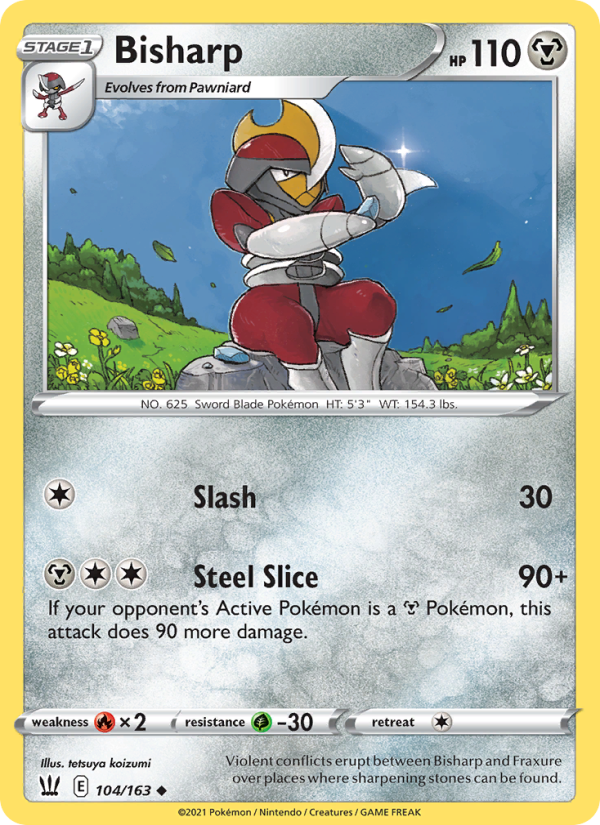
Image courtesy of TCGdex.net
Why Japanese Bisharp Cards Look Visibly Different in the TCG
For many Pokémon TCG fans, the moment you spot a Japanese Bisharp swsh5-104 on a sleeved table is the moment you notice something visually distinct. The metal-clad swordsman seems to carry a slightly different aura in Japanese printings compared to its English counterpart, and the differences go beyond language alone. As collectors chase holographic sparkles and as players map out field setups, understanding these visual variances helps explain why certain cards feel more “Japanese” in one print and more “international” in another. ⚡🔥
At the heart of Bisharp is a compact, strategic package: a Stage 1 Metal-type from the Battle Styles block, with 110 HP and two timely attacks. The card is illustrated by Tetsuya Koizumi, whose clean lines and action-forward composition bring Bisharp’s disciplined menace to life. The first attack, Slash, costs a Colorless energy and deals a reliable 30 damage—cheap pressure to wear down a swelling opponent. The second, Steel Slice, costs Metal + Colorless + Colorless and inflates damage to 90+—but only if your foe’s Active Pokémon bears Metal type as well. In practice, that means Bisharp can swing hard when the matchups align, while also showcasing the careful risk-reward calculus that defines many Japanese prints. The card’s weakness to Fire (×2) and resistance to Grass (−30) rounds out its battlefield identity, with a modest Retreat Cost of 1 that keeps it nimble on the bench as you set up Pawniard’s evolution to Bisharp.
“The blade shines through the artwork, not just in the knife’s edge but in how Koizumi captures the moment of impact—the moment a plan becomes a strike.”
What visually sets Japanese printings apart?
- Typography and language: Japanese text requires a different set of font treatments, line breaks, and spacing. The result is a slightly denser text box and a different rhythm to how moves and abilities read at a glance. This can create a different first impression of card readability during play and an alternate aesthetic for collectors who enjoy the cadence of Japanese wording.
- Artwork and layout choices: Even with the same artist and creature, the layout for Japanese releases often emphasizes different margins, symbol placement, and set logos. The Battle Styles era, with its distinctive set symbol and card back design, can appear more compact on Japanese cards, while English printings may feel more expansive due to formatting choices.
- Holo and reverse-holo presentation: Japanese print runs frequently feature their own foil patterns or distribution in both normal and reverse-holo variants. The appearance of a reverse-holo Bisharp, for instance, can present a different foil texture and color shift compared to its international counterpart, contributing to the “look” that fans identify as distinctly Japanese.
- Rarity indicators and set marks: The rarity symbol and the Battle Styles set emblem on Japanese cards follow their own design language, which some collectors find more angular or crisp in person. This can subtly influence perceived value and collectibility, especially for Uncommon cards like Bisharp swsh5-104.
- Foil distribution and card stock: Print quality varies by region and by print run. Japanese cards may use slightly different stock and foil deposition, which can affect how a card catches light and how deeply the artwork is embedded in the foil. The result is a tactile and visual nuance that many players notice when comparing a Japanese Bisharp to an English Bisharp.
These visual shifts aren’t just cosmetic; they subtly shape how players plan decks and how collectors curate their binders. A Japanese Bisharp’s crisp text presentation can feel more “tactical” on the table, while an English print might emphasize bold iconography and a broader foil glow in display cases. The interplay between language, layout, and foil is a reminder that Pokémon TCG printing is a global collaboration with region-specific artistry driving unique experiences. 🎨🎮
Card data as a guide to play and collect
Understanding the card’s mechanics helps bridge the gap between the artistry and the table. Bisharp swsh5-104 is a Metal type with 110 HP, evolving from Pawniard. Its Stage 1 evolution marks a common ladder in Battle Styles—mid-game presence with a blend of offense and tempo. On the battlefield, Slash offers a quick ping, while Steel Slice demands a certain rhythm: if your opponent leans into Metal, you can push a decisive 180 total damage (90+ from Steel Slice plus earlier hits) with the right setup. This reinforces a broader strategy of timing and type matchups that Japanese printings quietly support through their text clarity and compact card faces. The card’s Fire weakness and Grass resistance create a familiar but important tactical balance when swinging between heat and hedges in the meta.
Market data from recent years shows the typical price split between non-holo and holo variants, with non-holo Bisharp often sitting in the sub-€0.05 range on CardMarket (average around €0.04, with fluctuations) and holo versions commanding higher values due to rarity and foil appeal (average around €0.23 or more in active markets). In USD terms, TCGPlayer entries reflect modest-to-steady demand for common to uncommon cards—often a reliable entry point for new players and a charming target for collectors chasing set completion. As with many Binoculars-on-a-bootstrapped-market items, pricing trends swing with print runs, reprints, and the pulse of older set collectability. The contrast between the two worlds—visual identity and practical value—offers a fascinating lens into how Japanese printings can influence both gameplay decisions and long-term investment narratives. 💎
Why the art and its illustrator matter to fans
Tetsuya Koizumi’s signature touch on Bisharp brings a sense of disciplined motion and lethal efficiency to the card’s composition. The depiction of Bisharp with its blade-like appendages, set against a restrained background, echoes the character of the Pokémon: precise, calculating, and relentless in pursuit of sharpening stones and territory. The Japanese print’s emphasis on line precision and color balance can make Koizumi’s work feel especially tactile, inviting fans to study the blade’s gleam and the stance’s narrative tension. This artistry becomes part of the card’s story—an artifact that fans can admire beyond table-top dynamics. ⚔️
Putting it all together for collectors and players
Choosing between Japanese and English Bisharp printing isn’t just about price or rarity; it’s about the sensory experience and the collectible journey. The swsh5-104 card embodies a moment when design choices, play mechanics, and market sentiment intersect. The metal theme, the stage evolution, and the dual-attack dynamic make Bisharp a reliable mid-game pivot, especially in decks that prize pivot turns and shock damage. For players, paying attention to the Steel Slice condition—especially when facing Metal-types—can turn a simple setup into a momentum swing. For collectors, the Japanese print offers a crisp visual language, a piece of Koizumi’s artistry in a distinct regional presentation, and a reminder that even familiar creatures can arrive with a new coat of compelling polish. ⚡🎴
Phone Grip Click-On Universal KickstandMore from our network
- https://crypto-acolytes.xyz/blog/post/nft-stats-bagyo-176-from-bagyo-collection/
- https://transparent-paper.shop/blog/post/stable-diffusion-xl-prompt-dieselpunk-noir-neon-glow-rubberized-texture-terracotta-seafoam-palette-monolith-iconography-glow-macro/
- https://articles.digital-vault.xyz/blog/post/final-fantasy-tactics-development-timeline-explained/
- https://wiki.digital-vault.xyz/wiki/post/pokemon-tcg-stats-venusaur-card-id-ex14-28/
- https://crypto-acolytes.xyz/blog/post/nft-stats-b1828-from-b33-collection/
Bisharp
Set: Battle Styles | Card ID: swsh5-104
Card Overview
- Category: Pokemon
- HP: 110
- Type: Metal
- Stage: Stage1
- Evolves From: Pawniard
- Dex ID: 625
- Rarity: Uncommon
- Regulation Mark: E
- Retreat Cost: 1
- Legal (Standard): No
- Legal (Expanded): Yes
Description
Violent conflicts erupt between Bisharp and Fraxure over places where sharpening stones can be found.
Attacks
| Name | Cost | Damage |
|---|---|---|
| Slash | Colorless | 30 |
| Steel Slice | Metal, Colorless, Colorless | 90+ |
Pricing (Cardmarket)
- Average: €0.04
- Low: €0.02
- Trend: €0.07
- 7-Day Avg: €0.05
- 30-Day Avg: €0.04
Support Our Decentralized Network
Donate 💠More from our network
- https://crypto-acolytes.xyz/blog/post/nft-stats-bagyo-176-from-bagyo-collection/
- https://transparent-paper.shop/blog/post/stable-diffusion-xl-prompt-dieselpunk-noir-neon-glow-rubberized-texture-terracotta-seafoam-palette-monolith-iconography-glow-macro/
- https://articles.digital-vault.xyz/blog/post/final-fantasy-tactics-development-timeline-explained/
- https://wiki.digital-vault.xyz/wiki/post/pokemon-tcg-stats-venusaur-card-id-ex14-28/
- https://crypto-acolytes.xyz/blog/post/nft-stats-b1828-from-b33-collection/