
Image courtesy of TCGdex.net
Houndour’s Edge in Niche Matchups: Quick, Calculated, and Hard to Ignore
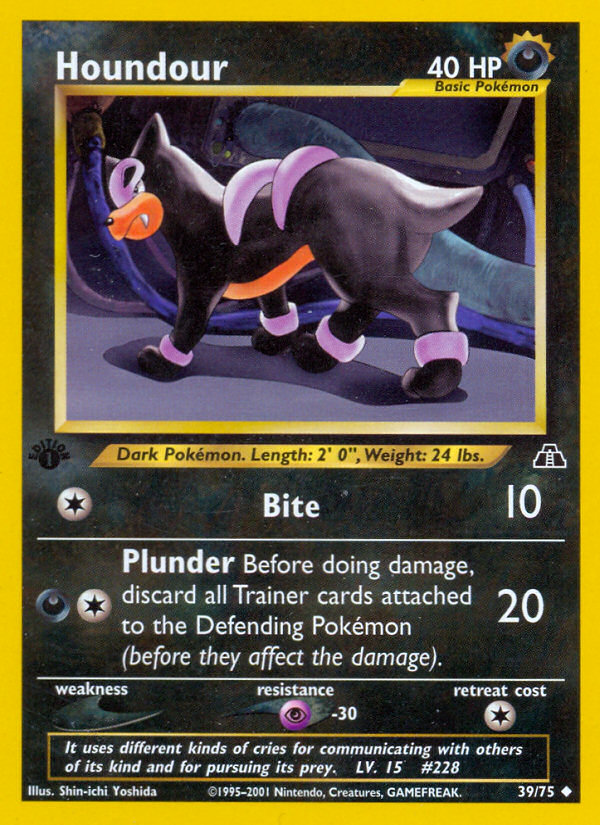
In the bustling landscape of the Neo Discovery era, a small, scrappy Dark-type like Houndour could punch above its weight in the right matchups. This basic Pokémon packs a two-pronged toolkit that feels simple on the surface but rewards strategic play when you read the board correctly. With a sturdy 40 HP (for its time) and a pair of straightforward attacks, Houndour becomes a disruptive irritant to opponents who lean on Trainer cards to power up or stabilize their plans. Its flavor is a blend of nimble aggression and mini-control, a combination that shines when you can force your opponent to adapt mid‑game.
Its attacks lay out the blueprint for how to leverage tempo in a field crowded with evolving strategies. Bite costs Colorless and delivers 10 damage—a modest number, but in the early turns it pressures weaker threats and sets up your next moves. The more interesting option is Plunder, which costs Darkness and Colorless for 20 damage—but it carries a potent precautionary twist: before dealing damage, you discard all Trainer cards attached to the Defending Pokémon. That conditional disruption can derail an opponent’s setup, removing key draw power, search abilities, or acceleration tools just as they’re about to bear fruit. In a format where Trainers often drive the engine, removing them before the hit lands is a subtle, effective form of control.
From a strategic perspective, Houndour excels in matchups where your opponent relies on Trainer-driven consistency. Think decks that search for supporters, attach extra tools, or pivot their plan with quick Trainer play—Houndour’s Plunder hits, then a follow-up Bite or a quick evolution swing, forcing your opponent to reconfigure their approach. The card’s Darkness typing also opens doors to synergy with other Dark-type or energy-discard themes you might encounter in vintage lineups, where the tempo swing from a single Plunder can snowball into a favorable exchange. And while the HP is a modest 40, that isn’t just a liability—it’s a reminder that Houndour is a tempo creature, designed to score quick prizes when paired with careful chip damage and an eye toward your evolutions.
“In the right hands, Houndour is a one-card disruption engine. Plunder doesn’t just deal damage; it reshapes the opponent’s plan by whittling away their toolkit.”
Speaking of evolutions, the card’s lineage matters for both strategy and collection. Houndour evolves into powerful Dark-type lines in later generations, and while Neo Discovery presents a snapshot of the game’s early era, imagining the path from Houndour to its bigger forms can inform how you picture this card’s value in a constructed or casual nostalgia deck. The artistry—courtesy of Shin-ichi Yoshida—captures a moody, nocturnal vibe that fits the Dark-type theme and evokes the era’s moody, mystery-filled storytelling. The artwork isn’t just pretty; it’s a reminder of a time when the game balanced simplicity with deep, strategic potential.
Card data snapshot — a quick reference for collectors and players alike: Houndour is a Basic Darkness-type Pokémon with the Neo Discovery set (Neo2). It carries the rarity tag of Uncommon and appears in first-edition printings, which are especially coveted by collectors. The illustrator credited for the art is Shin-ichi Yoshida. In terms of in-game stats, Houndour has 40 HP, two attacks (Bite for 10, Plunder for 20 with the Trainer-discard effect), and a Psychic resistance of -30. While this card is not legal in standard or expanded formats today, it sits as a charming historical piece that demonstrates how early Trainers built tempo-based games around small, nimble attackers.
For collectors, the Neo Discovery era remains a magnet for nostalgia and price variation. CardMarket data shows an average around the mid-30 EUR range for this card in certain editions, with a low around 8.9 EUR and a trend nudging back toward the mid-30s over time. On TCGPlayer, the first-edition variant often commands a higher premium; unlimited copies exist at a wide range of prices, reflecting both edition scarcity and the broader nostalgia market. This volatility is part of the charm of vintage Pokémon TCG collecting: a card like Houndour merges historical playstyle with the allure of first-edition rarity and the enduring curiosity of card art and lore.
When you pair these insights with the broader collector culture, Houndour becomes more than a curiosity. It’s a bridge between a compact battlefield presence and a story about how early players imagined the power of a simple Dark-type creature who could steal the tempo with a single Trainer kill. And even though modern formats have evolved far beyond Neo Discovery’s confines, the card retains a special, enduring glow for fans who remember the thrill of those first few turns when Plunder could decide the outcome of a round.
From niche strategy to collector value: why Houndour matters
In practice, your decision to include Houndour in a historical or nostalgia-focused deck rests on two pillars: an appreciation for the strategic bite of Plunder and the joy of flipping through a beautifully illustrated card that symbolizes an era. The card’s 40 HP means your plan is not to dominate in raw durability but to orchestrate a sequence—activate Plunder when it pins down a Trainer-dependent opponent, then capitalize on the confusion that follows. The energy costs are modest and typical of early formats, making it a feasible tempo sprite to deploy early in a game while you assemble your longer-term plan. And if you’re a collector who loves the look and lore of Shin-ichi Yoshida’s work, this card offers a tangible piece of history with a distinctly retro glow.
To bring this into a modern lens, imagine a hypothetical vintage-reimagined deck where Houndour serves as a one-turn disruption pivot while you set up a stronger Beasts or Dark-line backbone. It’s a game of contrasts: a tiny frame delivering a loud disruption, a reminder that sometimes the smallest creatures carry the biggest strategic weight when the conditions are right. ⚡🔥💎
For readers who want to explore more about the broader scene—how Meltan profiles, NFT-styled lore, and other digital-era discoveries intersect with Pokémon card culture—check the linked articles in our network. Each piece offers its own angle on statistics, lore, and market dynamics that help paint a richer picture of how this hobby grows and changes over time.
Product spotlight — If you’re looking for a practical way to carry your essentials while you dive into battles and lore, consider the Phone Case with Card Holder — Slim, Impact Resistant. It’s a handy companion for fans who commute to tournaments or browse card catalogs in comfort. Get yours today at the link below:
Phone Case with Card Holder — Slim, Impact Resistant
More from our network
Houndour
Set: Neo Discovery | Card ID: neo2-39
Card Overview
- Category: Pokemon
- HP: 40
- Type: Darkness
- Stage: Basic
- Dex ID: 228
- Rarity: Uncommon
- Regulation Mark: —
- Retreat Cost:
- Legal (Standard): No
- Legal (Expanded): No
Description
Attacks
| Name | Cost | Damage |
|---|---|---|
| Bite | Colorless | 10 |
| Plunder | Darkness, Colorless | 20 |
Pricing (Cardmarket)
- Average: €33.43
- Low: €8.9
- Trend: €33.76
- 7-Day Avg: €31.49
- 30-Day Avg: €32.05
Support Our Decentralized Network
Donate 💠More from our network
- https://wiki.digital-vault.xyz/wiki/post/pokemon-tcg-stats-meltan-card-id-sv05-179/
- https://cryptoacolytes.zero-static.xyz/89db0b68.html
- https://crypto-acolytes.xyz/blog/post/canelcorn26-canelcorn-pfp-nft-stats/
- https://transparent-paper.shop/blog/post/stable-diffusion-xl-prompt-neon-noir-liquid-light-cyberpunk-glow-prismatic-glow-art-high-contrast/
- https://blog.crypto-articles.xyz/blog/post/bibarels-ancient-ruins-exploring-pokemon-tcg-lore/