
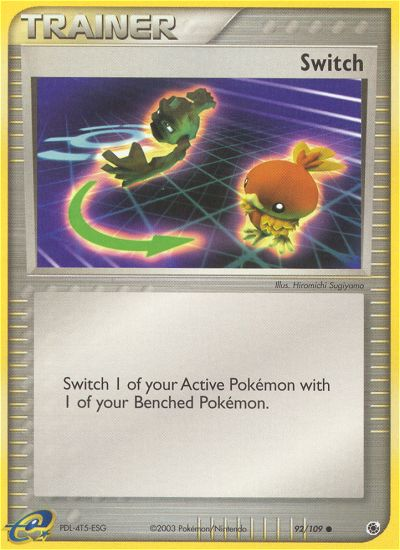
Image courtesy of TCGdex.net
Why this Switch card resonates with fans across generations
In the vast gallery of Trainer cards from the early days of the Pokémon TCG, some little staples outshine their modest rarity with sheer reliability and charm. The Switch card from the EX Ruby & Sapphire era—illustrated by Hiromichi Sugiyama—does exactly that. It’s a Common Item that every deck builder learned to love, not because it flashy‑reads like a powerhouse, but because it quietly changes the tempo of a match. ⚡ Fans of the game appreciate its elegant simplicity: swap your active Pokémon with a benched partner, instantly repositioning your battlefield and opening tactical options that feel almost like a game within the game.
Created during the Ruby & Sapphire chapter, Switch sits as a signpost of an era when players learned to value tempo and positioning just as much as raw power. The card’s design is unassuming, but the impact is enduring. It’s a reminder that the best tools in Pokémon TCG aren’t always the ones that deal the most damage—they’re the ones that reshape the board at the exact moment you need it most. For collectors, the familiarity of its art by Hiromichi Sugiyama—the bold lines and vibrant palette of the EX1 set—brings a sense of nostalgia that’s hard to replicate. 🎨
The gameplay magic of Switch
At its core, Switch is a straightforward "Item" trainer: Switch your Active Pokémon with one of your Benched Pokémon. That line might read as small, but in practice it unlocks a cascade of strategic possibilities. When a front-line Pokémon is running low on HP, you can retreat it for a fresh attacker without sacrificing a prize—a luxury that early matches often hinge on. In a format where attack costs, energy attachment, and retreat costs could drag the game into grinding stalemates, Switch provides a clean transition. It’s the kind of card that players memorize, because you don’t notice how often you need it until you find yourself reading the exact right moment to swap before the oppo’s next swing. 🔄
- Retreat without costs: If your best attacker is stuck or your board needs a quick pivot, Switch lets you reposition instantly.
- Protect a key matchup: Bring in a more favorable type or a sturdier pivot Pokémon to weather a difficult turn.
- Timing is everything: In the flow of a match, knowing when to switch can turn a losing battle into a narrow escape or a comeback.
- Deck-friendliness across eras: Its status as a Common in the Ruby & Sapphire era means many players held onto copies, contributing to its ubiquitous presence in vintage lists.
- Printing variety adds character: The ex1 set features multiple variants—normal, reverse, and stamp versions—each with its own collector’s appeal.
For modern players, mentioning Switch often leads to conversations about tempo and control rather than big-stack combos. While it isn’t legal in Standard or Expanded today (as per the set’s era and the card’s official status), its legacy lives on in how it shaped deck-building norms. Fans recall the thrill of turning the tide with a single, perfectly timed swap, a moment that feels almost cinematic in a tabletop duel. 🔥
Collectibility, variants, and value in today’s market
Even though Switch is labeled Common, its journey through time has made certain prints surprisingly desirable. The base EX Ruby & Sapphire release presents as a reliable staple, but collectors often chase the more visually distinct variants. The set’s stamp versions—such as those bearing signatures from artists like Reed Weichler, Chris Fulop, Tsuguyoshi Yamato, and Kevin Nguyen—deliver a veneer of rarity that elevates their shelf appeal. For those who enjoy playing the long game with price trends, Switch offers a fascinating case study in how a simple, widely printed card can rise in collector value due to nostalgia and variant intrigue. 💎
Market data from CardMarket and TCGPlayer provides a snapshot of where Switch sits today. CardMarket lists the average around €0.17 with a low of €0.02, while the holographic or reverse-holo versions command higher figures, reflecting their rarity and desire among collectors. On TCGPlayer, normal (non-holo) copies trend around $0.38 on the mid-price, with market prices hovering near $0.39 and occasional spikes as collectors hunt for the classic look. The reverse-holo variant can climb into the several-dollar range, driven by demand for rarer prints and the general appeal of holo finishes on classic cards. These numbers remind us that even “common” cards can shimmer for collectors when the right print, copy, or nostalgia flickers into view. 📈
Art, lore, and the voice of the illustrator
Hiromichi Sugiyama’s work on Switch embodies the era’s appetite for bold, expressive character design. The Ruby & Sapphire era favored crisp lines and bright color blocks that pop on the table, and this Switch is no exception. The artwork captures a sense of motion and decision—the exact moment a trainer slides a Pokémon back into the bench or swaps to a new frontliner. While there isn’t a sprawling in-universe lore tied to individual Trainer cards in the same way as legendary Pokémon, Sugiyama’s signature style helps the card feel like part of a living world you can revisit in memory. The result is a card that’s not just playable, but beloved for its aesthetic cadence and the heritage it carries. 🎴
And for fans who love desk accessories as much as deck lists, the product tie-in here is a nice reminder that the TCG lifestyle extends beyond the card sleeves. If you’re keen to elevate your gaming space, consider a sturdy, comfortable mouse pad to pair with your nostalgia-driven setups—a small but meaningful way to honor the era while you plan your next vintage‑themed list. The option to combine this tactile joy with modern gear is a neat bridge between generations of Pokémon fans. ⚡
custom gaming mouse pad 9x7in neoprene stitched edgesMore from our network
- https://blog.digital-vault.xyz/blog/post/tracking-avacyn-guardian-angel-silver-border-price-volatility-across-sets/
- https://wiki.digital-vault.xyz/wiki/post/pokemon-tcg-stats-alolan-persian-gx-card-id-sm12-129/
- https://wiki.digital-vault.xyz/wiki/post/pokemon-tcg-stats-fighting-energy-card-id-ex16-108/
- https://crypto-acolytes.xyz/blog/post/nft-stats-nuddies-1397-from-nuddies-collection/
- https://transparent-paper.shop/blog/post/stable-diffusion-xl-prompt-cyberpunk-noir-comic-panel-holographic-texture-neural-gray-palette-dusk-blue-accents-halftone/
Switch
Set: Ruby & Sapphire | Card ID: ex1-92
Card Overview
- Category: Trainer
- HP:
- Type:
- Stage:
- Dex ID:
- Rarity: Common
- Regulation Mark: —
- Retreat Cost:
- Legal (Standard): No
- Legal (Expanded): No
Description
Pricing (Cardmarket)
- Average: €0.17
- Low: €0.02
- Trend: €0.2
- 7-Day Avg: €0.17
- 30-Day Avg: €0.15
Support Our Decentralized Network
Donate 💠More from our network
- https://blog.digital-vault.xyz/blog/post/tracking-avacyn-guardian-angel-silver-border-price-volatility-across-sets/
- https://wiki.digital-vault.xyz/wiki/post/pokemon-tcg-stats-alolan-persian-gx-card-id-sm12-129/
- https://wiki.digital-vault.xyz/wiki/post/pokemon-tcg-stats-fighting-energy-card-id-ex16-108/
- https://crypto-acolytes.xyz/blog/post/nft-stats-nuddies-1397-from-nuddies-collection/
- https://transparent-paper.shop/blog/post/stable-diffusion-xl-prompt-cyberpunk-noir-comic-panel-holographic-texture-neural-gray-palette-dusk-blue-accents-halftone/