
Image courtesy of TCGdex.net
Why does this attack define tempo in Pokémon TCG matches?
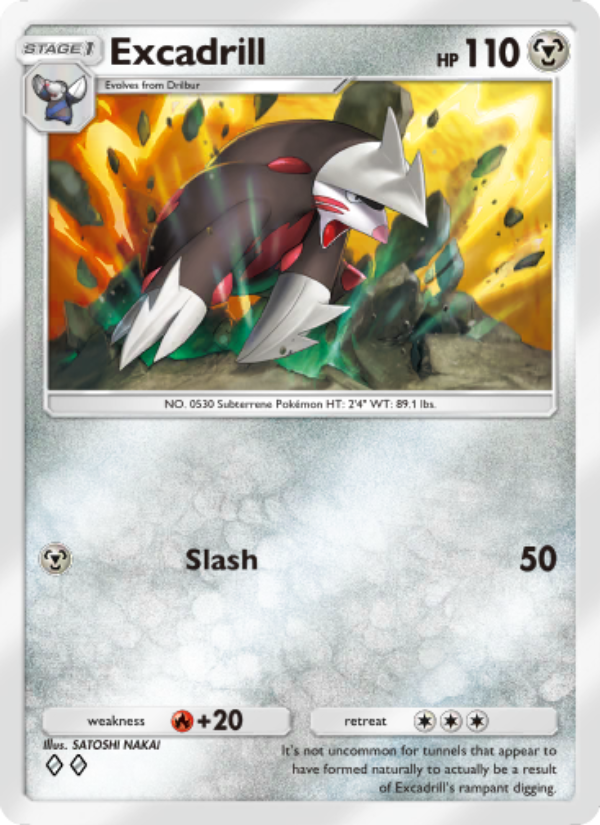
Tempo in the Pokémon TCG isn’t just about raw damage—it's a complex dance of energy attachment, board presence, and the pressure you apply on the opponent’s options. Excadrill, a Metal-type Stage 1 from the Celestial Guardians set, epitomizes how a single attack can shape the rhythm of a game. With 110 HP and an efficient, one-energy cost attack, Slash, Excadrill forces tempo decisions from turn to turn. The card’s design asks you to think about energy management, evolving timing, and how often you’re willing to trade a bench slot for early hand advantage. In a meta where big threats usually demand longer setups, Excadrill’s pressure is a reminder that speed—the ability to threaten meaningful damage quickly—remains a cornerstone of winning plays ⚡.
The attack Slash costs one Metal energy and delivers 50 damage. That’s a clean 50 for 1, which can translate into rapid bursts of damage across multiple turns, especially if you sequence your cards to keep Excadrill active on the field. The one-energy commitment is a key tempo lever: it’s affordable enough to threaten early knockouts or force your opponent to swing back with suboptimal trades, yet sturdy enough to survive a couple of turns thanks to its 110 HP. When you pair Excadrill with the evolution from Drilbur, you get a natural tempo ramp—invest energy on the board, evolve to your Stage 1, and begin applying sustained pressure. The tempo here isn’t just about offense; it’s about turning your bench into a tempo-generating engine, where each attachment compounds on the last turn to push toward a favorable endgame.
“In every tunnel lies a rhythm: dig once, strike twice, and keep the pace steady.”
Beyond the math, there’s a storytelling layer. Excadrill’s lore-friendly flavor—notable for those long tunnels the card’s description hints at—parallels how tempo emerges from consistent, predictable plays. You’re not simply throwing punches; you’re carving a path with each turn, shaping the battlefield so your opponent’s responses become increasingly fragile. The card’s Metal typing adds another dimension: it interacts with other Metal cards and tools that sometimes reduce attachment friction or smooth out energy acceleration, letting you sustain that tempo over several turns. And while Fire-type attackers pose a natural threat—Excadrill’s weakness reveals a soft point you must account for in your plan—the overall tempo strategy still centers on efficient energy use and calculated risk taking 🪨🔥.
Key stats that influence tempo on the table
- Cost and damage: Slash requires a single Metal energy and yields 50 damage, a solid early- to mid-game threat that rewards quick sequencing.
- HP and survivability: 110 HP gives Excadrill staying power against a range of early attacks, enabling you to keep the pressure while your deck cycles for the next piece.
- Retreat cost: A retreat of 3 means you’ll need to invest a little planning when you pull Excadrill back, adding to the tempo calculus—you’re balancing board presence with the risk of losing momentum if you’re forced to retreat too often.
- Evolution dynamic: Evolving from Drilbur into Excadrill creates a natural tempo ladder: you establish board presence with a Basic on turn one or two, then upgrade to a more threatening Stage 1 to amplify your pressure in subsequent turns.
- Weakness: Fire weakness (+20 damage from Fire threats) nudges you toward smarter matchups or protective plays, ensuring tempo isn’t squandered against the wrong opponents.
Deck-building with tempo in mind
Smart tempo-focused decks will favor Excadrill when paired with reliable energy acceleration and efficient draws. The Celestial Guardians framework already emphasizes dynamic, space-efficient plays, and Excadrill fits neatly into a game plan that wants to apply pressure while maintaining a lean energy curve. You’ll want to plan your bench so that Drilbur has a clear path to evolve, while keeping an active Excadrill ready to swing when the moment is right. Because the attacker’s power is bandwidth-friendly, you can press for successive 2-hit or 3-hit sequences, depending on what your opponent plays—without overcommitting energy beyond what you can sustain each turn. In practice, that means prioritizing consistent energy attachment, timely evolutions, and responsive plays to deny your opponent the tempo they’re chasing 🔧🎯.
Excadrill’s role in a metal-themed line can also pair well with other Celestial Guardians staples, potentially leveraging synergy with support Pokemon that help accelerate energy or draw through a watchful, tempo-aware game plan. The flavor of the set—cosmic guardians meeting earthy dig sites—translates nicely into a strategy where you’re constantly digging for the next efficient attach or the next evolution with minimal wasted turns. The result is a game that feels fast, confident, and in control, even when the opponent is trying to flip the tempo in their favor 💎🎴.
Art, stats, and the collector’s eye
Illustrator SATOSHI NAKAI brings a clean, kinetic style to Excadrill that echoes the card’s kinetic tempo. The holo variant amplifies the metallic sheen that tells you this creature thrives in engineered environments—the very kind of card you want in a collection if you’re chasing a cohesive Metal-type lineup. The rarity tag—Two Diamond—speaks to a special tier within Celestial Guardians, adding allure for collectors who want to balance playability with value. The set’s total card count (official 155, total 239) places Excadrill among a broad cohort of cards, but its ability to define tempo in practical games makes it a standout in many lists. For fans chasing a tactile reminder of why tempo matters, Excadrill is a memorable piece in the evolving chessboard of modern TCG strategy 🧭💎.
Market and value notes
In a game where tempo often translates to win probability, Excadrill’s 110 HP and efficient Slash keep it relevant as the meta shifts. The rarity and holo option can help maintain collectible interest while offering practical play value. As sets rotate and new Metal-type options appear, well-timed copies of Excadrill can retain demand among players who prize a dependable early-game attacker that scales into the mid-game with evolution. For collectors, the artwork by a renowned illustrator and the card’s holo variant offer two strong pull factors in addition to its mechanical utility.
If you’re looking to study tempo-inspired strategies outside of gameplay, consider checking broader discussions around how early momentum shapes matches, such as how some players use tempo to guide decision-making and deck construction. The five articles linked below provide a slice of the wider world where tempo, data, and strategy intersect across crypto, digital art, and science-inspired explorations — a reminder that tempo is a universal concept, not just a Pokémon tactic ⚡📈.
Rugged Phone Case - Tough Impact Resistant TPU PC ShieldMore from our network
Excadrill
Set: Celestial Guardians | Card ID: A3-119
Card Overview
- Category: Pokemon
- HP: 110
- Type: Metal
- Stage: Stage1
- Evolves From: Drilbur
- Dex ID:
- Rarity: Two Diamond
- Regulation Mark: —
- Retreat Cost: 3
- Legal (Standard): No
- Legal (Expanded): No
Description
It's not uncommon for tunnels that appear to have formed naturally to actually be a result of Excadrill's rampant digging.
Attacks
| Name | Cost | Damage |
|---|---|---|
| Slash | Metal | 50 |
Support Our Decentralized Network
Donate 💠More from our network
- https://wiki.digital-vault.xyz/wiki/post/pokemon-tcg-stats-silicobra-card-id-sv01-119/
- https://blog.crypto-articles.xyz/blog/post/nft-data-gib-3660-from-gib-collection-on-magiceden/
- https://transparent-paper.shop/blog/post/how-to-add-realistic-creases-to-digital-paper/
- https://crypto-acolytes.xyz/blog/post/nft-stats-jellylore-club3459-from-jellylore-club-collection/
- https://blog.digital-vault.xyz/blog/post/temperature-shapes-spectral-class-in-a-hot-blue-giant/