
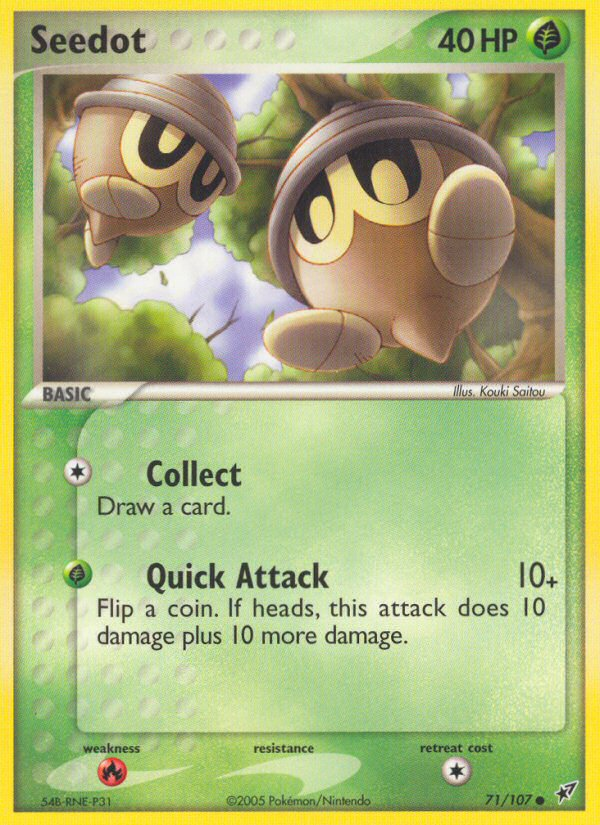
Image courtesy of TCGdex.net
Why Do Japanese Printings Differ Visually?
In the Pokémon TCG hobby, the visual language of cards tells a story just as engaging as the mechanics on the mat. Japanese printings have historically carved out a distinct aesthetic from their English-language counterparts, driven by design choices, printing technology, and market expectations in Japan. When you flip through a card like Seedot from the EX Deoxys era, you can feel the era’s artistry: the precise holo patterns, the set-logo stamp, and the subtle typography that distinguishes a Japanese holo from its international peers. These differences aren’t just cosmetic—they capture decades of production philosophy and collector culture.
Seedot in Focus: EX Deoxys (ex8-71)
Seedot, a Grass-type Basic Pokémon, arrives with a modest 40 hit points and a straightforward two-attack moveset. In the EX Deoxys era, Seedot’s card image is the work of Kouki Saitou, whose art brings a gentle, forest-floor charm to the character. The card is listed as Common, a parity you’ll notice in the modern Japanese printings that still celebrate accessibility for new players, while the holo variant (as noted in the detailed set information) adds a glimmering touch that can elevate a card’s visual appeal for collectors. In the ex8 set, the total card count sits at 107 official cards with a total of 108, signaling a robust printing window and a mix of reprints and fresh designs that Japanese sets often handled with care.
- Name: Seedot
- Set: EX Deoxys (ex8)
- HP: 40
- Type: Grass
- Stage: Basic
- Rarity: Common
- Illustrator: Kouki Saitou
- Attacks:
- Collect — Colorless to a card (draw a card)
- Quick Attack — Grass for 10+, with a coin flip to add 10 more on heads
- Weakness: Fire x2
- Variants: Normal and holo versions exist; holo often features a set-logo stamp on some print runs
Why might Japanese printings look different here? Two big reasons stand out. First, holo treatment and stamp usage varied by region and era. Japanese holo cards from the EX era often wore a distinctive holo pattern or a prominent set-logo stamp that could subtly shift the card’s sparkle. Second, typography and text layout were localized, with Japanese cards sometimes presenting the card name, type, and attack names in kanji or kana, alongside the English flavor text. These choices weren’t just about aesthetics—they reflected manufacturing workflows and the preferences of Japanese collectors, who prize certain holo textures and set insignia as markers of authenticity and era.
Visual Cues That Signal a Japanese Print
For Seedot ex8-71 and its peers, you can expect several telltale signs of Japanese printings versus English-language versions:
: The holo version may bear a stamp or a distinct holo pattern that aligns with the EX Deoxys wave. Collectors often chase these holo prints for their brighter sheen and the sense of rarity they convey—even for a common card like Seedot. - Set logo and border: Japanese printings sometimes feature a different border treatment or a primary set logo visible on holo cards. In EX Deoxys, this can translate into a more compact layout with the set symbol appearing alongside the card number, signaling the card’s lineage to discerning collectors.
- Typography and flavor text: Where the English version uses English text, Japanese printings may present localized text blocks. While these changes don’t alter gameplay—the Collect and Quick Attack effects remain the same—the visual rhythm of the card’s text is a signature of region and edition.
Gameplay Angles: Strategy and Value Across Regions
Seedot’s mechanics are timeless: a low-energy, draw-focused opening option with a reliable, if modest, Quick Attack that can stack a little extra damage with a coin flip. In practice, Seedot shines as a card that helps you navigate early-game tempo. Its Collect ability is a compact, low-cost way to accelerate card draw—handy in decks that want to stay refreshingly smooth without burning rare resources. Quick Attack introduces a bit of risk-reward drama: a 10-damage baseline that can become more punishing with favorable coin flips, especially if you’re leveraging Grass-energy acceleration or evolving into Nuzleaf for more robust Tempo later on. From a collector’s vantage point, the Japanese print’s visual identity can influence both perceived rarity and market interest. While Seedot is Common, the holo version—often with a distinctive stamp or texture—tends to command a premium relative to its non-holo cousin. It’s a reminder that in the world of card values, visual variant and print run matter as much as official rarity.
Market notes pulled from contemporary listings suggest holo Seedot ex8-71 cards generally carry higher price signals than non-holo copies. CardMarket shows holo variants with a broader price spectrum and occasional spikes, while non-holo copies tend to sit near the lower end of the scale. TCGPlayer data reinforces this: normal (non-holo) Seedot sits in modest territory, with holo versions often trading at a notable premium. If you’re building a collection that respects both gameplay history and visual storytelling, tracking these prints across regions adds an extra layer of depth to your hobby.
Collecting Insight: Keeping a Balanced Perspective
For modern players and seasoned collectors alike, Seedot ex8-71 offers a snapshot of how Japanese printings contribute to the broader tapestry of the Pokémon TCG. The card’s illustration by Kouki Saitou—paired with the grass-tinged charm of Seedot—reminds us that even common Pokémon carry a distinct personality when printed in a certain era. The existence of a holo variant, the set’s logo treatment, and the card’s place within the ex8 Deoxys release all contribute to a narrative about production practices, distribution, and consumer culture in Japan during that period. The collecting journey becomes a blend of gameplay memory and aesthetic appreciation: the way light catches the holo, the weight of a well-centered card, and the thrill of finding a perfect print in a charity shop or a dedicated binder raid.
Pricing Snapshot: A Quick Guide
Current market data paints a clear picture: non-holo Seedot ex8-71 tends to sit at modest levels—often around a few tenths of a euro or a few handful of cents in online markets. The holo variant, by contrast, can fetch higher prices due to demand for shine and the allure of a distinct set insignia. CardMarket’s holo “avg-holo” benchmarks sit higher than the non-holo average, while the general holo trend shows spikes that reflect collector interest in EX Deoxys-era prints. TCGPlayer’s listings mirror this dynamic: normal copies hover in the sub-$1 range, whereas reverse-holo or holo versions can see meaningful bumps, occasionally stretching into multiple dollars depending on condition and supply. Always check the latest listings for the most accurate snapshot, since prices swing with market mood and tournament season waves. ⚡
Neon Custom Desk Mouse Pad Rectangular 3mm Thick Rubber BaseMore from our network
- https://blog.crypto-articles.xyz/blog/post/nft-data-lightios-437-from-lightios-collection-on-magiceden/
- https://transparent-paper.shop/blog/post/stable-diffusion-xl-prompt-glitch-art-graffiti-neon-noir-samurai-cinema-low-poly-neural-gray-azure/
- https://crypto-acolytes.xyz/blog/post/nft-stats-midevil-4865-from-midevils-collection/
- https://crypto-acolytes.xyz/blog/post/nft-stats-nuked-ape-23-from-nuked-world-apes-collection/
- https://crypto-acolytes.xyz/blog/post/nft-santa-regina-2027-849-nft-santa-regina-2027-nft-stats/
Seedot
Set: Deoxys | Card ID: ex8-71
Card Overview
- Category: Pokemon
- HP: 40
- Type: Grass
- Stage: Basic
- Dex ID: 273
- Rarity: Common
- Regulation Mark: —
- Retreat Cost:
- Legal (Standard): No
- Legal (Expanded): No
Description
Attacks
| Name | Cost | Damage |
|---|---|---|
| Collect | Colorless | |
| Quick Attack | Grass | 10+ |
Pricing (Cardmarket)
- Average: €0.15
- Low: €0.02
- Trend: €0.32
- 7-Day Avg: €0.17
- 30-Day Avg: €0.14
Support Our Decentralized Network
Donate 💠More from our network
- https://blog.crypto-articles.xyz/blog/post/nft-data-lightios-437-from-lightios-collection-on-magiceden/
- https://transparent-paper.shop/blog/post/stable-diffusion-xl-prompt-glitch-art-graffiti-neon-noir-samurai-cinema-low-poly-neural-gray-azure/
- https://crypto-acolytes.xyz/blog/post/nft-stats-midevil-4865-from-midevils-collection/
- https://crypto-acolytes.xyz/blog/post/nft-stats-nuked-ape-23-from-nuked-world-apes-collection/
- https://crypto-acolytes.xyz/blog/post/nft-santa-regina-2027-849-nft-santa-regina-2027-nft-stats/