
Image courtesy of TCGdex.net
Strategic edge in a classic era: what makes Dark Alakazam tick
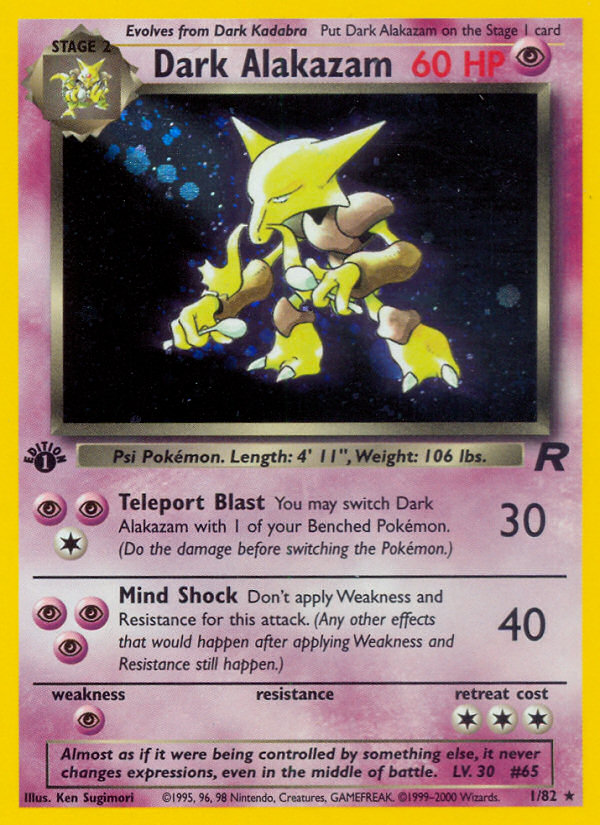
For fans who grew up with the Team Rocket era of the Pokémon Trading Card Game, Dark Alakazam sits at a fascinating crossroads of nostalgia and tactical depth. This Psychic-type Evolution from Kadabra enters the fray as a Rare holo from the base set’s dark-aligned branch, carrying a pair of surprisingly flexible attacks and an agility-forward vitality that many red-inked favorites simply didn’t offer in equal measure. With 60 HP, a Stage 2 evolution lineage, and the striking Ken Sugimori artwork that adorns its holoprint, Dark Alakazam embodies the era’s design philosophy: risk and calculation, not brute force, often won the day.
Card snapshot: the essentials that shape its performance
- Set: Team Rocket (base5)
- Rarity: Rare
- Stage: Stage 2 (evolves from Kadabra)
- HP: 60
- Type: Psychic
- Illustrator: Ken Sugimori
- Attacks:
- Teleport Blast — Cost: Psychic, Psychic, Colorless. Deal 30 damage and you may switch Dark Alakazam with 1 of your benched Pokémon after the attack resolves. This is a versatile pivot tool that can shape the board state while applying steady pressure.
- Mind Shock — Cost: Psychic, Psychic, Psychic. Deal 40 damage. Importantly, this attack’s effect says you don’t apply Weakness and Resistance for this attack, which creates a predictable floor of damage across many matchups, even when counterplay would normally hinge on type advantages.
- Weakness: Psychic x2
Why it can find a home in the right decks
Dark Alakazam’s true strength lies in how its two attacks interact with the flow of a match. Teleport Blast gives you a planned retreat and a chance to reconfigure your board after each exchange. In practical terms, you can deliver a solid 30 damage and then swap Dark Alakazam out for a fresh attacker on the bench—keeping your offensive threat alive while mitigating the risk of being knocked out in a single hit. That pivot capability was a big deal in slower, energy-light metas where players valued tempo and positioning as much as raw damage.
Mind Shock’s damage output is respectable for a Stage 2 from that era, and the notable caveat—no Weakness or Resistance calculations for this attack—can occasionally yield a reliable, symmetrical result against a range of opponents. Although Dark Alakazam is not a behemoth on the battlefield, its combination of a pivoting playstyle and a consistent, if modest, damage line made it a favorite in decks seeking balance between offense and board control. The card’s high-art holo presentation only amplified its presence on the table, encouraging players to experiment with its timing and bench management as part of a broader strategy. ⚡
Matchups, pacing, and deck-building implications
In a deck that aims to outmaneuver opponents rather than simply out-hit them, Dark Alakazam shines when paired with other Pokémon that help pressure the opponent while you keep your options open. The 60 HP stat is a reminder that positioning matters: Dark Alakazam can threaten important targets, but you’ll want to respect the risk of a fast knockout from stronger attackers. The Mind Shock damage floor makes it a steady option for softening mid-HP foes or trading efficiently in late game, especially when your bench carries reliable pivots or “follow-up” attackers ready to step in after a Teleport Blast swap.
Historically, many players built around the idea that a disciplined pivot could control the tempo of a match, forcing opponents to commit to over-committing early or to spread their resources thin. The balance between Teleport Blast’s repositioning and Mind Shock’s consistent 40 damage creates a mid-range profile that some meta decks found surprisingly effective, especially when paired with supportive Trainer cards from that era—a common approach for players who valued careful resource management over heavy power blocks. 🎴
Collector insights and market outlook
Beyond gameplay, Dark Alakazam holds a significant place in collectors’ hearts. As a holo Rare from the Team Rocket set, first-edition copies carry a premium that’s reflected in current market activity. CardMarket data shows a broad spread: low prices can dip into the low tens of euros, while averages hover around the mid-range with holo copies trending higher. In the U.S. market, TCGPlayer entries for 1st Edition holo copies have shown market prices commonly in the range of well over $100, with direct-offer prices fluctuating based on condition and printing quality. Unlimited holo printings, while more accessible, still command notable attention from detractors who chase nostalgia or complete-collection goals. The collector’s market underscores why Dark Alakazam remains a notable piece of a vintage Psychic lineup—its artwork, rarity, and historical role all contribute to a durable premium. 💎
For modern players curious about value as part of a broader investment mindset, the card’s value trajectory typically aligns with its rarity and nostalgic appeal. While it isn’t a staple in today’s legal formats, its presence on the table in retro-style challenges or curated decks can feel timeless, a reminder of the strategic elegance that defined early Pokémon TCG design. 🔮
Practical tips for builders today
- Accept the tempo trade-off: don’t expect two-turn KO lines every time; use Teleport Blast to position your threat, then capitalize with Mind Shock when opponents are forced to react.
- Keep bench discipline: ensure you have dependable benched Pokémon ready for a swap-in when Teleport Blast is used. A cautious bench rotation keeps you from funneling damage onto a fragile Stage 2.
- Energy management: the Mind Shock cost is heavy (three Psychics). A deck that supports reliable Psychic energy acceleration will help you reach the Mind Shock threshold more consistently.
- Mind the weakness: opponents with Psychic-type attackers will dish out double damage to Dark Alakazam. Plan your ladder of threats accordingly to avoid giving away easy KOs.
Bottom line
Dark Alakazam embodies a blend of strategic finesse and collector allure that helps explain its enduring appeal. Its dual-attack toolkit—one to pivot and threaten, the other to land steady damage while bypassing some defensive math—made it a meaningful part of the era’s decks. While not a frontline powerhouse by today’s standards, the card’s design legacy, striking holo art, and market value keep it relevant for players who vote with their sleeves and their collections. ⚡🔥
Product spotlight
Interested in a modern desk companion with a vintage vibe? Check out the product below and think about how classic cards inspired today’s art and print culture.
Custom Rectangular Mouse Pad 9.3x7.8in Non-Slip Desk Mat
More from our network
Dark Alakazam
Set: Team Rocket | Card ID: base5-1
Card Overview
- Category: Pokemon
- HP: 60
- Type: Psychic
- Stage: Stage2
- Evolves From: Kadabra
- Dex ID: 65
- Rarity: Rare
- Regulation Mark: —
- Retreat Cost:
- Legal (Standard): No
- Legal (Expanded): No
Description
Attacks
| Name | Cost | Damage |
|---|---|---|
| Teleport Blast | Psychic, Psychic, Colorless | 30 |
| Mind Shock | Psychic, Psychic, Psychic | 40 |
Pricing (Cardmarket)
- Average: €67.96
- Low: €13.99
- Trend: €51.61
- 7-Day Avg: €50.55
- 30-Day Avg: €55.57
Support Our Decentralized Network
Donate 💠More from our network
- https://transparent-paper.shop/blog/post/stable-diffusion-xl-prompt-vector-art-flat-design-neon-pastel-retro-futurism-desert-texture-glow-outlines/
- https://blog.digital-vault.xyz/blog/post/silver-borders-and-tatsumasa-the-dragons-fang-in-un-set-parodies/
- https://crypto-acolytes.xyz/blog/post/nft-stats-topu-inc-3822-from-topu-inc-collection/
- https://crypto-acolytes.xyz/blog/post/crafting-realistic-medieval-builds-in-minecraft/
- https://blog.crypto-articles.xyz/blog/post/nft-data-b303-from-b33-collection-on-magiceden/