

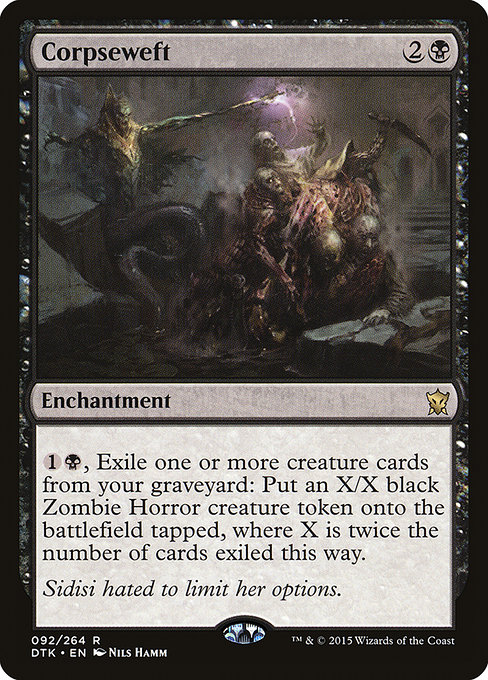
Image courtesy of Scryfall.com
Why Corpseweft Print Runs Differ Across Editions
Every MTG collector knows the thrill of chasing that perfect print—foil, nonfoil, language variants, and the subtle quirks that come with each edition. Corpseweft, a rare enchantment from Dragons of Tarkir, is a compelling lens for examining how print runs diverge across editions. Its disciplined, black-metal flavor matches the clamp of a black mana curve: {2}{B} to start, then a grisly, graveyard-driven payoff. The card text is precise and brutal: “{1}{B}, Exile one or more creature cards from your graveyard: Create a tapped X/X black Zombie Horror creature token, where X is twice the number of cards exiled this way.” In a world where graveyard shenanigans swing matches, Corpseweft stands as a strategic anchor for decks that want to convert exiled energy into a growing army. 🧙♂️🔥
Print runs differ for many reasons, and Corpseweft is a perfect microcosm. First, consider the foil versus nonfoil dynamic. In the data snapshot for its Dragons of Tarkir printing, the card exists in both foil and nonfoil finishes. Foil copies tend to appear in smaller print runs, which means relative scarcity and a premium on collector value. In market snapshots, you’ll often see foil variants priced higher than their nonfoil counterparts, reflecting not only aesthetic appeal but the inherent uncertainty of supply. For Corpseweft, the nonfoil area in some price rails sits around a modest baseline, while the foil options carry a noticeably higher premium—an economic whisper of “rarity in the wild.” The numbers aren’t lifeless, either: USD prices in the catalog hover around the low coin range for nonfoil, with foil copies exhibiting stronger bid-asks, illustrating how print runs shape value over time. 💎
Edition-to-edition differences aren’t solely about foil counts. Language variants, printing batches, and regional allocations all contribute to how many copies exist in the wild. Dragons of Tarkir was released in multiple print campaigns and booster configurations, and each print run can yield slightly different distributions across stores and regions. Even though Corpseweft isn’t a reprint in a later core set, the card’s presence in the DTK era’s broader production cycle means you may encounter subtle deltas in availability when comparing cards from the same set across different printings or bundles. The net effect is a familiar, almost nostalgic rhythm: some copies are easier to snag at tournaments or in bulk, while others are more elusive, tucked away in early boosters or sealed product. 🧙♂️🎲
Mechanics and how they echo print dynamics
The enchantment’s ability rewards graveyard manipulation and careful sequencing. You pay a single black mana and exile cards from the graveyard; the more you exile, the larger the Zombie Horror token becomes (X is twice the number of exiled cards). This scaling mechanic invites players to farm resources across multiple turns—creating a dramatic, late-game threat that can flip boards if left unchecked. When a card is printed in both foil and nonfoil within the same edition, players frequently debate whether foil aesthetics or raw print counts drive the number of complete playsets floating around. The thrill of unsealing a nicely foil Corpseweft at a table is matched only by the hunt for the exact, rare edition that aligns with your collection strategy. ⚔️
Flavor and lore also color edition desirability. Corpseweft’s flavor text, “Sidisi hated to limit her options,” ties the card to the broader Tarkir tapestry of Dragonlords and clans. That thematic tie can elevate a card’s perceived value, especially in a format where the story and card art matter as much as the numbers on the table. A well-loved card in a beloved art era often sees more consistent demand, which in turn nudges print runs into slightly more favorable trajectories for collectors chasing a complete DTK experience. 🎨
Practical tips for evaluating print run differences
If you’re chasing Corpseweft, consider whether you want foil or nonfoil. Foil copies typically command a premium due to restricted print runs, especially in a rare like Corpseweft from the DTK era. The price spread you observe in market data often tracks foil scarcity more reliably than other factors. ⚔️ While English is standard, foreign-language variants can have distinct print volumes. These can be appealing to collectors who focus on language diversity or who want a display-worthy collection with a global footprint. The card’s ability scales with exiled cards, which means decks built around it push a different kind of demand depending on whether your preferred format (Commander, Modern, etc.) leans into graveyard interaction. A print run analysis should weigh not just rarity but how often a card finds a home in top decks. 🔥 The numeric price impression—foil premiums versus baseline nonfoil—offers a window into supply dynamics, but it’s not a crystal ball. Foil prints can spike briefly during interest surges or reprints elsewhere, then normalize as supply catches up. 💎
Artist, frame, and collector appeal
Corpseweft was illustrated by Nils Hamm and appears in a classic “DTK” black-border frame from 2015. The card’s design—an enchantment that creates a scalable, black Zombie Horror token—fits neatly into the broader Eldrazi-scarred, khan-fueled Tarkir aesthetic. The art and frame choice influence how editions are perceived visually, which in turn nudges the collector’s eye toward certain print runs over others. When you pair strong art with a strong mechanic, you’re naturally steering both play and display value in directions that often outlive a single standard-rotation season. 🧙♂️🎨
Product spotlight and cross-promotional note
While we’re geeking out about print runs and graveyard shenanigans, a quick nod to a related item in our shop helps keep the momentum going. If you’re looking for a stylish, durable way to protect your everyday carry—or just want a little MTG-flair in real life—the Clear Silicone Phone Case—Slim Durable Open Port Design is a handy companion for your adventures between drafts and drafts. Check it out today for a sleek, protective everyday carry upgrade. Clear Silicone Phone Case - Slim Durable Open Port Design
More from our network
- https://wiki.digital-vault.xyz/wiki/post/pokemon-tcg-stats-unit-energy-grassfirewater-card-id-sm5-137/
- https://blog.digital-vault.xyz/blog/post/rillaboom-how-stats-evolved-across-generations/
- https://blog.digital-vault.xyz/blog/post/blue-giant-at-2-kiloparsecs-traces-stellar-associations/
- https://blog.crypto-articles.xyz/blog/post/nft-data-bagtardio-1549-from-bagtardio-collection-on-magiceden/
- https://crypto-articles.xyz/tmphwcnpzmg/under-the-ice-something-listens.html
Corpseweft
{1}{B}, Exile one or more creature cards from your graveyard: Create a tapped X/X black Zombie Horror creature token, where X is twice the number of cards exiled this way.
ID: 25cf24e7-2e6e-46e0-aedd-89e17953811c
Oracle ID: 9ffb5615-124e-4848-9e0d-120851bd50e5
Multiverse IDs: 394524
TCGPlayer ID: 96667
Cardmarket ID: 273335
Colors: B
Color Identity: B
Keywords:
Rarity: Rare
Released: 2015-03-27
Artist: Nils Hamm
Frame: 2015
Border: black
EDHRec Rank: 21928
Penny Rank: 12469
Set: Dragons of Tarkir (dtk)
Collector #: 92
Legalities
- Standard — not_legal
- Future — not_legal
- Historic — not_legal
- Timeless — not_legal
- Gladiator — not_legal
- Pioneer — legal
- Modern — legal
- Legacy — legal
- Pauper — not_legal
- Vintage — legal
- Penny — legal
- Commander — legal
- Oathbreaker — legal
- Standardbrawl — not_legal
- Brawl — not_legal
- Alchemy — not_legal
- Paupercommander — not_legal
- Duel — legal
- Oldschool — not_legal
- Premodern — not_legal
- Predh — not_legal
Prices
- USD: 0.13
- USD_FOIL: 0.50
- EUR: 0.14
- EUR_FOIL: 0.53
- TIX: 0.02
More from our network
- https://wiki.digital-vault.xyz/wiki/post/pokemon-tcg-stats-smoochum-card-id-ex15-64/
- https://blog.crypto-articles.xyz/blog/post/nft-data-planet-kaiju-5091-from-planet-kaiju-collection-on-magiceden/
- https://wiki.digital-vault.xyz/wiki/post/pokemon-tcg-stats-paldean-clodsire-card-id-sv03-128/
- https://blog.crypto-articles.xyz/blog/post/nft-data-bmb-community-season-1-5543-from-bmb-community-airdrop-season-1-collection-on-magiceden/
- https://crypto-acolytes.xyz/blog/post/nft-stats-hero-506-from-soul-gate-heroes-collection/