
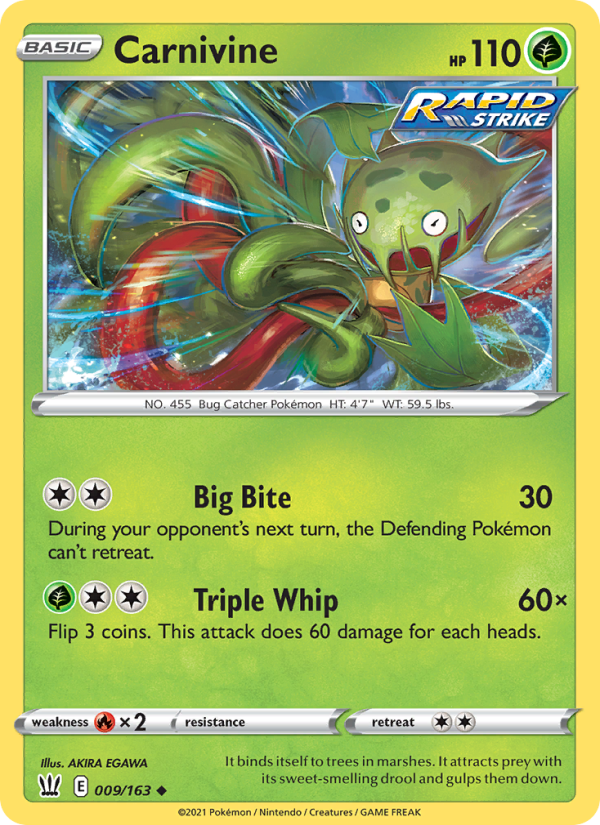
Image courtesy of TCGdex.net
Design philosophy behind Carnivine's mechanics
In the marais and mangroves of its lore, Carnivine lures prey with a sweet-smelling drool before delivering a hungry handshake that ends with a gulp. The card from Battle Styles translates that predatory charm into a compact, risk-and-reward engine on the tabletop. Its basic, Grass-type silhouette hints at steady, resource-rich plays, yet the mechanics insist you plan several moves ahead. The pairing of Big Bite and Triple Whip is a deliberate design choice: one attack punishes retreat and mobility, the other amplifies damage through a coin-flip gamble. This duality mirrors Carnivine’s predatory strategy—control the flow of engagement, then strike when the odds tilt in your favor. ⚡🔥💎
First, Carnivine’s Big Bite is deceptively simple: dealing 30 damage for two Colorless energy and, crucially, preventing the Defending Pokémon from retreating on the opponent’s next turn. The prevention of retreat is a classic control mechanic; it corrals your opponent into your planned sequence. In a format filled with flexible retreat costs and quick switching, this restraint can be a powerful limiter, allowing you to set up later pressure. The attack’s modest damage is a reminder that in Battle Styles, controlling tempo and positioning can be as valuable as raw power. The card’s 110 HP and a defensible retreat cost of 2 integrate into a broader strategy: stay in the battlefield long enough to weave in the bigger payoff while denying your foe easy exits. 🎴
Then comes the wild card: Triple Whip. The cost is a Grass and two Colorless energy, but the payoff hinges on three coin flips. Each heads delivers 60 damage; thus, the attack can skyrocket to 180 damage if you flip all heads, with the caveat that any tails yield nothing beyond wasted energy. This is pure risk-reward scheduling. It embodies Carnivine’s design philosophy—embrace the scent of opportunity, even when the air is thick with uncertainty. The art of timing, coin-toss probability, and probability management becomes a micro-game within the game. For players who enjoy chasing big swings while acknowledging variance, Triple Whip is a delicious thorn in the side of perfect play. The mechanic also subtly encourages deck-building decisions around coin-flip synergies and resource pacing, inviting players to test probabilities as part of the strategy. 🎲🎯
From a gameplay design perspective, Carnivine’s two-attack package embodies a balanced risk ladder. You can press with protection and pressure through Big Bite, then pivot to a potentially catastrophic hit when luck aligns with your planning. In tournaments and casual play alike, this dual-path design rewards thoughtful pacing, careful energy allocation, and keen judgment about when to threaten the opponent with a high-damage burst. The weakness to Fire and a modest retreat of 2 reinforce the need to shepherd Carnivine into favorable matchups and to leverage Grass energy growth without overextending. The Stage is Basic, letting new players discover the rhythm of the set while the seasoned players appreciate the subtle power of tempo control in a Grass bringer. 🔥🎨
What the design says about the Battle Styles era
Battle Styles as a set explored the tension between raw power and strategic positioning, with a tilt toward more “in-the-field” decision points. Carnivine’s mechanics fit this philosophy neatly. The card’s Uncommon rarity sits in a sweet spot where players can incorporate it into midrange decks without feeling obligated to chase it as a sole cornerstone. Its Expanded-legal status, contrasted with ineligible Standard play, also hints at a design landscape that values evolving rules environments where certain mechanics mature and interact with more depth. The artistry—credited to AKIRA EGAWA—brings Carnivine to life in a way that meshes with its flavor text: a creature bound to marshy trees, waiting for the moment to strike. The synergy between lore and mechanics is a nod to the design ethos of the era: make the creature’s temperament a tangible, playable experience on the table. 🎴💎
For collectors, Carnivine’s illustration and its rare-ish presence in Battle Styles invite both tactile appreciation and strategic nostalgia. The card’s HP sits at 110, a healthy buffer for a Basic Grass type in this era’s meta, while the Weakness to Fire keeps players mindful of matchups and card draw sequencing. The Dungeon-like feeling of its marshland habitat translates into a card that leans toward midfield control: not the most glamorous attacker, but a cunning enabler of larger, later-game plays that rely on probability and field management. 🕳️🎨
Market and value snapshot
In today’s price landscape, Carnivine’s value trends are modest but telling. CardMarket records a low around €0.02 and an average near €0.06 for non-holo copies, signaling that this card remains accessible for casual players and budget builders. TCGPlayer registers a broader spectrum for the normal (non-holo) copy, with low around $0.01 and mid around $0.10, and a high that can stretch toward $5.01 for the rare border cases in pristine condition. These numbers reflect not only scarcity but also the enduring appeal of this batch of Battle Styles cards—collectors appreciate the full-art look and the nostalgia of a well-timed, control-oriented Grass type. For investors, Carnivine’s value is a quiet barometer of the broader Standard/Expanded dynamic, reminding us that the health of an archetype often lives in the margins of market chatter and local meta shifts. 💎⚡
Whether you’re piloting a deck that leans on field control or chasing a dramatic, coin-flip victory, Carnivine offers a compact, thematically rich design that resonates with fans who love tactical patience as much as explosive swings. Its flavor text, its illustrator’s craft, and its mechanically fascinating moves all converge into a card that rewards players who read the board like a marshland predator reading the shifting reeds. If you’re building a Grass-centered list for Expanded play, Carnivine is a welcome nod to a creature that embodies both patience and opportunism—two traits every trainer admires when the moment finally bites. ⚡🌿🎴
Non-slip Gaming Mouse Pad Neon Vibrant Polyester SurfaceMore from our network
- https://transparent-paper.shop/blog/post/stellar-motions-refine-the-local-rest-frame-from-a-distant-hot-giant/
- https://crypto-acolytes.xyz/blog/post/nft-stats-bagtardio-1864-from-bagtardio-collection/
- https://wiki.digital-vault.xyz/wiki/post/pokemon-tcg-stats-lickitung-card-id-a4-230/
- https://blog.digital-vault.xyz/blog/post/slither-blade-parody-vs-serious-mtg-card-art/
- https://wiki.digital-vault.xyz/wiki/post/pokemon-tcg-stats-torkoal-card-id-sm1-23/
Carnivine
Set: Battle Styles | Card ID: swsh5-9
Card Overview
- Category: Pokemon
- HP: 110
- Type: Grass
- Stage: Basic
- Dex ID: 455
- Rarity: Uncommon
- Regulation Mark: E
- Retreat Cost: 2
- Legal (Standard): No
- Legal (Expanded): Yes
Description
It binds itself to trees in marshes. It attracts prey with its sweet-smelling drool and gulps them down.
Attacks
| Name | Cost | Damage |
|---|---|---|
| Big Bite | Colorless, Colorless | 30 |
| Triple Whip | Grass, Colorless, Colorless | 60× |
Pricing (Cardmarket)
- Average: €0.06
- Low: €0.02
- Trend: €0.08
- 7-Day Avg: €0.06
- 30-Day Avg: €0.05
Support Our Decentralized Network
Donate 💠More from our network
- https://transparent-paper.shop/blog/post/stellar-motions-refine-the-local-rest-frame-from-a-distant-hot-giant/
- https://crypto-acolytes.xyz/blog/post/nft-stats-bagtardio-1864-from-bagtardio-collection/
- https://wiki.digital-vault.xyz/wiki/post/pokemon-tcg-stats-lickitung-card-id-a4-230/
- https://blog.digital-vault.xyz/blog/post/slither-blade-parody-vs-serious-mtg-card-art/
- https://wiki.digital-vault.xyz/wiki/post/pokemon-tcg-stats-torkoal-card-id-sm1-23/