
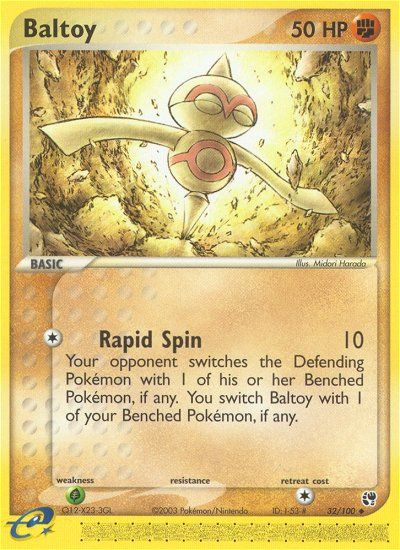
Image courtesy of TCGdex.net
Capturing the Desert’s Quiet Power
Collectors journey back to Sandstorm for moments of quiet design that still shout with character, and Baltoy is a perfect example. This Basic Fighting-type Pokémon carries an HP of 50 and a humility that invites closer study. The card’s rarity is listed as Uncommon, a sweet spot that makes it accessible for everyday fans while still delighting collectors who chase distinctive art and well-crafted flavor. The illustration, by Midori Harada, embraces a balanced, almost meditative composition: round, globe-like shapes echo the Poké’s clay origins, while the desert palette anchors Baltoy in its signature habitat. The result is a picture that feels tactile—like a figurine you could cradle in your palm while imagining the endless sands it calls home. ⚡
Artistry in Motion: Midori Harada’s Signature Touch
Harada’s linework on Baltoy reinforces the creature’s gentle gravity. The artwork embraces clean curves and subtle shading that give the clay figure a sense of weight without sacrificing whimsy. The piece leans into Baltoy’s iconic silhouette—a spherical head perched on a compact body—while the desert backdrop and warm earth tones create a sense of place that fans recognize across the Sandstorm era. For many collectors, the appeal isn’t just the creature itself; it’s the way Harada renders balance, symmetry, and quiet motion in a single frame. The result is a card that reads beautifully in a binder, even when tucked between more flamboyant holographics. 🎨
From Baltoy to Claydol: A Gentle Evolution Path
In the broader Pokémon TCG ecosystem, Baltoy evolves into Claydol, a transition that many players and collectors find nostalgically satisfying. This lineage adds a layer of narrative depth to the card—seeing Baltoy as the seed that grows into a more complex clay golem mirrors the evolving tastes of collectors who appreciate both the simplicity of early designs and the richer silhouettes of later sets. The Sandstorm era’s Baltoy sits at a crossroads: it’s not the flashiest card on the table, but its enduring charm and clear evolutionary thread make it a staple for anyone tracing the franchise’s art-forward history. 🧭
How the Card Plays: Strategy Wrapped in Art
Beyond its aesthetic appeal, Baltoy’s Rapid Spin attack provides a tactical hook. For a Colorless cost, Baltoy delivers 10 damage and, more importantly, forces a player swap: the Defending Pokémon must switch with a Benched Pokémon, and Baltoy itself can retreat to the bench for a fresh setup. In practice, this creates dynamic moments in games where momentum hinges on bench management and timing. Newer players can learn the importance of position—balancing risk and retreat—while veterans appreciate how this small move can stall an opponent’s rhythm or open a lane for a planned evolution. The art and the mechanic merge into a single experience: Baltoy is a reminder that sometimes subtle plays—like a calm, turning wheel—can swing the entire match. 🔄
- Set and rarity context: Sandstorm (ex2) brought bold desert imagery to life, with Baltoy standing out as an Uncommon Basic Pokémon.
- Type and weaknesses: Fighting-type with a Grass weakness (×2), shaping the matchups you’ll favor or wary of, depending on the field.
- HP and durability: A modest 50 HP, which makes Baltoy a great pivot for bench-slinging strategies rather than a frontline tank.
- Illustrator credit: Midori Harada, whose crisp, geometric approach elevates the card’s tactile feel.
- Evolution note: Evolves into Claydol, sealing the narrative arc from clay to more elaborate form.
Market Snapshot: Collecting Value and Public Perception
For modern collectors watching price trends, this Baltoy sits in a region of accessible curiosity. CardMarket data shows a Card Market average around €0.90 with a broad spectrum from a low near €0.15 to higher values as condition and edition balance out. On TCGPlayer, the standard (non-holo) print sits with a low around $0.74, a mid around $1.18, and a high near $3.07, reflecting steady interest in the Sandstorm era’s basics. The reverse holo variant—though less common in the Sandstorm era’s packaging—tends to command higher numbers, with recent data showing a low around $2.64, a mid near $4.84, and a high around $7.06, market price hovering around $4.52. These figures suggest Baltoy remains a well-loved entry for nostalgia-driven collectors and those building a Sandstorm-era art-focus binder. Always remember: prices shift with supply, grading, and regional demand, so treat these as living benchmarks rather than fixed values. 💎
For fans who value the art as much as the play, Baltoy’s Sandstorm portrayal offers a perfect blend of approachability and depth. The combination of Midori Harada’s artistry and the card’s practical versatility makes this piece a memorable anchor in many collections. It’s a reminder that in the Pokémon TCG, even a modest attack can carry a story—one that links desert winds, clay forms, and the careful craftsmanship that makes the hobby so enduringly magical. 🎴
Custom Gaming Neoprene Mouse Pad 9x7 Stitched EdgesMore from our network
- https://articles.zero-static.xyz/blog/post/phantom-interference-a-strategy-guide-to-similar-keyword-abilities/
- https://blog.crypto-articles.xyz/blog/post/nft-data-bmb-community-season-3-5886-from-bmb-community-airdrop-season-3-collection-on-magiceden/
- https://wiki.digital-vault.xyz/wiki/post/pokemon-tcg-stats-greninja-gx-card-id-sma-sv56/
- https://blog.crypto-articles.xyz/blog/post/nft-data-drifter-3093-from-drifters-masterwork-collection-on-magiceden/
- https://wiki.digital-vault.xyz/wiki/post/pokemon-tcg-stats-reuniclus-card-id-svp-212/
Baltoy
Set: Sandstorm | Card ID: ex2-32
Card Overview
- Category: Pokemon
- HP: 50
- Type: Fighting
- Stage: Basic
- Dex ID: 343
- Rarity: Uncommon
- Regulation Mark: —
- Retreat Cost:
- Legal (Standard): No
- Legal (Expanded): No
Description
Attacks
| Name | Cost | Damage |
|---|---|---|
| Rapid Spin | Colorless | 10 |
Pricing (Cardmarket)
- Average: €0.9
- Low: €0.15
- Trend: €1
- 7-Day Avg: €0.91
- 30-Day Avg: €0.7
Support Our Decentralized Network
Donate 💠More from our network
- https://articles.zero-static.xyz/blog/post/phantom-interference-a-strategy-guide-to-similar-keyword-abilities/
- https://blog.crypto-articles.xyz/blog/post/nft-data-bmb-community-season-3-5886-from-bmb-community-airdrop-season-3-collection-on-magiceden/
- https://wiki.digital-vault.xyz/wiki/post/pokemon-tcg-stats-greninja-gx-card-id-sma-sv56/
- https://blog.crypto-articles.xyz/blog/post/nft-data-drifter-3093-from-drifters-masterwork-collection-on-magiceden/
- https://wiki.digital-vault.xyz/wiki/post/pokemon-tcg-stats-reuniclus-card-id-svp-212/