
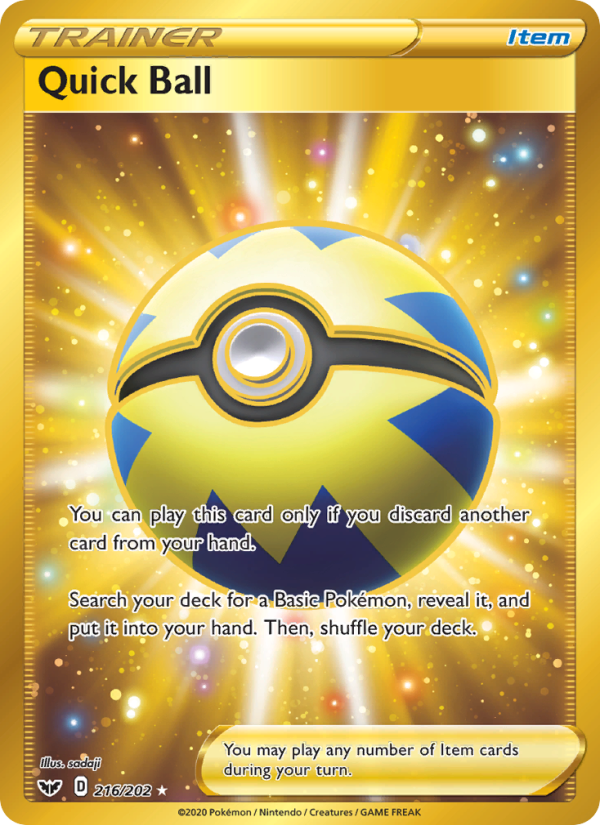
Image courtesy of TCGdex.net
How Quick Ball Shapes the Pokémon TCG meta and deck-building strategies
In the whirlwind of the Sword & Shield era, one Trainer Card has consistently changed the tempo of the game: Quick Ball. This holo-tinged Secret Rare from the Sword & Shield set grants a powerful, early-game edge by letting you discard a card from your hand to search your deck for a Basic Pokémon, reveal it, put it into your hand, and then shuffle. The card’s illustrated finesse by Sadaji, its holo rarity, and its ability to locate a Basic Pokémon quickly has made it a staple in countless decks, from aggressive one-Prize strategies to more controlled, tempo-driven lines. It’s a quintessential example of how a simple mechanic—searching for a Basic—can ripple through a format and influence strategic choices across dozens of archetypes.
Strategically, Quick Ball shines in the opening turns by accelerating your setup. In a game where every card drawn matters, being able to fetch a Sobble to begin an Inteleon evolution chain, or a Mimikyu, or a basic Basic of another line, lets you establish board presence sooner and pressure your opponent before they can stabilize. The card’s effect is especially potent when your deck centers around evolving lines or tempo tactics that rely on a quick ensemble of Basics to fuel the mid-game push. In the hands of a patient player, Quick Ball becomes the engine that keeps you from falling behind on setup while your opponent staggers to respond.
“The true power of Quick Ball isn’t just the fetch—it’s the tempo you gain when you start pressuring the board in turn one or two.” ⚡
Which decks feature Quick Ball most often? The answer is broad, but there are clear patterns. First, decks built around a central evolution line frequently lean on Quick Ball to fetch the early Sobble or other Basic Pokémon necessary to seed their strategy. The classic Sobble–Drizzile–Inteleon line, for example, benefits immensely from a fast Sobble fetch to jump-start the sequence and keep your engine running even if you miss a draw in the early turns. In such decks, Quick Ball acts as a compact accelerator, reducing the need to rely on slower draw power alone and allowing precise timing when you push into their instructor-driven mid-game plays.
Beyond the Inteleon engine, Quick Ball sees widespread use in any deck that must secure a Basic Pokémon quickly. This includes tempo-oriented strategies that want to establish a strong board state before the opponent can stabilize, as well as archetypes that punish slow starts with rapid aggression or with evolving threats that come online quickly. The common thread is clear: decks that prize speed, early pressure, and reliable access to the essential Basic Pokémon will default to Quick Ball as a core tool in their toolbox.
As a collectible, the card’s Secret Rare holo print from Sword & Shield is a favorite among players who prize both function and aesthetics. The holographic flourish, the signature style of Sadaji’s artwork, and the card’s status as a staple in modern decks contribute to its enduring appeal. While the non-holo variants may carry lower price points, the holo versions—especially in well-kept condition—remain sought after for both playability and binder appeal. Market indicators show holo Quick Ball values typically sit higher than their non-holo counterparts, with market prices that reflect demand for a staple engine card in popular deck builds.
From a collector’s lens, the Quick Ball print also provides a nice window into set composition and print runs. It comes from the Sword & Shield era, carrying the set ID swsh1 and a Card Count that sits within the official range for that release. The card bears the regulation mark D and has expanded-legal status, making it a relevant pick for players who want to practice and optimize within current and legacy formats alike. Illustrations by Sadaji add a distinct flair to the card, reinforcing why many fans enjoy not just the mechanics, but the artistry that punctuates the Pokémon TCG experience.
Practical takeaways for builders
- Anchor your opener: Use Quick Ball on turn one or two to fetch a Basic Pokémon and kickstart your evolution line. This reduces the risk of a slow start and helps you deploy threats earlier.
- Couple with other tutors: Quick Ball shines when paired with other search tools, especially in decks that need a specific Basic to counter a meta matchup or to accelerate into a key evolution.
- Mind the discard cost: The need to discard another card from hand means you’ll often be balancing tempo with resources. Plan your mulligan and hand composition to ensure you don’t deplete hand size too aggressively.
- Collectibility matters: For holo collectors, the Sword & Shield Quick Ball represents not only gameplay value but a desirable holo artifact, with market ranges reflecting its enduring popularity.
For readers who love keeping their playspaces tidy while they strategize, a little practical accessory never hurts. If you’re setting up for long tournament sessions or casual evenings with friends, a sturdy phone stand can help you keep notes, rulebooks, or device screens in view without crowding the table. Consider checking out a Phone Stand for Smartphones Sleek Desk Travel Accessory to augment your setup—it's a smart companion for any card-game night.
For fans who want a deeper dive into market dynamics, print history, and deck-building philosophy, Quick Ball’s journey through prints and price rounds out a fascinating narrative of how this tiny card continues to drive big plays in the Pokémon TCG. Its enduring relevance across formats speaks to the elegance of its design: a simple discard, a powerful search, and a bridge to the evolving, tactical decisions that define the game we all love. 🎴🔥💎
Product CTA: Phone Stand for Smartphones Sleek Desk Travel Accessory
More from our network
- https://articles.zero-static.xyz/blog/post/legends-behind-plated-rootwallas-notable-ability/
- https://crypto-acolytes.xyz/blog/post/nft-stats-bpw-1907-from-bonk-puppets-collection/
- https://blog.rusty-articles.xyz/blog/post/pass-the-torch-grading-guide-authenticity-and-centering-essentials/
- https://x-donate.zero-static.xyz/b35dcfea.html
- https://blog.rusty-articles.xyz/blog/post/minecraft-roadmap-analysis-reveals-whats-next-for-players/
Quick Ball
Set: Sword & Shield | Card ID: swsh1-216
Card Overview
- Category: Trainer
- HP:
- Type:
- Stage:
- Dex ID:
- Rarity: Secret Rare
- Regulation Mark: D
- Retreat Cost:
- Legal (Standard): No
- Legal (Expanded): Yes
Description
Pricing (Cardmarket)
- Average: €0.1
- Low: €0.02
- Trend: €0.13
- 7-Day Avg: €0.12
- 30-Day Avg: €0.11
Support Our Decentralized Network
Donate 💠More from our network
- https://articles.zero-static.xyz/blog/post/legends-behind-plated-rootwallas-notable-ability/
- https://crypto-acolytes.xyz/blog/post/nft-stats-bpw-1907-from-bonk-puppets-collection/
- https://blog.rusty-articles.xyz/blog/post/pass-the-torch-grading-guide-authenticity-and-centering-essentials/
- https://x-donate.zero-static.xyz/b35dcfea.html
- https://blog.rusty-articles.xyz/blog/post/minecraft-roadmap-analysis-reveals-whats-next-for-players/