
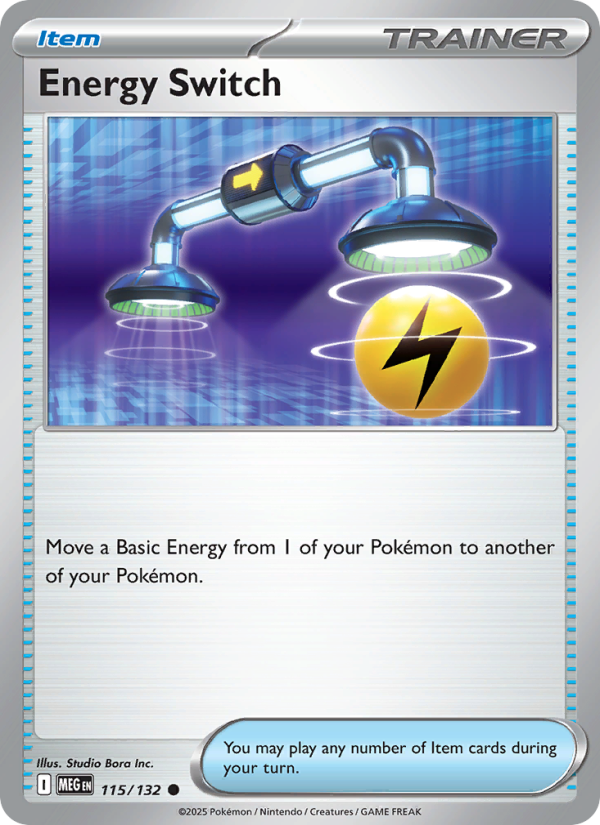
Image courtesy of TCGdex.net
Which Deck Archetypes Rely on Energy Switch in Pokémon TCG
Energy Switch is the kind of trainer card that quietly underpins a surprising range of deck archetypes. In the Mega Evolution era, where tempo and resource management often decide the pace of a match, this common trainer earns its keep by giving you precise control over where your energy ends up. The card’s effect is simple to state—move a Basic Energy from one of your Pokémon to another of your Pokémon—but the strategic implications run deep. When you’re juggling multiple attackers, retreat costs, and hand disruption, a single Energy Switch can be the difference between a KO and a stalled board. ⚡
Illustrated by Studio Bora Inc., Energy Switch is a trainer item that invites players to think about energy economy in a flexible, modular way. In its Mega Evolution iteration, the card is legal in the standard format, widely accessible, and forms part of a broad ecosystem where quick energy repositioning supports aggressive plays and resilient defense. The card’s very accessibility—Common rarity with holo, reverse, and normal variants—means it’s a staple in budget decks and a familiar tool for seasoned players alike. The art and packaging align with the era’s emphasis on clean utility and crisp illustration, showing energy shifting as a practical game mechanic rather than a flashy gimmick. 🎨
Core mechanics that enable archetypes
The essence of Energy Switch is deceptively simple: you can move a Basic Energy from one Pokémon to another. This is especially valuable in archetypes that rely on cycling energy to fuel multiple threats or to reposition energy to a single, key attacker mid-game. Because the card targets Basic Energy, it bypasses the complications of dealing with special energies and persistent attachments, giving you reliable tempo even when you’re facing energy denial or bench-heavy counters. In many lineups, you’ll see Energy Switch used to keep damage-producing threats primed for a sequence of attacks, or to transfer energy to a fresh attacker that can threaten a KO with the right attack cost. 🔄
Archetypes that commonly rely on Energy Switch
- Pivot and multi-attacker builds – In decks that rely on rotating attackers while maintaining energy efficiency, Energy Switch lets you move a Basic Energy from a spent attacker to a new threat. This keeps pressure on your opponent while you burn through your resources, letting you chain exchanges that lead to rapid takedowns without overinvesting in a single line.
- Two-attack or multi-turn payoff decks – Some archetypes hinge on delivering two strong attacks back-to-back. By shuttling energy between Pokémon, you can ensure the second attacker has what it needs for its big strike, even after the first KO or retreat. Energy Switch reduces awkward energy pockets that would otherwise slow down your second strike.
- Energy recycling and bench pressure strategies – In archetypes that prize board presence and bench management, moving energy around allows you to keep your active threats adaptable. You can place energy where retreat costs line up with your bench setup, maintaining pressure without wasting turns.
- Adaptive control lists – Even in control-leaning lists, Energy Switch offers a surprising amount of tempo. You can yank energy away from a threat you expect to KO you and redirect it toward a more favorable matchup, smoothing out rough turns where you might otherwise stall out of options.
From a gameplay perspective, the card’s utility grows with the rest of your toolbox. If you’re pairing Energy Switch with a stage 2 engine or a quick-aggressive bench pressure plan, you’ll find the ability to reallocate energy on the fly a powerful enabler. It’s not about battery farming on one attacker alone; it’s about shaping the battlefield by reallocating energy to the most threatening target at the right moment. And because it’s a standard-legal staple in many lists, it’s a reliable option you can count on in a tight matchup. 🔥
Collector’s snapshot: rarity, pricing, and value trends
Energy Switch sits in the Common tier within the Mega Evolution set, yet its practical utility often elevates its perceived value in decks that prize efficiency and speed. The card’s official count sits at 132 for standard release within a total of 188 cards for the set, with holo and reverse holos offering a touch of rarity for collectors who chase aesthetic variety. In terms of market data, the card typically trends as an affordable staple. CardMarket shows an overall average around EUR 0.08, with holo variants hovering a bit higher around EUR 0.14. TCGPlayer places normal printings in the low-dollar range, with direct prices sometimes dipping to a few cents for non-foil copies, and holo versions peaking closer to the mid-range. For budget players building a streamlined list, Energy Switch remains a smart pickup that won’t strain the wallet, while collectors can chase the holo treatment for a bit more sparkle on the binder page. 💎
In the real world, the value dynamics reflect playability and availability. A card that enables flexible energy management tends to hold steady demand across formats, even when it isn’t the centerpiece of a flagship deck. Its presence in Standard means it remains a relevant piece for decks that want to optimize energy charts without losing tempo—particularly in sets where basic energy management is a recurring theme. The Megaevolution era’s emphasis on versatile trainer choices makes Energy Switch a natural choice for players who value option-rich playbooks in their deckbuilding toolkit. 🎴
Tips for leveraging Energy Switch in games
- Plan energy moves ahead of turns. Identify which attacker will benefit most from a fresh energy at the exact moment you threaten a KO or a retreat reduces risk for your next attacker.
- Watch retreat costs and energy thresholds. If your primary attacker’s attack cost can be met with a single Basic Energy and an Energy Switch, you can maintain pressure without over-attaching.
- Use Energy Switch to respond to threats. If your opponent is stacking a two-pronged offense, a timely energy relocation can keep you in the driver’s seat and prevent a knockout on your active Pokémon.
- Combo awareness matters. Remember that you cannot move Energy Switch to or from a non-Basic Energy, so plan with your energy mix in mind.
For fans eager to protect their prized cards while they practice these tactics on the go, the linked product below offers a practical accessory option—while the tactics of energy management unfold on the table, your cards stay organized and accessible. The synergy between thoughtful deckbuilding and convenient accessories helps you stay in the zone, whether you’re climbing ladder rank or trading tips with friends. ⚡🎮
Phone Case with Card Holder Slim Impact ResistantMore from our network
- https://wiki.digital-vault.xyz/wiki/post/pokemon-tcg-stats-professor-oaks-setup-card-id-sm12-201/
- https://blog.crypto-articles.xyz/blog/post/nft-data-toolbox-483-from-toolboxes-collection-on-magiceden/
- https://wiki.digital-vault.xyz/wiki/post/pokemon-tcg-stats-roserade-card-id-xy2-9/
- https://crypto-acolytes.xyz/blog/post/blue-white-giant-shines-through-crowded-field-astrometry-at-4-kpc/
- https://blog.crypto-articles.xyz/blog/post/nft-data-solidskulls-1559-from-solidskulls-collection-on-magiceden/
Energy Switch
Set: Mega Evolution | Card ID: me01-115
Card Overview
- Category: Trainer
- HP:
- Type:
- Stage:
- Dex ID:
- Rarity: Common
- Regulation Mark: I
- Retreat Cost:
- Legal (Standard): Yes
- Legal (Expanded): No
Description
Pricing (Cardmarket)
- Average: €0.08
- Low: €0.02
- Trend: €0.07
- 7-Day Avg: €0.07
- 30-Day Avg: €0.08
Support Our Decentralized Network
Donate 💠More from our network
- https://wiki.digital-vault.xyz/wiki/post/pokemon-tcg-stats-professor-oaks-setup-card-id-sm12-201/
- https://blog.crypto-articles.xyz/blog/post/nft-data-toolbox-483-from-toolboxes-collection-on-magiceden/
- https://wiki.digital-vault.xyz/wiki/post/pokemon-tcg-stats-roserade-card-id-xy2-9/
- https://crypto-acolytes.xyz/blog/post/blue-white-giant-shines-through-crowded-field-astrometry-at-4-kpc/
- https://blog.crypto-articles.xyz/blog/post/nft-data-solidskulls-1559-from-solidskulls-collection-on-magiceden/