
Image courtesy of TCGdex.net
A Case Study in Balance: Persian from Base Set 2
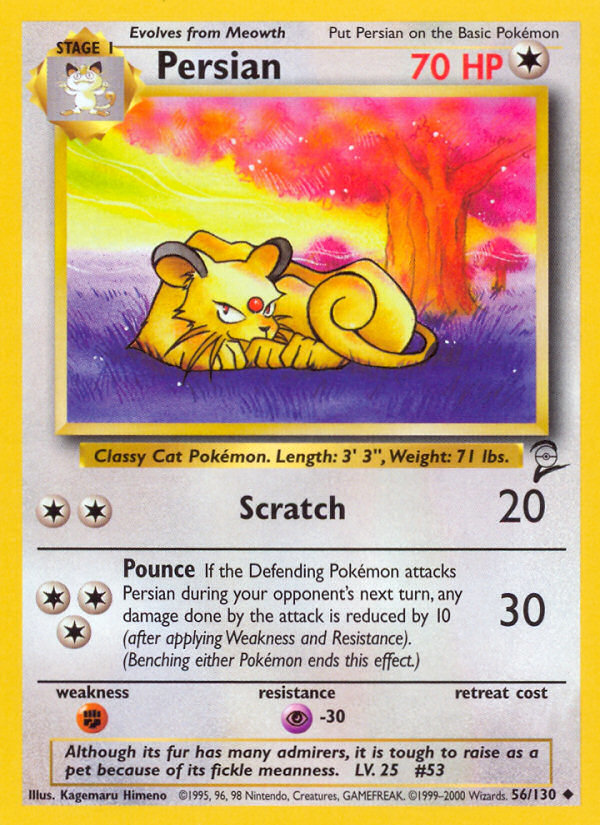
In the vast ecosystem of Pokémon TCG design, balance is a living conversation between offense, defense, resource costs, and the tempo of play. Persian, a Stage 1 evolution from Meowth in Base Set 2, offers a compact yet telling lesson. With 70 HP, a pair of colorless-attacks, and a calculated defensive wrinkle tucked into its high-energy option, this card embodies how early sets encouraged players to read not just raw numbers but the story those numbers tell about pacing, risk, and strategic choice ⚡🔥.
Card snapshot: the essentials that shape balance
- Name: Persian
- Set: Base Set 2 (Base Set 2 reprint)
- Rarity: Uncommon
- Type: Colorless
- Stage: Stage 1 (evolves from Meowth)
- HP: 70
- Attacks: Scratch (Colorless, Colorless) for 20; Pounce (Colorless, Colorless, Colorless) for 30 with a twist
- Effect: If the Defending Pokémon attacks Persian during your opponent’s next turn, any damage done by the attack is reduced by 10 (after applying Weakness and Resistance). Benching either Pokémon ends this effect.
- Weakness/Resistance: Fighting ×2 / Psychic -30
- Illustrator: Kagemaru Himeno
- Official card count (set): 130
What jumps out here is not a single flashy ability but a thoughtful pairing of offense and defense. Scratch offers a reliable 20 for two Energy, a modest opening move that fits a stage-1 line. Pounce, however, is where the philosophy of balance flexes: a three-energy investment to reach 30 damage, paired with a situational shield that softens the next big hit from the opponent—if Persian survives long enough to trigger it. The caveat—your opponent’s attack on their next turn can still land, just less painfully—plus the rule that benching ends the effect, creates a dynamic checkpoint in tempo and risk management.
How the mechanic design teaches tempo and risk
Balance in Pokémon TCG often lives at the edge of tempo: can a player apply pressure without overextending resources? Persian’s Pounce is instructive here. Paying three Energy for 30 damage is a fair exchange given that the payoff includes damage mitigation on the opponent’s next turn. It rewards players who plan ahead and read the battlefield: if you fear a strong retaliation, you might position Persian to soak a hit and soften the counterstrike, trading efficiency for survivability.
The defensive effect “after applying Weakness and Resistance” ensures the mitigation feels earned—its value scales with the opponent’s potential to burst Persian down in one hit. Yet the requirement to commit several Energy and the fact that the effect ends if either player benches a Pokémon keeps players honest about risk. This is balance by constraint: you don’t get a guaranteed shield; you get a calculated, situational hedge that may shift the momentum but won’t carry you to inevitability.
How weakness and resistance shape decision-making
Persian’s vulnerability to Fighting ×2 and resistance to Psychic -30 further anchors its role in deck-building decisions. In a metagame where Fighting-types could threaten Persian’s modest 70 HP, the risk is real, nudging players toward a support suite or a Meowth-predicated path that keeps Persian safely cushioned behind a fortress of type matchups. The Psychic resistance softens some common threats from the era, but the two-pronged weakness keeps Persian from becoming a frontline wall. In this way, balance isn’t about making a card “good” in a vacuum; it’s about ensuring it fits a broader tempo and type distribution within a limited set of cards.
Collector’s lens: rarity, availability, and value signals
As an Uncommon in Base Set 2, Persian sits in a tier that is accessible to many players while still holding a touch of collectability. The Base Set 2 line, with 130 official cards, was designed to be both approachable for new players and enticing for collectors who appreciate reprints and classic art. Market data across platforms shows a spectrum of value: cardmarket reports a recent average around 1.53 EUR, while TCGPlayer lists a broad range with low prices near $0.50 and highs that can stretch into the low double digits for pristine or holo variants. Although Persian itself is not a drastically expensive card, its value for players comes in its utility in historical decks and its place in the nostalgic tapestry of early Pokémon TCG design. The balance of price and playability mirrors how collectors evaluate balance, too: steady demand paired with accessible supply creates a healthy, enduring corner of the market ⚡💎.
Art, lore, and the balance of presentation
Kagemaru Himeno’s illustration for Persian captures the sleek, agile vibe of a feline Pokémon that uses stealth as a strategic tool. The art’s elegance doesn’t just please visually; it reinforces the card’s thematic balance—cat-like grace paired with decisive, economical moves. In Base Set 2, the continuation of the classic line (Meowth to Persian) echoes a period where evolving a Pokémon was as much about gaining a rung on the ladder as about unlocking new gameplay possibilities. The artistry emphasizes a calm elegance that aligns with Persian’s measured approach to battle—the idea that balance is a blend of speed, posture, and the right moment to strike or retreat.
Practical deckbuilding angles: where Persian fits in
In a hypothetical Base Set 2-era deck, Persian could be slotted as a mid-game stabilizer. Opening with a Meowth to accelerate Persian into the field, a player might lean on Scratch to apply early pressure, then pivot to Pounce when the board state demands a defensive posture. The three-Energy requirement for Pounce invites a tempo that discourages spamming, encouraging thoughtful energy attachment management. Persian’s exemption from intense meta-shifts of later years isn’t about overpowering a match; it’s about showing how a card uses calculated risk and timing to preserve balance during a longer duel.
For modern players and historians alike, the Persian card remains a useful lesson: balance is not a single stat, but a conversation among HP, attack costs, effects, weaknesses, and the surrounding ecosystem of the set. It’s about teaching players to read the board, forecast the opponent’s options, and cherish the moment when a well-timed Pounce changes the tempo without tipping the scales too far in either direction ⚡🎴.
Customizable Desk Mouse Pad Rectangular Rubber BaseMore from our network
Persian
Set: Base Set 2 | Card ID: base4-56
Card Overview
- Category: Pokemon
- HP: 70
- Type: Colorless
- Stage: Stage1
- Evolves From: Meowth
- Dex ID: 53
- Rarity: Uncommon
- Regulation Mark: —
- Retreat Cost:
- Legal (Standard): No
- Legal (Expanded): No
Description
Attacks
| Name | Cost | Damage |
|---|---|---|
| Scratch | Colorless, Colorless | 20 |
| Pounce | Colorless, Colorless, Colorless | 30 |
Pricing (Cardmarket)
- Average: €1.53
- Low: €0.3
- Trend: €1.91
- 7-Day Avg: €1.96
- 30-Day Avg: €1.64
Support Our Decentralized Network
Donate 💠More from our network
- https://crypto-acolytes.xyz/blog/post/medieval-minecraft-builds-crafting-castles-villages-and-fortresses/
- https://crypto-acolytes.xyz/blog/post/nft-stats-pumpcard-273-from-pumpcard-collection/
- https://blog.crypto-articles.xyz/blog/post/nft-data-vault-runners-1996-from-vault-runners-collection-on-magiceden/
- https://crypto-acolytes.xyz/blog/post/master-rust-raids-proven-tactics-to-win-every-time/
- https://wiki.digital-vault.xyz/wiki/post/pokemon-tcg-stats-trevenant-card-id-xyp-xy94/