

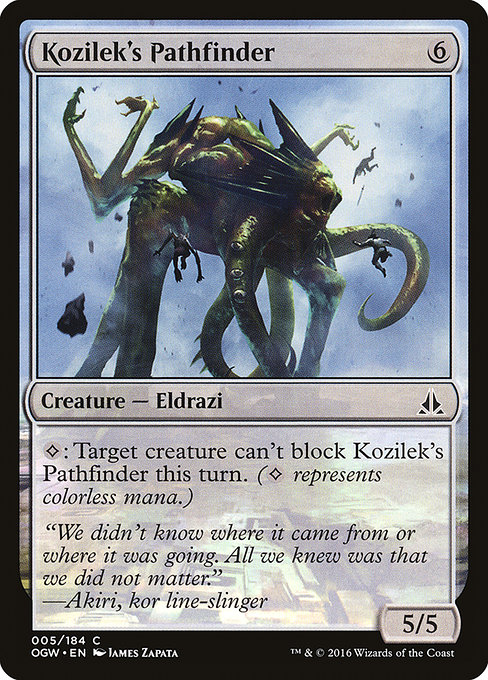
Image courtesy of Scryfall.com
What Parody Cards Teach About MTG Culture: Kozilek's Pathfinder
Parody cards aren’t just jokes printed on cardboard; they’re cultural artifacts that reveal how players read the game, share inside jokes, and negotiate identity within a sprawling multiverse. In a hobby where countless decks chase personal expression as much as victory, a card like Kozilek's Pathfinder—a 6-mana, colorless Eldrazi from Oath of the Gatewatch—offers a perfect lens. It’s a reminder that MTG isn’t just a strategy game; it’s a living archive of how we talk about power, mysteries, and the thrill of the chase. 🧙♂️🔥💎
The card’s design is a study in contrast. It’s a colorless 5/5 from the Eldrazi-infested world of the Blind Eternities, which means it carries no traditional color alignment to water-down its lore or its mechanical niche. Its mana cost is a pure, stubborn {6}, demanding patient planning and a willingness to commit to a longer-game plan. And then there’s the line of text: {C}: Target creature can't block this creature this turn. — a simple ability, but one with outsized implications in both casual and competitive play. The colorless “C” symbol (representing colorless mana) is more than flavor here; it’s a nod to the broader design space that fans celebrated in the OGW era: the rise of Eldrazi-infused, colorless-heavy strategies that challenged traditional expectations about what a mana curve could look like. ⚔️🎲
Kozilek’s Pathfinder in the wilds of game culture
On the table, Pathfinder is a blunt instrument that can break a stagnating board stall. In practice, it rewards careful timing and deck construction: you’m pay the cost to erase blockers for a turn, press through for damage, or threaten to end a standoff before your opponent can stabilize. That flavor of tempo—pay to manipulate combat, reap the immediate payoff, and revel in the dramatic flip of fate—speaks to the heart of parody culture: a community that loves to remix power dynamics, poke at meta-narratives, and celebrate clever plays that feel almost cinematic. The flavor text—“We didn't know where it came from or where it was going. All we knew was that we did not matter.” — Akiri, kor line-slinger — adds a layer of mythic mystery to the card, inviting players to fill the gaps with their own jokes, theories, and fan-fiction about Eldrazi wanderers and their improbable road trips through the Multiverse. 💎
“We didn't know where it came from or where it was going. All we knew was that we did not matter.”
The artistry by James Zapata, with its stark black borders and the ominous form of the Eldrazi, reinforces a core truth about parody: great cards—parody or not—are often remembered for their design language as much as their rules text. The piece sits in the OGW frame, a time when Magic’s colorless shift was turning heads in competitive circles and casual circles alike. The art isn’t just decoration; it’s a cue that the culture around parody cards is as much about the art-and-idea ecosystem as it is about sums of power on the battlefield. 🎨🧩
From a collector’s lens, Kozilek’s Pathfinder also teaches a subtle truth about value in MTG culture. It’s a common card with foil availability, which means you’ll frequently see it in sleeves among budget builds or as a shared joke in EDH tables. The price tag—about a few dollars for non-foil and a touch more for foil—reflects its status as a beloved, accessible piece rather than a powerhouse staple. Even as a common, its place in community storytelling remains priceless: it’s a talking point about how players interpret colorless power, and how a single line of rules text can shape entire meme ecosystems around unblockable plans and tempo-driven swings. 🔥💎
Parody and identity in MTG aren’t limited to Unhinged or social media memes; they show up in the way players weave humor into deck building. A card like Kozilek’s Pathfinder becomes a touchpoint for discussing how far you’re willing to push a game plan, how you manage blockers when your own board state is under pressure, and how you narrate your wins with a wink. The broader network of articles you’ll find around the Digital Vault ecosystem—ranging from “parody and identity in MTG” to “modern texture design elevates social media branding”—illuminates how MTG culture travels beyond the cards themselves. It’s a reminder that the deck you bring to the table is also the story you tell about your own gaming family. 🧙♂️🎲
Design, culture, and the ongoing conversation
As games and memes continue to collide, parody cards like Kozilek’s Pathfinder function as cultural barometers. They reveal what players value in a dynamic, what they fear in a meta, and how they use humor to soften the stakes of competition. The card’s colorless identity echoes a broader trend: the rise of “colorless matters” archetypes, where raw stats and blunt edges compensate for a lack of flashy colors. It’s a design conversation that’s both nostalgic—remembering OGW’s bold experiments—and forward-looking, as new sets continue to push the envelope with artifact-centric, colorless, and modal possibilities. ⚔️🎨
And so, the little jokes we tell around a 6-mana 5/5 with a single activation cost to torment blockers aren’t just laughs at the table; they’re a living archive of how MTG players negotiate power, humor, and community in a game that’s as much about storytelling as it is about removing blockers. Parody cards teach us that culture in MTG isn’t just carved in stone: it’s etched in every clever line of text, every shared meme, and every time we pull off a pathfinding play that makes the whole table lean in with a grin. 🧙♂️💫
Ready to explore a bit more of the network’s diverse perspectives on gaming culture? The five linked pieces below offer a spectrum of angles—from parody and identity in MTG to the artistry of modern design and even deep dives into trading card stats across related games. Dive in and see how other communities are talking about game culture, branding, and the ever-evolving landscape of collectible card play.
Slim Glossy Phone Case for iPhone 16 Lexan PCMore from our network
- https://blog.digital-vault.xyz/blog/post/parody-and-identity-in-mtg-march-from-the-black-gate/
- https://wiki.digital-vault.xyz/wiki/post/pokemon-tcg-stats-fairy-charm-ability-card-id-sm10-171/
- https://blog.crypto-articles.xyz/blog/post/nft-data-ms-cats-396-from-ms-cats-collection-on-magiceden/
- https://blog.digital-vault.xyz/blog/post/modern-texture-design-elevates-social-media-branding/
- https://wiki.digital-vault.xyz/wiki/post/pokemon-tcg-stats-farfetchd-card-id-sm9-127/
Kozilek's Pathfinder
{C}: Target creature can't block this creature this turn. ({C} represents colorless mana.)
ID: b75585bd-fdd8-44d1-8c7c-b96df5fc473e
Oracle ID: de5a8edb-c41a-4f3a-9231-c54486ba7739
Multiverse IDs: 407515
TCGPlayer ID: 111046
Cardmarket ID: 287322
Colors:
Color Identity:
Keywords:
Rarity: Common
Released: 2016-01-22
Artist: James Zapata
Frame: 2015
Border: black
EDHRec Rank: 18378
Penny Rank: 13937
Set: Oath of the Gatewatch (ogw)
Collector #: 5
Legalities
- Standard — not_legal
- Future — not_legal
- Historic — not_legal
- Timeless — not_legal
- Gladiator — not_legal
- Pioneer — legal
- Modern — legal
- Legacy — legal
- Pauper — legal
- Vintage — legal
- Penny — legal
- Commander — legal
- Oathbreaker — legal
- Standardbrawl — not_legal
- Brawl — not_legal
- Alchemy — not_legal
- Paupercommander — legal
- Duel — legal
- Oldschool — not_legal
- Premodern — not_legal
- Predh — not_legal
Prices
- USD: 0.10
- USD_FOIL: 0.31
- EUR: 0.10
- EUR_FOIL: 0.19
- TIX: 0.03
More from our network
- https://crypto-acolytes.xyz/blog/post/nft-stats-gib-1523-from-gib-collection/
- https://wiki.digital-vault.xyz/wiki/post/pokemon-tcg-stats-chespin-card-id-xy8-9/
- https://wiki.digital-vault.xyz/wiki/post/pokemon-tcg-stats-dragonair-card-id-ex11-41/
- https://blog.digital-vault.xyz/blog/post/celestial-drift-of-a-32852-k-hot-blue-star-at-30-kpc/
- https://blog.crypto-articles.xyz/blog/post/nft-data-pump-punks-998-from-pump-punks-collection-on-magiceden/