

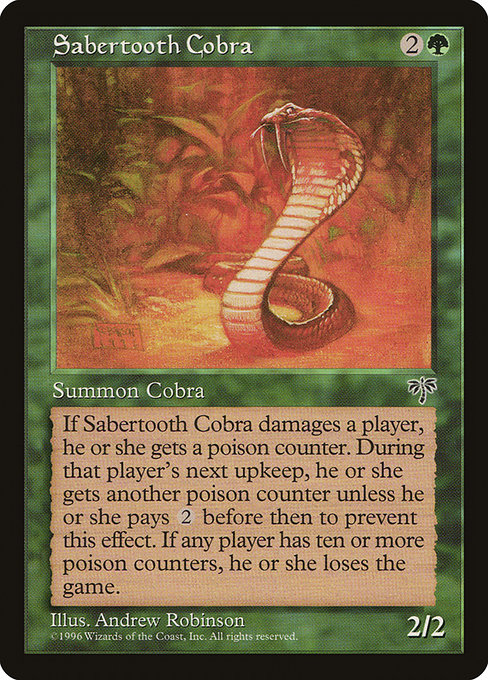
Image courtesy of Scryfall.com
The Alchemy of Art: Why Some MTG Images Stand the Test of Time
Magic: The Gathering has always been more than a collection of numbers and rules—it’s a tapestry woven from color, composition, and lore. Some pieces achieve iconic status not merely because they sit on a card that sees tournament play, but because the artwork crystallizes a moment, a mood, or a creature so fully that the image becomes inseparable from the memory of the game itself 🧙♂️🔥. Sabertooth Cobra, a Mirage-era member of the green cohort, is a prime example. It’s not just a creature with a green mana cost; it’s a window into a mid-90s fantasy aesthetic where color, danger, and the jungle danced together on the card frame.
Sabertooth Cobra appeared in Mirage, released in 1996, a period when MTG art was transitioning from the bold, high-contrast lines of earlier years to a warmer, more painterly texture. The Cobra’s simple 2/2 body for {2}{G} fits green’s love of efficient bodies, but the image—courtesy of Andrew Robinson—does more than convey stats. The serpent is poised with a tension that feels almost cinematic: a predator coiled in verdant shadow, fangs bared, scales catching the dappled light. It is the kind of image that invites you to imagine the scent of rain-wet leaves, the hiss of a stalk, and the precision of a strike. In that single frame, art communicates mood, tempo, and the jungle’s quiet, deadly grace 🎨.
“Iconic art renders the world in a single glance—color, atmosphere, and memory coalescing into something you’ll recognize at a distance.”
Mechanics and art share a surprising kinship in Sabertooth Cobra. The card’s text introduces a pulse you can feel even when you’re not staring at the image: a trigger on damage that enforces a slow, creeping pressure on your opponent’s life total through poison counters. When this creature deals damage to a player, that player receives a poison counter; at the next upkeep, they face another counter unless they pay {2} before that step. It’s a reminder that green, though classically associated with growth and resilience, can introduce bite—an effect not of big numbers, but of persistent pressure. The interplay between the art’s venomous vibe and the card’s clockwork mechanic helps explain why Sabertooth Cobra sticks in memory: the image and the text reinforce a theme of risk, precision, and the jungle’s hidden dangers 🐍⚔️.
From a design perspective, Mirage’s Sabertooth Cobra embodies the era’s pragmatic elegance. It’s a common creature with a straightforward stat line, but the illustration elevates it. The artwork’s composition—slender, sinuous form set against dense emeralds, with careful attention to light and shadow—reads as both a natural predator and a symbol of green’s ecological finesse. Andrew Robinson’s lines are crisp enough to read in a scan, yet painterly enough to reward a closer, slower look. That balance—immediacy at first glance, depth upon inspection—helps a card become iconic. You don’t just see a snake; you feel a moment in the wild where danger lingers just out of frame 🧭.
Let’s talk about the color language. Green in Sabertooth Cobra is more than a hue; it’s a mood. It suggests life cycles, camouflage, and the cunning of ambush. The cobra’s posture implies motion and intention, hinting at the precise moment before an attack. In the broader tapestry of MTG art, such moments—where a creature’s anatomy and its narrative purpose align—generate a sense of storytelling that fans carry from draft nights to casual Saturdays. When you flip through Mirage packs or cave into a vintage EDH table, Sabertooth Cobra’s image lingers because it whispers an old-school jungle story that players instantly recognize and appreciate 🧙♂️💚.
For collectors and nostalgia seekers, Sabertooth Cobra is a gentle reminder that the value of iconic MTG art isn’t solely tied to rarity or utility in a deck. Its common rarity belies its enduring appeal, a sign that art can outlive the card’s market tier when it captures a moment of balance between beauty and bite. Mirage’s borders, the 1997 frame era, and the card’s modest price point (a reminder of how accessible vintage artwork once felt) contribute to its aura. The Cobra sits comfortably at the crossroads of form and memory, a perfect postcard from an era when the game was still expanding into the multiverse’s wider magical imagination 🔮.
Designers and illustrators often talk about the responsibility of giving a creature a silhouette that reads at a distance and rewards a closer look. Sabertooth Cobra accomplishes that with a few strokes—curved back, glistening fangs, a hints-of-forest palette. It’s that dual-layer experience: the initial read as a green drop on the stack, followed by the lap of detail that reveals a story of predation and survival. In a way, the art anticipates MTG’s later evolution toward more elaborate narratives in card frames; here, a single creature breathes life into a fully fledged woodland ecosystem on cardboard 🧩.
As you revisit Sabertooth Cobra, you’re also revisiting a time capsule of the game’s broader culture. The Mirage era was flush with vivid fantasies, and this card’s image captures a particular vibe: a world where danger lurks in lush, sun-dappled canopies, where a small creature can bend the game’s tempo with the threat of poison counters. It’s a reminder that iconic MTG art isn’t solely about spectacle; it’s about the stories those pictures tell, the strategies they foretell, and the memories they evoke when you’re across the table from a familiar green silhouette ❇️.
With Sabertooth Cobra, the memory lingers not because it’s a flashy mythic, but because it embodies a quiet mastery: an artwork that resonates with color theory, a mechanic that creates tension, and a nostalgia that makes veterans smile. If you’re hunting for a tangible reminder of Mirage’s elegance, this card offers a compact, accessible piece of that era’s artful magic. And if you’re carrying a modern device through your daily quests, you can do so with the same rugged confidence you see in a well-drawn forest predator—protected by your own version of a Sabertooth Cobra’s jungle-ready resolve 🧭🎲.
Rugged Phone CaseMore from our network
- https://crypto-acolytes.xyz/blog/post/nft-stats-pandarianz-467-from-the-pandarianz-collection/
- https://crypto-acolytes.xyz/blog/post/dynamic-world-events-that-keep-mmorpgs-alive/
- https://wiki.digital-vault.xyz/wiki/post/pokemon-tcg-stats-gastly-card-id-swsh11-064/
- https://wiki.digital-vault.xyz/wiki/post/pokemon-tcg-stats-dedenne-gx-card-id-sm10-219/
- https://blog.crypto-articles.xyz/blog/post/nft-data-bogi-pass-147-from-bogi-pass-collection-on-magiceden/
Sabertooth Cobra
Whenever this creature deals damage to a player, that player gets a poison counter. The player gets another poison counter at the beginning of their next upkeep unless they pay {2} before that step. (A player with ten or more poison counters loses the game.)
ID: 48ead72b-f3f5-4065-a33c-0992cf1fdb34
Oracle ID: 115c7ca7-c27b-43ca-9281-be6913e90059
Multiverse IDs: 3407
TCGPlayer ID: 5209
Cardmarket ID: 8187
Colors: G
Color Identity: G
Keywords:
Rarity: Common
Released: 1996-10-08
Artist: Andrew Robinson
Frame: 1997
Border: black
EDHRec Rank: 18518
Penny Rank: 16668
Set: Mirage (mir)
Collector #: 238
Legalities
- Standard — not_legal
- Future — not_legal
- Historic — not_legal
- Timeless — not_legal
- Gladiator — not_legal
- Pioneer — not_legal
- Modern — not_legal
- Legacy — legal
- Pauper — legal
- Vintage — legal
- Penny — not_legal
- Commander — legal
- Oathbreaker — legal
- Standardbrawl — not_legal
- Brawl — not_legal
- Alchemy — not_legal
- Paupercommander — legal
- Duel — legal
- Oldschool — not_legal
- Premodern — legal
- Predh — legal
Prices
- USD: 0.15
- EUR: 0.29
- TIX: 0.04
More from our network
- https://blog.crypto-articles.xyz/blog/post/nft-data-three-headed-shiba-006-from-baby-dowge-collection-on-magiceden/
- https://wiki.digital-vault.xyz/wiki/post/pokemon-tcg-stats-flareon-card-id-sv035-136/
- https://blog.crypto-articles.xyz/blog/post/arcanine-break-dominates-fast-tempo-decks-in-pokemon-tcg/
- https://crypto-acolytes.xyz/blog/post/nft-stats-rektardio-593-from-rektardio-collection/
- https://crypto-acolytes.xyz/blog/post/nft-stats-tardio-346-from-tardio-collection/