
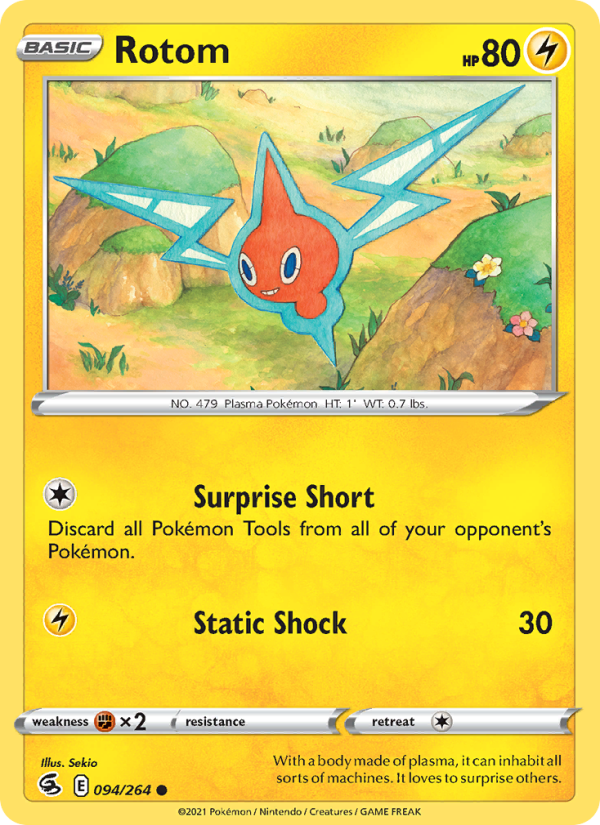
Image courtesy of TCGdex.net
Forecasting Rotom's TCG Trajectory with Machine Learning
In the vibrant ecosystem of the Pokémon Trading Card Game, even a humble Basic Pokémon can become a bellwether for futures—to both decks and collections. Rotom, the Plasma-bodied Electric presence from Fusion Strike, is a terrific case study for what modern machine learning models can tell us about a card’s evolving role. This Lightning-type 80 HP staple carries two surprisingly versatile attacks and a flavor that begs to be explored through data: a strategic niche shaped by Tool interactions and a price curve that reflects both supply and meta demand. ⚡ As of the latest data, Rotom swsh8-94 sits in Expanded formats but does not cross into Standard play, a detail that itself informs how predictive models weigh rotation risk against deck viability.
From the outset, Rotom’s stat line and toolkit hint at a slow-burn but influential footprint. A Common rarity in Fusion Strike, its basic form relies on a pair of attacks that are anything but ordinary in practice. The first move, Surprise Short, costs Colorless and has a strategic kicker: it forcibly disrupts the opponent’s board by discarding all Pokémon Tools from every opposing Pokémon. The second attack, Static Shock, lands a neat 30 damage for a Lightning energy cost. In ML terms, Rotom’s price and playability hinge on two levers: the frequency of Tool-heavy decks and the broader volatility of the Expanded ecosystem where it currently resides. This makes Rotom an appealing subject for a suite of models that blend market signals with deck archetype signals. 🔎
Card snapshot: Rotom swsh8-94 in Fusion Strike
- Name: Rotom
- Set: Fusion Strike (swsh8)
- Rarity: Common
- Type: Lightning
- Stage: Basic
- HP: 80
- Attacks:
- Surprise Short — Cost: Colorless — Effect: Discard all Pokémon Tools from all of your opponent's Pokémon.
- Static Shock — Cost: Lightning — Damage: 30
- Retreat: 1
- Regulation Mark: E
- Illustrator: Sekio
- Legal formats: Expanded only (Standard not currently supported)
That toolkit—an on-demand tool-disruption engine paired with a modest damage punch—creates a dynamic where Rotom can shine as a disruptive pivot in longer games. ML systems often reward disruption when it translates into stalled opponent setups or delayed power pushes. But Rotom’s own fragility, with 80 HP and a single-Energy–afforded punch, keeps it honest: it’s a strategic tempo piece rather than a tank or high-variance finisher. The artful illustration by Sekio adds to its collectible appeal, a factor modern models increasingly capture via visual-manifold features that correlate artwork with card desirability. 🎨
What machine learning models tell us about Rotom’s future
When we forecastRotom’s trajectory, a few model categories come into play. Time-series approaches—such as ARIMA, Exponential Smoothing, and Prophet—can project price curves using historical price points drawn from CardMarket and TCGPlayer data. For Rotom, the normal rarity pool sits in a sweet, low-price territory (approximate mid-price around $0.12 with occasional spikes), while the holo variants—when present—tend to attract higher baselines (roughly around $0.15 or more). These signals suggest a classic “low-cost entry, occasional volatility” profile that ARIMA and Prophet can model well, especially when seasonality aligns with rotations and deck trends. Beyond univariate forecasting, multivariate and neural models, including LSTMs or Transformer-based time-series models, can incorporate exogenous features: format legality (Expanded vs. Standard), tool-card prevalence in the current meta, and the rate at which Tool-centric strategies appear in deck lists. In Rotom’s case, the Surprise Short attack directly interacts with Tool-heavy strategies, so features capturing Tool-related card draw, removal, and parity shifts in Expanded could meaningfully improve accuracy. A graph-based approach could even map Rotom’s price sensitivity to adjacent Tool-removal staples and Lightning-type staples, revealing network effects in play and price. 🔬
Recent dataset details add texture to these predictions. CardMarket shows a low price near €0.01 and a mid price around €0.12 for non-holo Rotom, with occasional spikes toward €2.00 in rare moments where demand aligns with tool-removal narratives or reprint rumors. On TCGPlayer, normal copies hover around $0.12, with holo distinctions pushing that range higher (still a bargain by most standards). For ML practitioners, these numbers illustrate a landscape where Rotom is ripe for probabilistic forecasting: occasional surges when specific deck archetypes rise, tempered by broad supply in a large print run. The accessibility of Expanded-format play means there’s a larger, more diverse data stream for models to learn from, though that also introduces more volatility during rotation shifts. 💎
Strategic takeaways for players and collectors
For players, Rotom is a reminder that disruption can coexist with a lean stat line. If you’re piloting an Engine-heavy or Tool-focused deck, Rotom’s Surprise Short offers a global action that can delay an opponent’s setup across multiple fronts. In practice, you’d couple Rotom with cards that establish tempo—paralysis on early turns, pressure on the opponent’s resources, and a plan to finish after you’ve pried open an advantage with Tool removal. The 1 retreat cost keeps Rotom nimble for tempo lines, while Static Shock provides a modest, reliable source of damage when you don’t need to rely on your bench to finish. 🎮 From a collector’s perspective, Rotom’s Fusion Strike art by Sekio combines nostalgia with a modern electric aesthetic. Its Common rarity makes it an affordable entry point for new collectors, yet the right moment—perhaps a rotation window or a tool-heavy meta shift—can tilt demand toward a spike in price and trade interest. The Expanded legality also means it remains a talking point for those who track format-centric markets and the cross-format dynamics that ML models are increasingly trained to interpret. ⚡
Art, lore, and the data-driven future
Rotom’s lore—a playful, mischievous Pokémon that inhabits machines—aligns nicely with a modern data narrative: in a world where tools and tech define pace, a Pokémon that disrupts equipment can become a strategic pivot. Sekio’s illustration breathes electric personality into the card, a factor that ML systems increasingly weigh when predicting collector sentiment and market value. The Fusion Strike era, with its broad card pool and robust card counts (hundreds of cards across official print runs), provides ample data for models to detect subtle shifts in valuation and demand. 🎴
For readers curious about broader context, a curated set of related readings from our network offers a glimpse into how data, art, and game design intersect in the Pokémon world:
Phone Grip Click-On Reusable Adhesive Holder KickstandMore from our network
Rotom
Set: Fusion Strike | Card ID: swsh8-94
Card Overview
- Category: Pokemon
- HP: 80
- Type: Lightning
- Stage: Basic
- Dex ID: 479
- Rarity: Common
- Regulation Mark: E
- Retreat Cost: 1
- Legal (Standard): No
- Legal (Expanded): Yes
Description
With a body made of plasma, it can inhabit all sorts of machines. It loves to surprise others.
Attacks
| Name | Cost | Damage |
|---|---|---|
| Surprise Short | Colorless | |
| Static Shock | Lightning | 30 |
Pricing (Cardmarket)
- Average: €0.03
- Low: €0.02
- Trend: €0.04
- 7-Day Avg: €0.02
- 30-Day Avg: €0.03
Support Our Decentralized Network
Donate 💠More from our network
- https://blog.digital-vault.xyz/blog/post/ampharos-music-remixes-and-pokemon-fan-tributes/
- https://transparent-paper.shop/blog/post/stable-diffusion-xl-prompt-quantum-surrealism-comic-book-panels-infinite-recursion-mirror-texture-gold-foil-bold-line-art/
- https://blog.crypto-articles.xyz/blog/post/nft-data-mebananas241-from-monkeyseatbananas-collection-on-magiceden/
- https://wiki.digital-vault.xyz/wiki/post/pokemon-tcg-stats-m-charizard-ex-card-id-xy2-69/
- https://wiki.digital-vault.xyz/wiki/post/pokemon-tcg-stats-shiftry-card-id-ex12-12/