
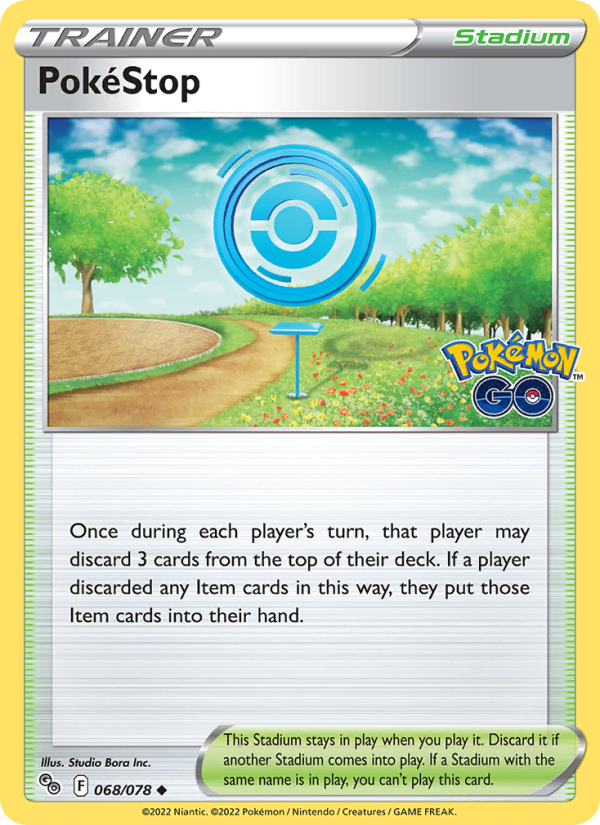
Image courtesy of TCGdex.net
What factors shape Poké Stop's long-term value in Pokémon TCG
Poké Stop lands in a colorful niche of the Pokémon Trading Card Game: a Stadium Trainer introduced in the Pokémon GO expansion (set code swsh10.5). Its Uncommon rarity and the fact that it’s a Stadium—rather than a Pokémon or Energy card—place it in a different queue of demand than many chase cards. As collectors and players alike watch the meta evolve, a few constant forces tend to shape its long-term value: how often Stadium cards appear in decks, how it interacts with item-heavy strategies, the mechanics of the GO set itself, and the broader rotation of formats that keep standard play fresh. ⚡🔥
First, the set context matters. Poké Stop is part of the Pokémon GO expansion, a unique crossover that brought GO-style themes into the TCG. The card data tells us this is a standard Uncommon with a sanctioned place in Expanded (regulation mark F), but not in Standard. That distinction is more than paperwork: it constrains the card’s exposure to new players and collectors who focus on the Standard rotation. In the long run, that often means Poké Stop sits taller as a niche choice for veteran players who experiment within Expanded or Hobbyists who track every Stadium from special sets. The set’s overall size—88 cards in total with 78 official cards—also frames supply. Fewer total print runs for a GO-era Stadium card can help stabilize value, especially if it sees recurring play in community-created or locally popular decks.
Next, consider the card’s actual effect. Once during each player's turn, you may discard 3 cards from the top of their deck, and if any Item cards were among them, those Items go to the player’s hand. This creates an engine of potential Item recycling and deck thinning—two familiar levers players pull to improve consistency. In practice, that means the card can enable a “draw plus filter” dynamic: you threaten a disciplined discard to fish out Items back to hand, accelerating access to crucial tools like Poké Balls, Treasures, or draw-support Items late in the game. The long-term value, then, rests not just on raw power but on how the meta in Expanded adapts to Item-focused strategies and whether a deck archetype emerges that can reliably leverage this Stadium in multiple matches. In other words, Poké Stop’s value is tied to how much players value Item recursion in a disciplined Stadium slot, and how often Item-based engines appear in the evolving pool of competitive decks. 🎴🎨
Market dynamics also tug on long-term value. The Card Market data snapshot provided shows a modest but positive trend for this card: an average price around 0.02 EUR, with a 30-day glimpse around 0.21 EUR and a 30-day trend of about 0.11. In practical terms, Poké Stop is generally an affordable addition for most collectors, which lowers entry barriers and increases its appeal to shielded-investors who favor steady, long-horizon growth rather than jumps in price. This kind of price behavior—low entry, slow appreciation—often pairs well with the collector’s dream of a complete GO-era Stadium lineup. It isn’t a “get-rich-quick” card, but it can drift upward as the GO subset gains nostalgic respect and as Expanded-focused players seek underrated tools to shore up their decks. 💎
Another factor is rarity and print lifecycle within the GO set. As an Uncommon, Poké Stop sits between the more frequently seen Common Trainers and the rarer Trainer staples that define meta shifts. The presence of both a Normal and a Reverse variant in the GO set adds a layer of collectibility: while non-holo often trades for practical value, Reverse Holos tend to command a premium among completionists. If the GO era undergoes a broader “stadium nostalgia” phase—where players chase the Stadiums that defined post-rotation play—the long-term value of Poké Stop could breathe a bit more on the collector’s side, especially for players who aim to assemble the full set or complete GO-themed booster boxes. 🧩
Strategic takeaways for players and collectors
- Expanded-only relevance matters. Since Poké Stop isn’t standard-legal, its value hinges on players who persist in Expanded formats or casual collectors who chase GO-era cards. If Expanded remains a vibrant, community-driven format, the card’s demand could endure even as Standard rotates. ⚡
- Item synergy is king. The card’s ability to recycle Item cards makes it attractive to decks that lean heavily on Item-based tools. Identify Item-rich lines in the GO set and project how they might interact with a reliable Stadium in the late game. This is where long-term value gets texture beyond mere rarity. 🔧
- Condition and finish matter more for Uncommons. With both Normal and Reverse variants, mint copies—particularly in good sleeves and centering—can hold steadier value for graded collectors who pursue completeness or high-grade GO-era runs. The market tends to reward solid condition, even for lower-rarity cards that see consistent play. 🧼
- Watch for reprint signals. Stadium cards are often revisited in print cycles, especially when a subset gains fans for its thematic cohesion. If a reprint or alternate art drops in a future GO-themed release, Poké Stop’s value could experience a gentle recalibration. Stay tuned to set announcements and price trackers. 📰
- Judging the long arc. For investors, the yardstick isn’t a quick spike but consistent, tempered growth. The combination of Expanded usability, Item-recycling potential, and GO-set nostalgia positions Poké Stop as a thoughtful addition to a diversified collection rather than a single-punch winner. 📈
Art, lore, and the GO crossover vibe
Poké Stop as a Stadium taps into the feel of the GO universe—where real-world locations and GO’s catching rhythms collide with the Pokémon TCG’s strategic tempo. The GO expansion used familiar icons in fresh ways, giving Trainers a thematic anchor that’s easy to recognize on the table and in the binder. For fans who grew up exploring GO Gyms and PokéStops, this card offers a tangible link to the crossover era—the nostalgia factor alone can add intangible long-term value for collectors who chase memories as much as mechanics. And while the illustrator credit isn’t listed in every database, we celebrate the artistry that keeps these GO cards looking crisp and collectible in long-term storage. 🎴🌟
With all that in mind, collectors and players alike should consider a measured approach. If you’re building an Expanded collection or hunting for GO-era staples, Poké Stop represents a sensible piece that can both function in decks and appreciate as part of a GO-themed archive. Its practical utility—tied to deck-thinning and Item recapture—adds a layer of functional value that complements the nostalgia-fueled allure. ⚡🃏
Clear Silicone Phone Case - Slim Durable ProtectionMore from our network
PokéStop
Set: Pokémon GO | Card ID: swsh10.5-068
Card Overview
- Category: Trainer
- HP:
- Type:
- Stage:
- Dex ID:
- Rarity: Uncommon
- Regulation Mark: F
- Retreat Cost:
- Legal (Standard): No
- Legal (Expanded): Yes
Description
Pricing (Cardmarket)
- Average: €0.02
- Low: €0.02
- Trend: €0.11
- 7-Day Avg: €0.03
- 30-Day Avg: €0.21
Support Our Decentralized Network
Donate 💠More from our network
- https://crypto-acolytes.xyz/blog/post/devil-238-de-evils-nft-stats/
- https://wiki.digital-vault.xyz/wiki/post/pokemon-tcg-stats-golurk-card-id-swsh9-083/
- https://crypto-acolytes.xyz/blog/post/golden-boy-58-golden-boy-nft-stats/
- https://transparent-paper.shop/blog/post/stable-diffusion-xl-prompt-graphic-novel-neon-collage-mixed-media-texture-halftone-cyberpunk-neon-noir/
- https://blog.crypto-articles.xyz/blog/post/nft-data-george-plays-clash-royale-epic-348-from-gpcr-nft-collection-collection-on-magiceden/