

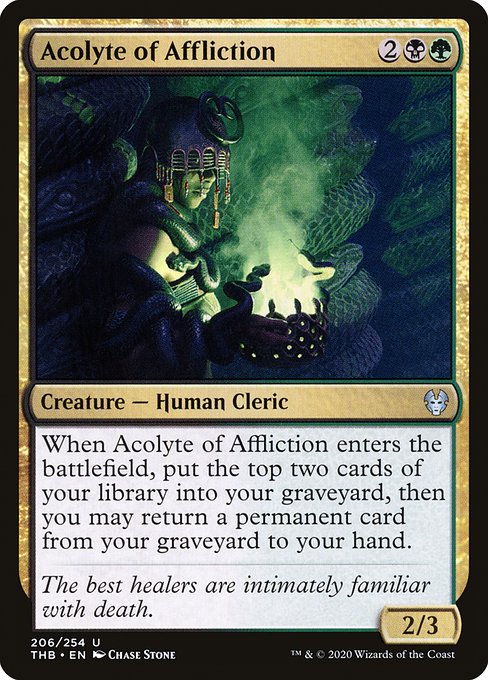
Image courtesy of Scryfall.com
Design Chaos and Human Behavior: Acolyte of Affliction in Focus
Magic: The Gathering has always thrived on a delicate tension between control and chaos, a dance that reveals a lot about how we humans approach risks, rewards, and memory itself. Acolyte of Affliction, a Theros Beyond Death uncommon from the black-green spectrum, is a little theater of that tension. With a mana cost of {2}{B}{G}, it sits at 4 mana and slides neatly into midrange graveyard strategies. Its body is modest—2 power, 3 toughness—but its entrance is an invitation to examine decision-making under imperfect information. When this creature enters, you mill two cards, and then you may return a permanent card from your graveyard to your hand. It’s a package that feels like a weather vane for how players treat chance, memory, and the promise of recursion in a game that rewards both cunning and courage 🧙♂️🔥.
The dual-color identity of B and G anchors Acolyte in a long tradition of decks that flirt with the graveyard as a resource. Mill effects have always inspired a certain caution in players: you’re tearing through the top of your library, which means you’re also shaping what you’ll draw next, and you’re opening the door to rematerializing cards you thought were gone for good. The mill here is gentle but persistent—two cards at a time—yet the real juice is the second half: a potential return from the graveyard to your hand. That moment-to-moment choice—how aggressively do you dig, and when do you reach back to recover a critical piece—speaks volumes about how wielders of fate interpret risk and agency in a card game 🪄.
“The best healers are intimately familiar with death.” —Flavor text from Acolyte of Affliction
That flavor text isn’t just whimsy. It encapsulates how design often wants us to confront uncomfortable truths with a steady hand. The Acolyte embodies that paradox: a cleric who leans into the afterlife as part of the healing process. In practice, you’re not just milling for milling’s sake; you’re creating cedes and reservoirs—your graveyard becomes a pantry from which you can fetch a permanent card when you need it. It’s a design that rewards planning, yet it invites improvisation, a hallmark of chaos that MTG veterans actually savor. The card nudges you to ask: Do I prefer a tight, predictable plan, or do I trust the chaos to drop a critical piece back into play when the moment matters most ⚔️🎨?
From a game-design perspective, Acolyte of Affliction illustrates how chaos can be harnessed without tipping into frustration. The mill is not an outright punishment; it’s a strategic screen that reveals information—what you’re likely to draw next, what you’re enabling in your graveyard, and which permanents are ripe for exploitation when the time is right. In a world where removal and tempo strategies often steal the limelight, the Acolyte’s arrival signals a different kind of power: resurrection and resourcefulness. The synergy between milling and graveyard recursion creates a feedback loop that can reshape a game state in a few turns, especially in formats that embrace longer, more interactive plays 🧠💡.
It’s also worth noting how this card reflects the thematic heartbeat of Theros Beyond Death. The set leans into death’s inevitability and the uneasy peace it offers—life’s cycles, rebirth, and the stubborn persistence of memory. Acolyte’s 2/3 body is not what you cast for raw resilience; it’s a pivot point for a strategy that thrives on “what you remember you still can do.” The two-card mill acts as a memory tax and a map, nudging players to consider which cards are “worth saving” from the graveyard and which ones are better forgotten. In a meta that often punishes slow, methodical play, this card offers a humane reminder that sometimes the most elegant solutions emerge from embracing the unknown and choosing to trust the next draw with a well-timed rescue from the graveyard 🧙♂️💎.
How do players actually deploy Acolyte in practice? In Limited, it’s a strong addition to a greedy strategy that appreciates both graveyard synergy and midrange pressure. In Constructed, it slides into burrs of BG or Sultai shells where reanimation, graveyard value, and board presence collide. The card’s rarity—uncommon—speaks to its flexible power: not a bomb, but a reliable engine that can tilt a game if you lean into it. And because Acolyte is both a mill threat and a reanimation trigger, it invites a spectrum of plays—from casting to exile—making each match feel a little different than the last. The volatility of the graveyard becomes a feature, not a flaw, and that’s the core charm of design chaos in MTG 🧩🔥.
For players who savor the nuts and bolts of strategy, Acolyte also serves as a great case study in how card design communicates intent. The set’s mythos gives consent for death as a tool, not just a consequence, and the card’s text confirms that sentiment: you mill, you may reanimate, and you decide when the graveyard should become a springboard. It’s a microcosm of the broader question: how do we humans respond when randomness and memory intersect in a shared space? Do we clutch at control, or do we lean into the flow and sculpt the outcome with careful, courageous choices 🧲⚖️?
Whether you’re a veteran of Burnishing Reaches or a curious newcomer chasing design stories, Acolyte of Affliction invites you to read your own behavior across the surface of the battlefield. It’s not just a card; it’s a design experiment wearing a cloak of necromantic mercy. The mill may take a breath, but the graveyard holds the chorus: a chorus you’ll melodically conduct as you steer toward the win, one carefully resurrected step at a time 🧪🎯.
Speaking of balancing acts and practical gear in the real world, a little tangential inspiration never hurts. If you’re carrying a device that keeps you connected to the multiverse, you’ll appreciate a slim, resilient case that mirrors the precision and elegance you value in a well-tuned deck. It’s the kind of everyday object that reminds us how small design decisions—like a protective shell for your phone—can echo the same design philosophy we admire in Magic: purposeful, thoughtful, and just a touch mischievous.
For readers curious about other design narratives in the broader card and crypto ecosystem, the linked articles in the network below offer a chorus of perspectives—from NFT data narratives to typography analyses and beyond. They’re not just about trends; they’re about how human behavior weaves through technology, collectibles, and storytelling. Enjoy the journey, and may your draws continue to surprise you in delightful, if chaotic, ways 🧙♂️🔥💎⚔️🎲.
Slim Glossy Polycarbonate Phone Case for iPhone 16More from our network
- https://blog.crypto-articles.xyz/blog/post/nft-data-sir-orion-shattered-573-from-risen-collection-on-magiceden/
- https://crypto-acolytes.xyz/blog/post/nft-stats-alchemist-4064-from-e-lander-alchemist-collection/
- https://blog.rusty-articles.xyz/blog/post/the-fallen-apart-mtg-card-typography-and-layout-analysis/
- https://crypto-acolytes.xyz/blog/post/nft-stats-l964-blast-processor-from-haste-armor-collection/
- https://blog.zero-static.xyz/blog/post/un-set-randomness-unleashed-with-swathcutter-giant/
Acolyte of Affliction
When this creature enters, mill two cards, then you may return a permanent card from your graveyard to your hand.
ID: a14afed6-ca42-442d-ba86-621179e6957c
Oracle ID: d57c246f-18e5-4523-898c-1509db738363
Multiverse IDs: 476457
TCGPlayer ID: 207089
Cardmarket ID: 432434
Colors: B, G
Color Identity: B, G
Keywords: Mill
Rarity: Uncommon
Released: 2020-01-24
Artist: Chase Stone
Frame: 2015
Border: black
EDHRec Rank: 11685
Penny Rank: 2226
Set: Theros Beyond Death (thb)
Collector #: 206
Legalities
- Standard — not_legal
- Future — not_legal
- Historic — legal
- Timeless — legal
- Gladiator — legal
- Pioneer — legal
- Modern — legal
- Legacy — legal
- Pauper — not_legal
- Vintage — legal
- Penny — not_legal
- Commander — legal
- Oathbreaker — legal
- Standardbrawl — not_legal
- Brawl — legal
- Alchemy — not_legal
- Paupercommander — not_legal
- Duel — legal
- Oldschool — not_legal
- Premodern — not_legal
- Predh — not_legal
Prices
- USD: 0.12
- USD_FOIL: 0.25
- EUR: 0.10
- EUR_FOIL: 0.30
- TIX: 0.03
More from our network
- https://wiki.digital-vault.xyz/wiki/post/pokemon-tcg-stats-electrike-card-id-tk-ex-latio-1/
- https://blog.digital-vault.xyz/blog/post/design-editable-pitch-decks-that-impress-investors/
- https://crypto-acolytes.xyz/blog/post/meme-coin-showdown-dogecoin-vs-shiba-inu-vs-pepe/
- https://blog.crypto-articles.xyz/blog/post/nft-data-unique-from-rise-collection-on-magiceden/
- https://wiki.digital-vault.xyz/wiki/post/pokemon-tcg-stats-skeledirge-card-id-sv01-038/