
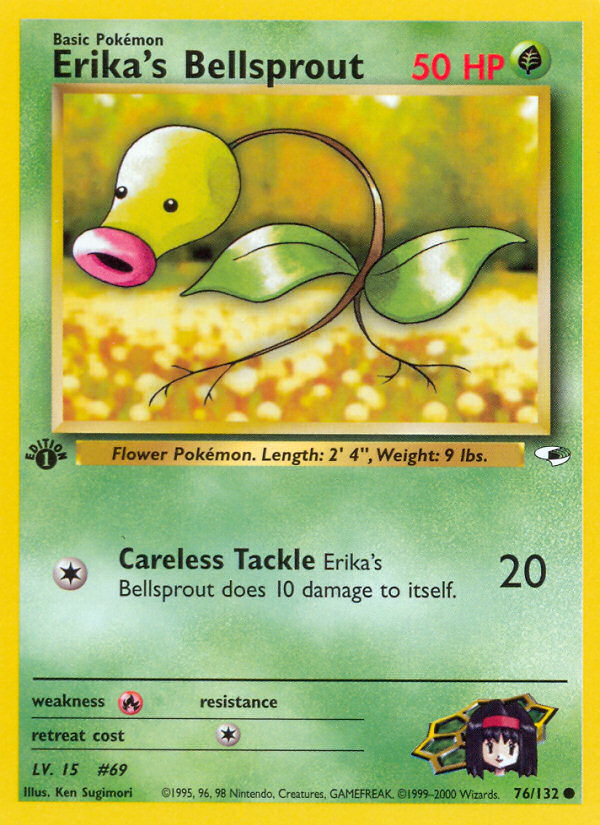
Image courtesy of TCGdex.net
Understanding the constraints behind Erika's Bellsprout’s design
In the Gym Heroes era, a Pokémon card wasn’t just about flashy stats; it was a product of engineering constraints, publishing limits, and the evolving philosophy of the Pokémon Trading Card Game. Erika’s Bellsprout, a humble Grass-type Basic from the Gym Heroes set, embodies those early design decisions with a simplicity that still teaches modern players a few timeless lessons. Its 50 HP, a single Colorless-energy attack, and a self-inflicted twist are not accidents of luck—they’re a deliberate balance of accessibility, risk, and strategic clarity that defined how players learned to craft decks and gauge risk versus reward ⚡.
Core constraints of early Pokémon TCG design
Short text blocks, straightforward transitions, and a limited pool of mechanics were the norm when Gym Heroes released. The game favored quick, teachable experiences, which meant cards tended to feature:
- Low to moderate HP on common/basic Pokémon to keep battles fast and forgivable for new players.
- Energry costs that leaned on the broad “Colorless” or simple energy types, rather than a sprawling ecosystem of special energies and ride-alongs.
- Clear, single-purpose attacks without layered gimmicks that could overwhelm a beginner or slow the turn cadence.
- Rarity tiers that placed familiar names in the hands of casual players and collectors alike, ensuring a steady stream of accessible staples for any deck.
Erika’s Bellsprout sits squarely in that design philosophy. A Basic Grass-type with 50 HP, it’s intentionally affordable to include in early-innings decks, acting as a reliable, cheap start that still nudges players toward thinking about timing and risk. The fact that it’s illustrated by Ken Sugimori—the artist whose work defined the look of the original era—also speaks to a design intent: to fuse approachable mechanics with iconic, instantly recognizable art that fans could rally around 🔥🎨.
Attack design and energy economy
The core move here, Careless Tackle, costs a single Colorless energy and delivers 20 damage to the opponent. But the real design constraint is the text: Erika’s Bellsprout also deals 10 damage to itself when it uses the attack. This is a classic example of early TCG risk management baked into a seemingly simple mechanic. The self-damage creates a delicate balance: you gain early pressure on your opponent, but you’re also trimming your own options in a meta where healing items were scarce and chasing momentum mattered. With 50 HP, that self-harm isn’t crippling, but it’s enough to remind players that every attack has a consequence — a subtle lesson in resource management that is as educational as it is tactical ⚡💎.
The attack’s Colorless cost is another deliberate constraint. It allows Bellsprout to be slotted into a deck with a mix of Grass and Colorless energies without forcing a hard green-dedicated build. This reflects the era’s design philosophy: keep deck-building approachable, encourage players to experiment with different lines, and reward timing and careful play rather than complex combos. The combination of 20 damage and self-damage also mirrors the early game’s emphasis on meeting simple objectives—deal damage to the foe while not overextending on your own frontline. In this sense, Erika’s Bellsprout teaches restraint as a tactical virtue 🔥🎴.
Set context, art, and rarity shaping perception
As a member of Gym Heroes, Erika’s Bellsprout exists within a nostalgia-forward printing that prized clear silhouettes, bold artwork, and a sense of place within a gym-themed arc. The card is marked as Common, underscoring its role as a reliable, accessible piece for players stacking their first decks. It also carries a 1st Edition variant, a badge of collector significance that elevates its status among enthusiasts who chase the tactile thrill of early print runs. The basic status of Bellsprout and its evolution into Weepinbell would have felt natural to players assembling the early game’s evolving lines, reinforcing the joy of growing your roster as you learned the rhythm of rounds and the tempo of matches 🎨💎.
Illustrator Ken Sugimori’s art contributed to a consistent, instantly recognizable look that helped players identify and remember their strongest and most-loved cards. In a time when players were still learning how to judge power curves, the visual clarity of Sugimori’s designs—paired with a simple mechanical footprint—made Erika’s Bellsprout a dependable staple rather than a flashy anomaly. The simplicity is its wisdom: it exists to teach, not overwhelm, and to anchor players in a shared, memorable experience that could be revisited with affection in the years to come ⚡🎮.
“Constraints can breed elegance. When a card is allowed only a few lines of text and a single resource cost, the resulting gameplay feels clean, teachable, and memorable.”
Collector insights and market value of Erika’s Bellsprout
Today, Erika’s Bellsprout sits at the intersection of nostalgia and practical value. Its Common rarity and basic stage mean it remains widely accessible for new collectors and vintage players alike, even as the game has evolved far beyond its earliest rules. Contemporary market data reflects this balance: CardMarket shows an average price around €1.05, with one-day and short-term indicators often hovering near the €1–€1.50 range for more active listings, and a 1st Edition footprint that can push toward the mid-range for collectors seeking that stamp. TCGPlayer’s figures echo a similar pattern: 1st Edition copies typically sit around the $1.50 mark on mid pricing, with lower-end examples dipping toward the dollar range and occasional higher asks for near-mint copies. In Unlimited print runs, prices remain surprisingly accessible, offering a low barrier to entry for anyone revisiting classic Gym Heroes nostalgia. And while this card isn’t legal in Standard or Expanded formats anymore—an expected fate for a nearly 30-year-old basic—it continues to be prized for its historical value and teachable gameplay concepts. If you’re chasing a sense of the era, Erika’s Bellsprout delivers a compact, affordable snapshot of early Pokémon TCG design, with room to appreciate both its art and its mechanics 🎴💎.
For players who enjoy building decks that celebrate the fundamentals—resource management, tempo, and straightforward risk/reward—this card remains a meaningful touchstone. Even in today’s climate of highly specialized decks and advanced trainer-support ecosystems, Erika’s Bellsprout reminds us of where the game began and why those early constraints mattered. It’s a small but mighty reminder that sometimes the simplest ideas yield lasting impact, especially when guarded by the iconic look of Sugimori’s artwork and the gym-town charm of Erika’s world ⚡🎨.
Gaming Mouse Pad 9x7 - Custom Neoprene with Stitched EdgesMore from our network
- Using Deepslate Tile Slab for Cliff Faces and Terrain in Minecraft
- Blue White Star Illuminates the Milky Way: HR Diagram
- Sighted Caste Sorcerer: Why It Became a Cult Favorite
- Stable Diffusion XL Prompt: Cubism & Neon-Lit Surreal Space Architecture
- Chandra, Heart of Fire: Reprint History Across MTG Sets
Erika's Bellsprout
Set: Gym Heroes | Card ID: gym1-76
Card Overview
- Category: Pokemon
- HP: 50
- Type: Grass
- Stage: Basic
- Dex ID: 69
- Rarity: Common
- Regulation Mark: —
- Retreat Cost:
- Legal (Standard): No
- Legal (Expanded): No
Description
Attacks
| Name | Cost | Damage |
|---|---|---|
| Careless Tackle | Colorless | 20 |
Pricing (Cardmarket)
- Average: €1.05
- Low: €0.1
- Trend: €0.97
- 7-Day Avg: €1.21
- 30-Day Avg: €1.1
Support Our Decentralized Network
Donate 💠More from our network
- https://blog.rusty-articles.xyz/blog/post/using-deepslate-tile-slab-for-cliff-faces-and-terrain-in-minecraft/
- https://blog.rusty-articles.xyz/blog/post/blue-white-star-illuminates-the-milky-way-hr-diagram/
- https://blog.digital-vault.xyz/blog/post/sighted-caste-sorcerer-why-it-became-a-cult-favorite/
- https://transparent-paper.shop/blog/post/stable-diffusion-xl-prompt-cubism-neon-lit-surreal-space-architecture-lava-rock-texture-frosted-lavender-mist/
- https://blog.digital-vault.xyz/blog/post/chandra-heart-of-fire-reprint-history-across-mtg-sets/