
Image courtesy of TCGdex.net
Rarity, Variants, and the Pulse of Pull Rates for Unown (SM8-91)
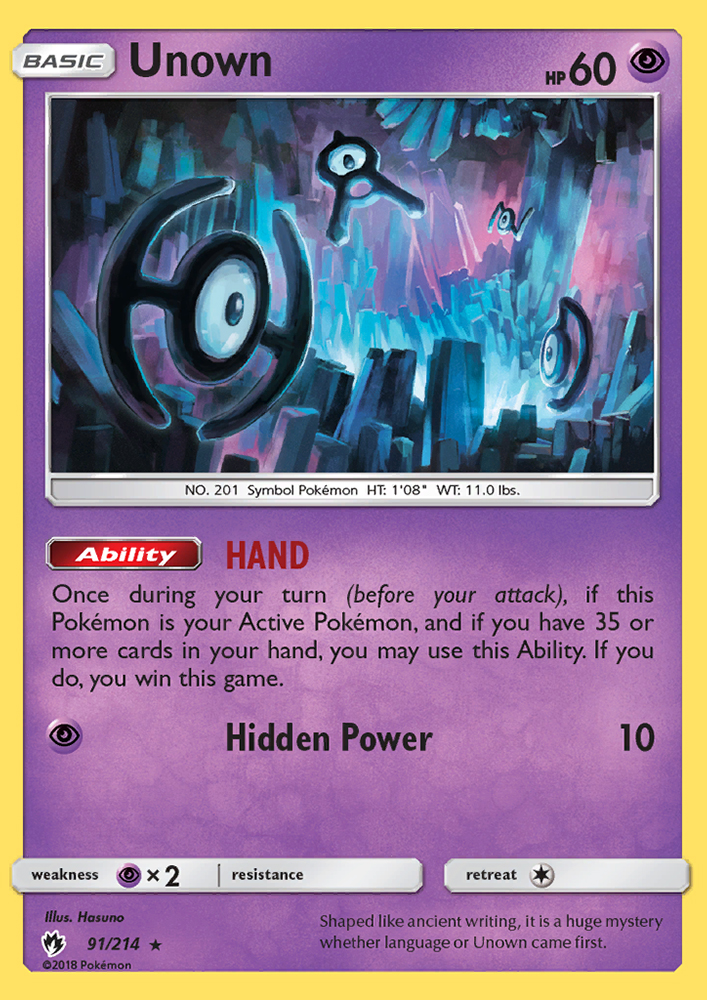
For collectors and players alike, rarity acts like a compass in the vast sea of Pokémon TCG cards. It hints at how often you might stumble upon a card in booster packs and how scarce a given print might be on the secondary market. The Lost Thunder classic Unown—illustrated by Hasuno and labeled as a rare Psychic Basic—is a perfect case study. With 60 HP and a quirky, could-change-the-game Ability named HAND, this little Unown invites a closer look at how rarity translates into actual pull rates, print variants, and market dynamics.
In practice, rarity is not a single lock-and-key mechanism but a family of printings that can alter your odds in subtle ways. Unown exists in multiple print forms within Lost Thunder: a standard non-holo rare, a reverse-holo variant, and a holo variant. Each print type carries its own appeal and, more importantly for collectors, its own market value. The card’s 60 HP and a Psychic-type weakness pair with a modest attack—Hidden Power for 10 damage—yet the real story here is how the card’s rarity and variant printing shape what players actually pull from a booster pack and how much collectors are willing to pay to add it to a collection. ⚡
How rarity and variant printing affect pull rates in practice
Traditionally, a booster pack in a standard modern expansion contains a mix that guarantees at least one Rare or better card, plus a Rare or better in the reverse-holo or holo slot. In Lost Thunder, that means your Unown can appear as a standard Rare, a Reverse-Holo Rare, or a Holo Rare. Each form is a different fulfillment tier within the same rarity class, so the “pull rate” you experience in the wild is a blend of set composition, distribution odds, and your luck in the draw.
For players chasing value, the holo variants are particularly compelling. The data snapshot from market pricing shows a meaningful gap between non-holo and holo-like prints. Non-holo Unown from this set typically trades in the low-to-mid range, with Cardmarket showing a recent average around EUR 1.02 for holo variants and around EUR 1.65 as an average across prints. On the U.S. side, TCGplayer lists non-holo averages around USD 0.56 with occasional listings peaking toward $2.99, while the reverse-holofoil option sits around a mid-to-high range near $1.70 with occasional bumps above that in market activity. These numbers aren’t just price tags; they reflect perceived rarity, supply, and the appeal of the holo finish that many players chase in a set’s lifecycle. The presence of a holo or reverse-holo print can therefore be a telltale indicator of pull-rate reality: you’ll encounter more non-holo copies, and the coveted holo versions will show up less frequently, driving higher market value when seen. 💎
Beyond prices, the card’s illustrated identity matters, too. Hasuno’s artwork elevates Unown beyond a simple stat line—fans remember the design, and rare holo prints often become centerpiece pieces for display. The rarity label (Rare) aligns with the set’s distribution logic, but the real-life pull-rate experience is shaped by how many holo and reverse-holo variants were printed and how many players chase them in a given market window. It’s a balance of supply, demand, and nostalgia, with the price curve offering a practical lens into that balance. 🎴
Strategic angles for collectors and players
From a gameplay perspective, Unown’s HAND ability reads as a dramatic, “one-turn-win” fantasy—if you’re your own worst enemy in card count, this can feel like a clever gimmick rather than a reliable engine. The ability triggers once per turn when this Pokémon is Active and you hold 35 or more cards in hand, a condition that’s rare in competitive decks but delightfully possible in casual play or niche themed builds. In terms of rarity and pull-rate interest, that dramatic ability adds to Unown’s aura as a collector’s find, especially in holo and reverse-holo prints where the card’s personality shines through the finish. The Tiny 60 HP and a single, modest Psychic attack keep Unown’s power curve gentle, but the card’s collectability and print-perfect charm add to its pull-rate narrative—people want to pull not just a card, but a memory of a moment in the game. 🔥🎨
For deck builders, the takeaway is practical: while you might not slot Unown into a high-powered archetype, it’s a fantastic curiosity that highlights how rarities influence both play and collection. If your focus is watching market trends, the holo prints—often priced well above non-holo copies—serve as a proxy for rarity-driven demand. When you see a spike in holo Unown listings, it’s usually a signal that collectors are pursuing the variant, which in turn nudges pull-rate expectations higher for that print. ⚡💎
Market snapshot: what the numbers say about value and rarity
Numbers help quantify the intuition. The Unown (sm8-91) from Lost Thunder sits in the Rare slot with holo and reverse-holo variants complicating the pull-rate picture. Cardmarket’s latest readings suggest an average holo price around EUR 1.02 with a separate holo trend at roughly 2.31, indicating modest demand but clear premium for the holo finish. In USD markets, non-holo averages hover around $0.56, with a high watermark near $2.99 for some listings, while reverse-holo values sit around $1.70 on average (market price around $1.77) and can reach higher with rare listings. These figures align with a common pattern: holo and reverse-holo prints carry a premium, reflecting their relative scarcity inside booster distributions and the collector premium that tends to cluster around holo-printed rares. 📈
Illustrator Hasuno’s distinctive art anchors the card in the Lost Thunder era, a time when the set’s generous mix of Rare, Holo, and Reverse-Holo options encouraged both chasing and completing playsets. In short, rarity paves the path, but the actual pull rate is a mosaic—pack physics, distribution decisions by the publisher, and the market’s appetite for nostalgia all weave together to determine how often you’ll see Unown in its various prints. 🔎🎴
Bottom line: embracing rarity without chasing shadows
Unown’s story in Lost Thunder is a compelling example of how rarity and pull rates interact with gameplay and collecting psychology. The card’s rare status, its diverse finish options, and its unusual HAND ability create a multi-layered experience: casual players can enjoy the quirky mechanic, while collectors observe a clear price-and-peak relationship for holo and reverse-holo prints. If you’re building a modern collection or a nostalgic deck, this Unown variant set is a small but telling lens into how rarity translates into value, availability, and the thrill of the pull. And if you’re curious to explore more of what the data says in related realms, dive into the five network articles linked below and see how different collectibles fare in their own ecosystems. ⚡💎
Customizable Desk Mouse Pad Rectangular Rubber BaseMore from our network
- https://crypto-acolytes.xyz/blog/post/nft-stats-stormveil-teft-from-teft-supreme-collection/
- https://blog.crypto-articles.xyz/blog/post/nft-data-gorbage-chest-349-from-gorbage-chest-collection-on-magiceden/
- https://wiki.digital-vault.xyz/wiki/post/pokemon-tcg-stats-solrock-card-id-xy1-64/
- https://rusty-articles.xyz/tmp_xb6q1gv/8c364216.html
- https://blog.digital-vault.xyz/blog/post/from-mockups-to-code-design-handoff-essentials/
Unown
Set: Lost Thunder | Card ID: sm8-91
Card Overview
- Category: Pokemon
- HP: 60
- Type: Psychic
- Stage: Basic
- Dex ID: 201
- Rarity: Rare
- Regulation Mark: —
- Retreat Cost: 1
- Legal (Standard): No
- Legal (Expanded): No
Description
Abilities
-
HAND — Ability
Once during your turn (before your attack), if this Pokémon is your Active Pokémon, and if you have 35 or more cards in your hand, you may use this Ability. If you do, you win this game.
Attacks
| Name | Cost | Damage |
|---|---|---|
| Hidden Power | Psychic | 10 |
Pricing (Cardmarket)
- Average: €1.65
- Low: €0.1
- Trend: €1.26
- 7-Day Avg: €1.52
- 30-Day Avg: €1.3
Support Our Decentralized Network
Donate 💠More from our network
- https://crypto-acolytes.xyz/blog/post/nft-stats-stormveil-teft-from-teft-supreme-collection/
- https://blog.crypto-articles.xyz/blog/post/nft-data-gorbage-chest-349-from-gorbage-chest-collection-on-magiceden/
- https://wiki.digital-vault.xyz/wiki/post/pokemon-tcg-stats-solrock-card-id-xy1-64/
- https://rusty-articles.xyz/tmp_xb6q1gv/8c364216.html
- https://blog.digital-vault.xyz/blog/post/from-mockups-to-code-design-handoff-essentials/