

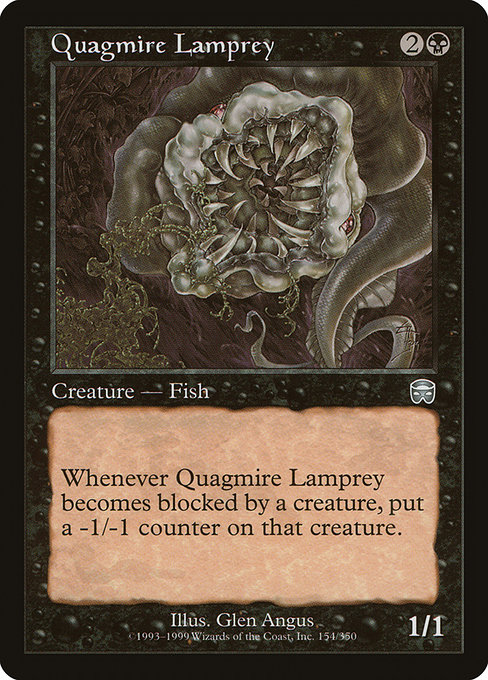
Image courtesy of Scryfall.com
Reading the Tide: Quagmire Lamprey's Threat Assessment in MTG
In the grand ledger of MTG, some cards don’t shout for attention so much as they murmur a sly, persistent threat. Quagmire Lamprey is one of those. For a black mana curve that bends toward disruption, this uncommon creature from Mercadian Masques sits at 2 generic and 1 black mana (a tidy 3 mana total) and arrives as a modest 1/1. Its true value, though, is not its size but its trigger: Whenever this creature becomes blocked by a creature, put a -1/-1 counter on that creature. That single line shapes tempo, blocks, and the calculus of every combat step 🧙♂️🔥.
Threat assessment requires measuring what happens after blockers engage. Lamprey’s ability doesn’t remove the blocker immediately; it punishes the opponent for committing a creature to the fight by shrinking that creature over time. A once-sturdy 3/3 can become a 2/2, then a 1/1 after a couple of crawls through the friction of combat, and a final dent might come from further damage or removal. The Lamprey doesn’t swing for victory on its own, but it chips away at the math of the board, turning favorable blocks into riskier propositions for your opponent ⚔️. It’s the classic nibble that reshapes decision trees in slower black archetypes, especially where the opponent relies on big blockers to steady the game.
From a threat-assessment perspective, Quagmire Lamprey is most potent when paired with a plan that doesn’t rely on brute force alone. Use it to encourage or force trades, buy time against larger threats, and then leverage your own removal suite or planeswalkers to close the loop. The card’s cost and body mean you’re often fighting a tempo battle: you’re not a rush-of-war finisher, you’re a puzzle-box piece that makes your opponent think twice before committing a blocker. In the right shell, that pressure compounds—one well-timed block can cascade into multiple weakened blockers, easing subsequent turns for a finisher or a synergistic black engine 🧙♂️🎲.
For formats with historical depth like Legacy or Vintage, Lamprey’s threat assessment includes format familiarity: it’s not modern-legal, but it fits in older black strategies that prize efficient disruption and combat tricks. Commander players might also find value in Lamprey as a value engine in slower games where a cantrip-for-counter dynamic doesn’t exist; it’s a way to tilt combat while your deck assembles its late-game plan. The key question remains: can you make the creature stick long enough to bend the battlefield in your favor? In many games, yes—especially if you defend it with selective removal and pressure from other threats 🔥.
On the collector side, Lamprey is a window into a vivid era of MTG art and design. Glen Angus’s illustration captures a nightmarish eel that feels at home in Mercadian Masques’s darker, more atmospheric moments. The card’s rarity is Uncommon, and it exists in both nonfoil and foil finishes. Market data from Scryfall tells a pragmatic story: non-foil copies hover around a few dimes, with foils sitting a bit higher, reflecting both nostalgia and the demand for vintage prints. The numbers may be modest, but for the dedicated completionist or a nostalgic budget deck, Quagmire Lamprey offers a tangible anchor to late-90s MTG design—worth a smile and a measured nod to the era’s flavor 🧩💎.
Designer notes and strategic nuance aside, a practical takeaway is to treat Quagmire Lamprey as a situational tool rather than a stand-alone plan. It asks you to think about how your local metagame handles blockers, removal, and board development. If you’re leaning into a black-centric tempo or midrange shell, Lamprey can be a reliable, low-cost disruptor that buys you a turn or two while you assemble a broader board presence. It’s not a one-card victory condition, but it’s a steady reminder that in MTG, sometimes the most elegant threat is the one that quietly reshapes the lines of engagement rather than announcing its presence with a splashy enter-the-battlefield effect 🧙♂️🎨.
Creative decks around Quagmire Lamprey often rely on synergy with other black tools that appreciate outlasting threats or punishing suboptimal blocks. While Lamprey itself remains lean, its real power comes from the tempo and inevitability it introduces in midgame combat—the kind of effect that makes an opponent second-guess every attack or block they declare. If you’re curating a vintage-inspired black deck, Lamprey is a quiet stalwart you can lean on when your plan is to survive early pressure and outlast through attrition. It’s not flashy, but it’s flavorful and effective in the right pocket of MTG history 🧙♂️💎.
PU Leather Mouse Pad With Non-Slip BackingMore from our network
- https://crypto-acolytes.xyz/blog/post/nft-stats-solnautz-639-from-solnautz-collection/
- https://blog.crypto-articles.xyz/blog/post/nft-data-bagtardio-102-from-bagtardio-collection-on-magiceden/
- https://blog.rusty-articles.xyz/blog/post/willbreaker-mtg-limited-editions-and-print-scarcity-trends/
- https://blog.digital-vault.xyz/blog/post/advanced-sequencing-with-mountain-stronghold-land-tricks-for-mtg/
- https://blog.digital-vault.xyz/blog/post/designing-powerful-digital-business-card-templates/
Quagmire Lamprey
Whenever this creature becomes blocked by a creature, put a -1/-1 counter on that creature.
ID: 3c91c44e-6bfc-4595-9cdb-17d73f912c09
Oracle ID: f5b374d8-bf22-44f7-a18a-18c096a84640
Multiverse IDs: 19822
TCGPlayer ID: 6645
Cardmarket ID: 11527
Colors: B
Color Identity: B
Keywords:
Rarity: Uncommon
Released: 1999-10-04
Artist: Glen Angus
Frame: 1997
Border: black
EDHRec Rank: 28688
Set: Mercadian Masques (mmq)
Collector #: 154
Legalities
- Standard — not_legal
- Future — not_legal
- Historic — not_legal
- Timeless — not_legal
- Gladiator — not_legal
- Pioneer — not_legal
- Modern — not_legal
- Legacy — legal
- Pauper — not_legal
- Vintage — legal
- Penny — not_legal
- Commander — legal
- Oathbreaker — legal
- Standardbrawl — not_legal
- Brawl — not_legal
- Alchemy — not_legal
- Paupercommander — not_legal
- Duel — legal
- Oldschool — not_legal
- Premodern — legal
- Predh — legal
Prices
- USD: 0.21
- USD_FOIL: 0.58
- EUR: 0.17
- EUR_FOIL: 1.67
- TIX: 0.09
More from our network
- https://donation.digital-vault.xyz/donation/post/support-open-projects-keep-the-lights-on/
- https://blog.digital-vault.xyz/blog/post/gaeas-protector-price-trends-and-collector-value-explored/
- https://crypto-acolytes.xyz/blog/post/how-ai-shapes-encounters-in-open-world-games/
- https://blog.digital-vault.xyz/blog/post/how-to-add-ai-assistants-to-digital-products/
- https://rusty-articles.xyz/tmpqlws8s3w/autonomous-elemental-characterization-via-generalized-software-architecture-and-low-cost-robotic-platform.html