
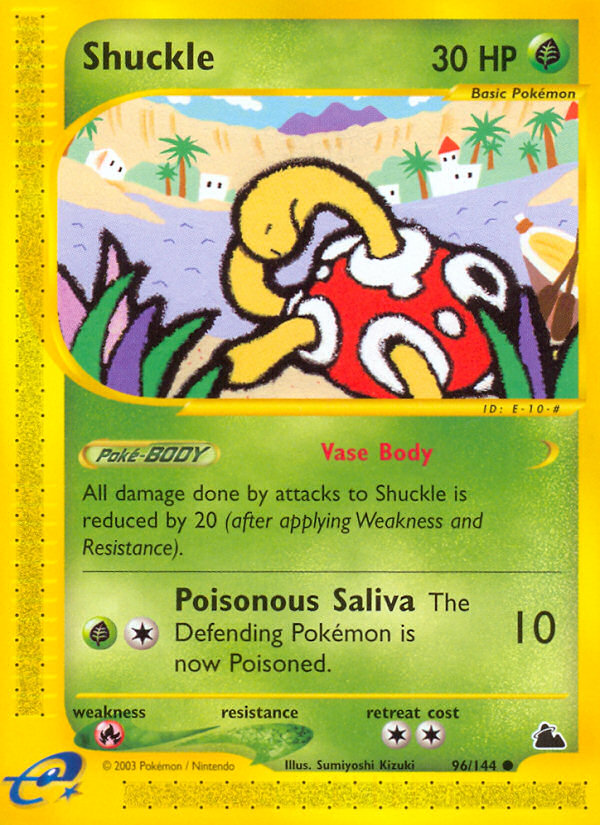
Image courtesy of TCGdex.net
Stability by Stacks: A closer look at how Shuckle's Vase Body interacts with other effects
Shuckle’s Skyridge card is a quiet mathematician in a gravelly world of big blows and flashy attacks. With 30 HP and Grass typing, this Basic Pokémon looks modest on the surface, but its Poke-BODY Vase Body turns the tide in the right matchup. Vase Body says that all damage done to Shuckle is reduced by 20, after applying Weakness and Resistance. That small line of text is a doorway to some surprisingly nuanced gameplay, especially when you start thinking about how multiple effects can stack to further cushion a fragile 30 HP torso.
In practice, damage calculation in the Pokémon Trading Card Game follows a clear ladder. First, you compute the attacking attack’s raw damage, then apply Weakness and Resistance based on the attacking Pokémon’s type versus Shuckle’s Grass type. Only after those multipliers do you apply any damage modifiers such as Vase Body. This sequencing is what makes ability stacking both predictable and powerful: each layer modifies the damage in its own step, and when several layers exist, they accumulate in a way players can plan around.
Let’s walk through a concrete scenario to illustrate how these layers stack. Suppose an opposing Fire-type Pokémon targets Shuckle and uses an attack that would deal 40 base damage. Fire is a known weakness to Grass, so that 40 becomes 80 after applying Weakness. Now Vase Body steps in: subtract 20 from that 80, leaving 60 damage actually dealt to Shuckle. If another effect is on the field—say, a second ability or a Stadium card that says “reduce damage to your Pokémon by 10”—the final figure would drop further to 50. If a second damage-reduction effect is active, you can subtract more, still respecting the floor of zero damage. The math remains straightforward, but the outcome can be strategically decisive when you’re trying to protect a low-HP basic like Shuckle from a single knockout swing.
This stacking logic becomes even more interesting when you bring other “damage-reducing” sources into the mix. Poke-Bodies on other Pokémon, certain Trainer cards, or specific Stadium effects can apply to the same target at once. Because these are modifiers that affect the damage after the initial calculations of weakness/resistance, they stack additively. The key caveat is that not all effects are purely additive—some are replacement effects or prevent-all-damage effects, which can cap or bypass the stacking entirely. In the Skyridge era, Vase Body interacts in a way that rewards careful sequencing and timing: you want to preserve the Shuckle you’ve built up on the bench just long enough to absorb a few big shots, then pivot to a plan that wears down your opponent’s board while you stay safe.
Gameplay strategy: turning Shuckle into a stubborn wall ⚡
- Timing is everything. With Vase Body in play, you want to maximize the value of each attack you face. By trading smaller hits or stalling while your opponent’s resources dwindle, you can keep Shuckle around longer, slowly wearing down threats through Poisonous Saliva or safe, calculated exchanges.
- Supportive stacking partners. Cards that add damage reductions on other turns or against particular attackers can synergize with Vase Body. If multiple effects apply, calculate the final damage after all modifiers. The result can be a surprisingly resilient line of defense despite Shuckle’s modest 30 HP.
- Risk vs. reward with Poisonous Saliva. Shuckle’s attack inflicts Poisoned on the Defending Pokémon. This status condition adds pressure that doesn’t rely on raw HP alone. While Vase Body protects Shuckle from direct hits, Poisonous Saliva helps you threaten the opponent’s board state, potentially turning stalemates into openings.
- Weakness awareness. Remember Shuckle’s own Fire weakness. If you’re facing a Fire-type deck, expect more aggressive pressure. Vase Body still applies, but you’ll be cycling through damage calculations with higher base values to contend with.
- Resource budgeting. Shuckle’s low HP makes it a prime candidate for a “tanky stall” plan rather than a damage-soaker that soaks up all attack damage in a single turn. Use the extra resilience to set up other Pokémon that can finish the job while Shuckle holds the line.
Collector’s notes: Skyridge, rarity, and value
Shuckle from Skyridge is listed as a Common card with a humble but beloved presence in many collectors’ binders. The set itself featured a robust run of 144 official cards, with Skyridge’s distinctive art direction and a Sumiyoshi Kizuki illustration style that fans often celebrate for its charm and precision. For collectors chasing non-holo copies, this Shuckle remains accessible and a charming piece for casual displays or vintage-collection runs. Pricing data (as of late 2025) suggests non-holo Shuckle can sit in the low-to-mid price range for vintage Grass-types from this era, while rarer variations, like reverse holos, command higher figures in the market. Always cross-check current listings from Cardmarket and TCGPlayer for the latest; values can swing with supply, condition, and demand.
As you weigh the value of a Shuckle with Vase Body, consider how its defensive role complements other pieces in a deck. It’s not just about raw damage; it’s about survivability, tempo, and the story of a dusky-toned turtle who makes you rethink what “sturdy” means in a game built on quick scalps and clever plays. The art, the rarity, and the nostalgia of Skyridge all contribute to its enduring appeal — a reminder that sometimes reinforcement comes not from shock value, but from patient, reliable defense.
Card data snapshot
- Name: Shuckle
- Type: Grass
- HP: 30
- Stage: Basic
- Rarity: Common
- Illustrator: Sumiyoshi Kizuki
- Ability: Vase Body — All damage done to Shuckle is reduced by 20 (after applying Weakness and Resistance).
- Attack: Poisonous Saliva — Cost: Grass, Colorless; Damage: 10; Effect: The Defending Pokémon is now Poisoned.
- Weakness: Fire ×2
- Set: Skyridge
More from our network
- https://blog.crypto-articles.xyz/blog/post/nft-data-meta-muse-615-from-meta-muses-collection-on-magiceden/
- https://crypto-acolytes.xyz/blog/post/crypto-diplomacy-how-decentralized-finance-reshapes-geopolitics/
- https://blog.crypto-articles.xyz/blog/post/nft-data-orange-rock-165-from-orange-rocks-collection-on-magiceden/
- https://wiki.digital-vault.xyz/wiki/post/pokemon-tcg-stats-pyukumuku-card-id-sm10-53/
- https://blog.crypto-articles.xyz/blog/post/nft-data-mad-bombs-1009-from-mad-bombs-collection-on-magiceden/
Shuckle
Set: Skyridge | Card ID: ecard3-96
Card Overview
- Category: Pokemon
- HP: 30
- Type: Grass
- Stage: Basic
- Dex ID: 213
- Rarity: Common
- Regulation Mark: —
- Retreat Cost:
- Legal (Standard): No
- Legal (Expanded): No
Description
Abilities
-
Vase Body — Poke-BODY
All damage done to Shuckle is reduced by 20 (after applying Weakness and Resistance).
Attacks
| Name | Cost | Damage |
|---|---|---|
| Poisonous Saliva | Grass, Colorless | 10 |
Pricing (Cardmarket)
- Average: €2.79
- Low: €0.3
- Trend: €3.2
- 7-Day Avg: €2.36
- 30-Day Avg: €2.42
Support Our Decentralized Network
Donate 💠More from our network
- https://blog.crypto-articles.xyz/blog/post/nft-data-meta-muse-615-from-meta-muses-collection-on-magiceden/
- https://crypto-acolytes.xyz/blog/post/crypto-diplomacy-how-decentralized-finance-reshapes-geopolitics/
- https://blog.crypto-articles.xyz/blog/post/nft-data-orange-rock-165-from-orange-rocks-collection-on-magiceden/
- https://wiki.digital-vault.xyz/wiki/post/pokemon-tcg-stats-pyukumuku-card-id-sm10-53/
- https://blog.crypto-articles.xyz/blog/post/nft-data-mad-bombs-1009-from-mad-bombs-collection-on-magiceden/