

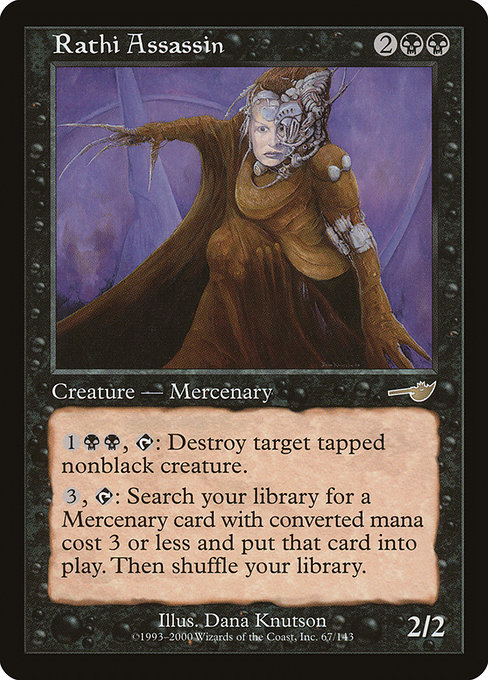
Image courtesy of Scryfall.com
Design Theory in Un-sets and the Rathi Assassin
If you’re a long-time MTG devotee, you’ve likely spent more than a few hours debating what makes a card truly sing on paper and in play. Un-cards—those silver-bordered experiments that rip open the seams of rules and expectations—are not just jokes with quirky art; they’re design-as-therapy sessions. They push us to ask: what is a game mechanic for, really? Do we reward clever timing, clever wording, or clever storytelling? And how far can a mechanic bend before it breaks the entire tapestry of rules we know? 🧙♂️🔥
Design theory in this space centers on tension: a card should feel novel enough to spark delight, yet familiar enough to be playable without collapsing the system. In the realm of genuine, print-form MTG design (the real cards that live in Nemesis and beyond), you’ll notice a strain of purposeful clarity paired with a flourish of risk. That balance is what allows players to grasp a new idea quickly while still feeling the thrill of discovery. The two-ability paradigm on Rathi Assassin offers a pocket-size case study in this balance: a sturdy black creature that carries both a controlled removal option and a tutoring utility that unlocks late-game value, all wrapped in a single, compact frame. ⚔️🎨
Rathi Assassin as a microcosm of design space
Rathi Assassin is a rare black creature—Phyrexian Zombie Mercenary Assassin—costing 2 generic and 2 black mana (2BB). It taps for a potent one-mana-and-two-black combo: 1}{B}{B}, Tap to destroy a target tapped nonblack creature. That condition—“tapped nonblack”—gives players a strategic read on the battlefield state. It rewards you for sequencing and attack timing, turning a single activation into tempo that can swing a game when your opponent has just committed their best blocker. Then, for a more dramatic swing, 3, Tap to search your library for a Mercenary permanent card with mana value 3 or less, put it onto the battlefield, then shuffle. The second ability is a compact tutor that invites you to think about the Mercenary subtheme as a discrete design space. The card’s color identity remains black, and its power/toughness sits at 2/2—not a flashy beatstick, but a reliable engine piece if you lean into Mercenary synergies. 💎
What makes this design worth studying is not just the raw text, but the way it invites a broader plan without leaning on random chaos. Un-cards exist to test what would happen if the rules were slightly more permissive or more playful. Nemesis, though not an Un-set, bears design DNA that values modularity and interlocking mechanics—two ideas that resonate with the kind of experimentation you see when designers tinker with humor, timing, and self-referential strategies. The Rathi Assassin demonstrates how a single card can reward both aggressive tempo and strategic planning, a hallmark of robust design that translates well into more conventional sets. 🧙♂️⚔️
Gameplay implications: tempo, value, and the mercenary echo
In practice, Rathi Assassin rewards players who manage the battlefield’s tempo. The first ability provides a targeted removal option for a creature that has just tapped to attack or activate a nonblack ability—an in-set nod to the importance of board state and timing. It’s not a one-note fixer; it’s a disciplined tempo play that helps you weather opposing develops and pressure your opponent to answer threats in a measured way. The mana investment is fair for a tricky suppression tool, especially given the potential for the second ability to accelerate a Mercenary-centric board state. When you tutor for a Mercenary permanent with mana value 3 or less, you’re basically pulling a lever that can alter the late game, enabling you to flood the board with small, synergistic pieces that can overwhelm outright, or set up a win condition that wasn’t visible on turn four. This dual-utility design mirrors the design challenges that Un-cards love to provoke: how far can you push a mechanic before it becomes self-sabotaging, and how often should a card reward you with an additional, meaningful decision later in the game? 🧠🎲
From a flavor perspective, the card embodies a merger of subthemes. The Phyrexian zombie mercenary vibe taps into black’s lore of curses, rot, and survival cunning. The Kareem of “assassin” archetypes, and the shadow-draped art by Dana Knutson in Nemesis, contribute to a darkly elegant narrative that designers keep circling back to when they imagine how a card speaks to an entire set’s story. The rarity—rare—signals that this is a design worth exploring in a draft or constructed context, even if its raw numeric might seem modest at first glance. The art, the name, and the two distinct lines of play come together to create a character you can remember in a crowded field of cards. 💎🖤
Takeaways for designers and players
- Two-path design: A card with both a removal effect and a tutoring effect gives players meaningful choices across the game’s phases. That flexibility helps the card age well in multiple formats and metagames. ⚔️
- Subtheme resonance: Tapping into a Mercenary-synergy arc creates a natural target for deck-building focus without breaking the broader color identity. 🎨
- Tempo vs. value: The balance between early removal and late-game payoff is delicate; successful designs give players a reason to stay engaged at every stage. 🧭
- The art of restraint: A compact stat line paired with a modest but flavorful ability set demonstrates how to pack personality into a single card. 🔎
- Un-sets as design laboratories: Even when not explicitly silver-bordered, the best design principles from playful sets inform how we think about rules, humor, and player agency. 🧙♂️
For collectors and players who enjoy archetype-focused thinking, Rathi Assassin remains a neat touchstone: a card that embodies the tension between removal and strategy, between tempo and payoff, and between lore and gameplay. Its existence encourages designers to respect the clarity of a good rule-set while inviting players to imagine new possibilities within constraints. If you’re chasing a reminder of how a single card can open doors to broader design conversations, you won’t have to look far. The shadow of the assassin looms as a compelling metaphor for experimental design—always pointing us toward what might lie just beyond the next untapped corner of the board. 🕯️🗡️
Gaming Neon Mouse Pad 9x7 Custom Stitched EdgesMore from our network
- https://wiki.digital-vault.xyz/wiki/post/pokemon-tcg-stats-stonjourner-card-id-a1a-048/
- https://crypto-acolytes.xyz/blog/post/nft-stats-chubby-ape-gen2-2832-from-chubby-ape-gen2-collection/
- https://blog.digital-vault.xyz/blog/post/mastering-inescapable-blaze-triggers-probability-demystified/
- https://blog.crypto-articles.xyz/blog/post/nft-data-solidskulls-1062-from-solidskulls-collection-on-magiceden/
- https://blog.rusty-articles.xyz/blog/post/top-auction-sales-for-galarian-rapidash-v-in-pokemon-tcg/
Rathi Assassin
{1}{B}{B}, {T}: Destroy target tapped nonblack creature.
{3}, {T}: Search your library for a Mercenary permanent card with mana value 3 or less, put it onto the battlefield, then shuffle.
ID: 3e3597c3-3053-49f8-ab7e-a774e2fb082f
Oracle ID: 1ea0c775-fde0-4a21-b4c2-8bcec0e4f4f8
Multiverse IDs: 22890
TCGPlayer ID: 7208
Cardmarket ID: 11790
Colors: B
Color Identity: B
Keywords:
Rarity: Rare
Released: 2000-02-14
Artist: Dana Knutson
Frame: 1997
Border: black
EDHRec Rank: 22458
Set: Nemesis (nem)
Collector #: 67
Legalities
- Standard — not_legal
- Future — not_legal
- Historic — not_legal
- Timeless — not_legal
- Gladiator — not_legal
- Pioneer — not_legal
- Modern — not_legal
- Legacy — legal
- Pauper — not_legal
- Vintage — legal
- Penny — not_legal
- Commander — legal
- Oathbreaker — legal
- Standardbrawl — not_legal
- Brawl — not_legal
- Alchemy — not_legal
- Paupercommander — not_legal
- Duel — legal
- Oldschool — not_legal
- Premodern — legal
- Predh — legal
Prices
- USD: 0.32
- USD_FOIL: 1.43
- EUR: 0.33
- EUR_FOIL: 6.75
- TIX: 0.33
More from our network
- https://blog.crypto-articles.xyz/blog/post/nft-data-snake-badge-135-from-gboy-badges-collection-on-magiceden/
- https://crypto-acolytes.xyz/blog/post/nft-stats-bitcreep-35-from-the-bitcreeps-collection/
- https://y-landing.zero-static.xyz/dc44911e.html
- https://blog.crypto-articles.xyz/blog/post/nft-data-nuddies-603-from-nuddies-collection-on-magiceden/
- https://blog.rusty-articles.xyz/blog/post/top-5-bravely-default-ii-locations-you-must-explore/