
Image courtesy of TCGdex.net
Typhlosion Evolution Timing: Strategies for When to Evolve or Hold
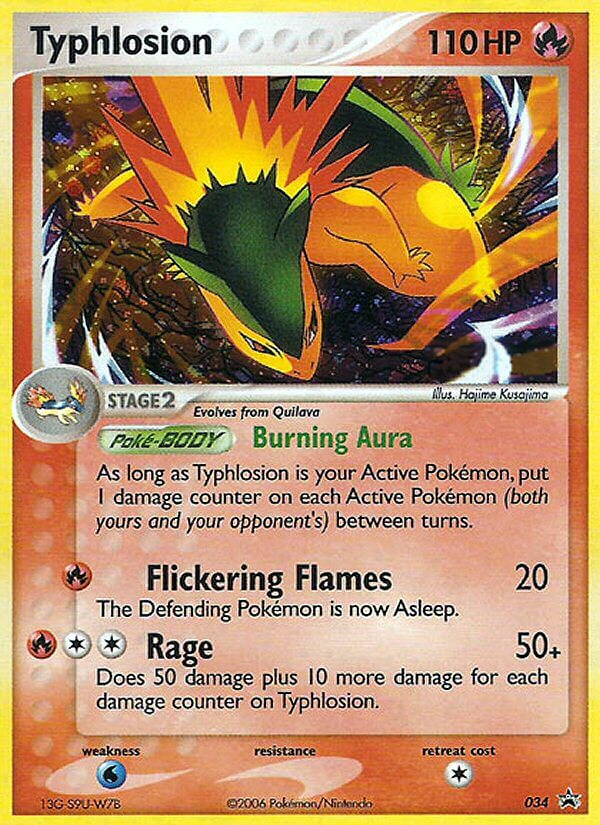
In the fast-paced world of the Pokémon TCG, timing can be the difference between a dramatic comeback and a sudden knockout. Typhlosion, a Pokémon from the Nintendo Black Star Promos line, embodies that tension beautifully. This Fire-type Stage 2, illustrated by Hajime Kusajima, sits at 110 HP with a toolkit that rewards careful planning. Its Burning Aura Poke-BODY nudges the board toward tense, turn-by-turn decision-making, while its pair of attacks—Flickering Flames and Rage—offer both control and raw reach when used at the right moment. ⚡🔥
Card snapshot at a glance: Typhlosion (np-34) is a Stage 2 Fire-type with 110 HP, evolving from Quilava. The card carries a Common rarity in the Nintendo Black Star Promos set. Its illustrator is Hajime Kusajima, and its two attacks read as follows: Flickering Flames for 20 damage with the opponent’s Active Pokémon now Asleep, and Rage for 50 damage plus an extra 10 for each damage counter on Typhlosion. A critical weakness to Water-type attacks (×2) reminds you to keep track of the control you’re exerting on matchups. Each turn you rely on this Pokémon, you’ll navigate the push-and-pull between keeping Typhlosion safe and unleashing its power. 🧨
Burning Aura—Typhlosion’s Poke-BODY—plays a unique role in shaping your tempo. As long as Typhlosion remains your Active Pokémon, both players’ Active Pokémon take a damage counter between turns. That subtle mechanic shifts the risk calculus: you’re pressing for a decisive strike, but you’re also accelerating wear on both sides. It’s a dance of damage that can tilt a close game in your favor if you time your evolution into Typhlosion just as your opponent’s defenses crack. 🎴
How Burning Aura and Flickering Flames influence the board
Burning Aura deliberately raises the stakes. The lingering one-damage-counter ping on both sides each turn adds urgency to compute when you’ll push for a knockout and when you’ll hold back to weather counterattacks. Meanwhile, Flickering Flames gives you a tactical tool to disrupt your opponent by forcing the Defending Pokémon into Sleep, buying you precious turns to reposition your board state. The combination works best when you’re ready to convert a sleep into an advantage—whether by following up with Rage, which unleashes big numbers once Typhlosion has a few damage counters already on it. It’s a high-variance but highly rewarding play style for players who thrive on tempo games. 🔥💤
Timing your evolution: a practical framework
- Early-game planning (Turns 1–2): If you’re beginning with Quilava in play, your focus is on energizing your board and setting up the threat of Typhlosion. Since Typhlosion is a Stage 2, you’ll typically want to stage up when you can safely commit to keeping Typhlosion Active through multiple turns, rather than rushing it out too soon and exposing it to early knockouts. Use Quilava’s presence to stall and draw into the two-part evolution chain. 🔎
- Midgame surge (Turns 3–4): By this point, you should be eyeing Typhlosion’s arrival with a plan. If you can ensure you’ll hit the right Energy mix (primarily Fire) to fuel Flickering Flames and Rage, evolving into Typhlosion becomes a strong turning point. The moment Typhlosion is Active, Burning Aura starts to pressure both sides, so you want to read your opponent’s bench and active options—can you force a favorable trade while Typhlosion stays on board? 🎯
- Late-game power spike: If you’ve managed to position Typhlosion where it can survive longer than expected, Rage becomes a serious finisher. The attack scales with how many damage counters you’ve piled on Typhlosion, turning a seemingly modest 50 into a much more intimidating strike. This is especially potent when your opponent relies on slow-burn strategies or needs to stall for draws. Maintain caution with Water-types—they loom as the natural counters and can swing the outcome if you misjudge the matchup. 💎
When to hold, and when to push for the knockout
The core question is always about resource management and risk tolerance. If you’re facing a marathon tempo deck with rapid clock pressure, you might prefer to hold Typhlosion back in the later turns if your opponent has sustained pressure on your side and you’re short on healing or retreat options. However, the moment you sense a window—an energy-dused window where a single well-timed attack can swing the prize—you should seize it. Flickering Flames gives you that sleep setup that can enable a second attack to finish the job, while Rage can blow the doors open when Typhlosion has taken a bit of damage and sits in the sweet spot for maximum output. The balance is delicate, but it’s precisely what makes Typhlosion a satisfying puzzle for players who love midrange to late-game fireworks. ⚡🔥
Collector and lore notes
Beyond gameplay, Typhlosion NP-34 carries collectible intrigue. While it sits in the Common rarity, its art by Hajime Kusajima and its status as a Nintendo Black Star Promo lend it a distinctive charm that resonates with collectors who chase nostalgia and print run quirks. The high-detail fire motif, paired with the classic Quilava-to-Typhlosion evolution arc, mirrors the lore of Blazing Trail in the Johto region, reminding players why the Fire-type line has remained a fan favorite for generations. The card’s presentation—paired with its dynamic in-game effects—continues to spark discussions among players about when and how to evolve in a way that blends strategy with storytelling. 🎨🎴
For players evaluating competitiveness and value, the common rarity level means it sits within reach for many collections, yet the real thrill comes from the deck-building experiments it inspires. The synergy of Burning Aura with a sleep-inducing attack pattern invites you to craft a disciplined, tempo-forward plan that’s both tactical and thematic. If you’re adding Typhlosion to a Fire-centric deck, consider how your energy acceleration and bench management can best maximize its two-pronged assault while keeping your opponent off-balance. 🎮
To dive deeper into related discussions and current trends, check out these network articles and references that explore broader themes in the Pokémon TCG and beyond.
Gaming Mouse Pad 9x7 Neoprene Custom Graphics Stitched EdgeMore from our network
Typhlosion
Set: Nintendo Black Star Promos | Card ID: np-34
Card Overview
- Category: Pokemon
- HP: 110
- Type: Fire
- Stage: Stage2
- Evolves From: Quilava
- Dex ID: 157
- Rarity: Common
- Regulation Mark: —
- Retreat Cost:
- Legal (Standard): No
- Legal (Expanded): No
Description
Abilities
-
Burning Aura — Poke-BODY
As long as Typhlosion is your Active Pokémon, put 1 damage counter on each Active Pokémon (both yours and your opponent's) between turns.
Attacks
| Name | Cost | Damage |
|---|---|---|
| Flickering Flames | Fire | 20 |
| Rage | Fire, Colorless, Colorless | 50 |
Support Our Decentralized Network
Donate 💠More from our network
- https://blog.crypto-articles.xyz/blog/post/ns-zorua-unleashing-support-pokemon-synergy-in-tcg/
- https://crystal-static.zero-static.xyz/bbb17b7b.html
- https://blog.rusty-articles.xyz/blog/post/reading-snare-tactician-artwork-for-narrative-clues/
- https://wiki.digital-vault.xyz/wiki/post/pokemon-tcg-stats-altaria-gx-card-id-sm75-41/
- https://blog.crypto-articles.xyz/blog/post/nft-data-malware-949-from-malware-relics-collection-on-magiceden/