
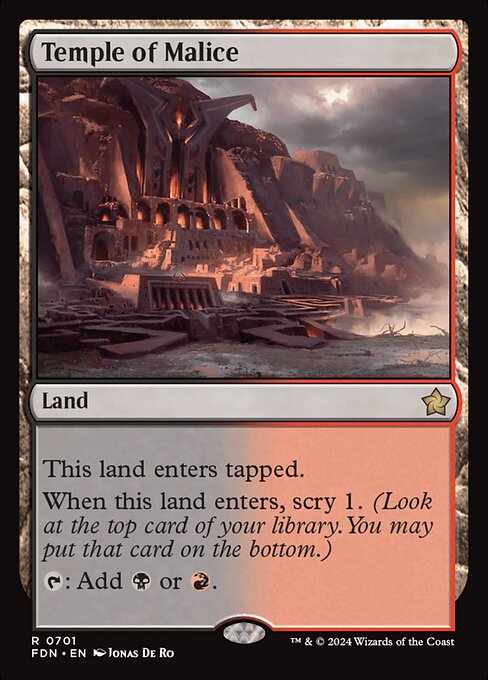
Image courtesy of Scryfall.com
Luck versus Skill: Navigating the Randomness Maze with Temple of Malice
MTG has always been a dance between fate and control, a delicate waltz where your mulligans, draws, and decisions shape the final result just as much as your deck’s design. Temple of Malice embodies that tension in a tiny, unassuming way: a land that enters tapped, offers a moment of clarity with a single scry, and then hands you the keys to a black-and-red mana pool. 🧙♂️🔥💎 It’s not just a mana fixer; it’s a micro-lesson in how skill, information, and risk-reward interplay can tilt the odds in your favor, one top card at a time.
Foundations’ Temple of Malice sits in a unique place in the color pie. Its mana ability is a dual fix for both black and red, two colors known for aggressive plays, disruption, and potent card advantage engines. By giving you two potential colors of mana, the land invites you to lean into a two-color tempo sandwich or a broader multi-color shell—yet it does so with a built-in constraint: you must wait for it to come into play and you must learn to work with what the top card shows you. The result is a subtle test of patience and planning: do you keep a top-deck killer or a red-hot remove-a-threat card? The choice rests in your hands… and a single scry line of sight. 🧲
What Temple of Malice Actually Does
From a rules perspective, the land is straightforward: it enters the battlefield tapped; when it enters, you look at the top card of your library and may put that card on the bottom (that’s scry 1). Then you can tap it for either black or red mana. The
oracle_text: "This land enters tapped. When this land enters, scry 1. (Look at the top card of your library. You may put that card on the bottom.) {T}: Add {B} or {R}."makes its intent crystal: you’re not accelerating pure volume of mana, you’re shaping the game’s early tempo with information. And in a meta where early tempo can decide who’s in the driver’s seat, that tiny advantage compounds over the first few turns. 🔍
With no mana costs on the card itself, Temple of Malice is a strategic pivot rather than a raw ramp engine. It belongs to a core set that emphasizes foundational play—Foundations (fdn)—and the rarity of rare reflects its role as a steadying, dependable piece rather than a flashy, game-ending bomb. The card’s rarity and historical placement highlight a design philosophy: sometimes the best card isn’t the one winning you the game outright, but the one keeping you in the game long enough for your skill to shine. ⚔️
Tempo, Fixing, and the Color Identity
Temple of Malice’s mana ability leans into two colors that often trade blows in the mid-to-late game: black’s disruption and red’s aggression. In practice, you’ll use the land to fix chaos into a coherent plan. The scry 1 on entry quietly informs your next move—do you keep a card that accelerates pressure or bottom something that could derail your plan? The choice is a small, hourly battle between luck and your own tactical instinct. The card’s color identity—B and R—also signals which archetypes it supports: mono-red aggro that needs a consistent one-land fix, or a black-red multicolor strategy that edges into midrange with selective discard or direct damage. The design nudges players toward a deliberate pace, where you’re rewarded for reading the top of your deck as if it were a road map. 🗺️
Crafting a Play Pattern: When to Lean on a Temple
In a crowded field of, say, Burn, Rakdos midrange, or tempo-leaning builds, Temple of Malice shines as a flexible, repeatable turn-one or turn-two ability. You won’t always hit your perfect curve, but you’ll know sooner what you’re drawing into—thanks to scry. If you’re riding a card-advantage plan, the land’s scry helps you streamline your deck’s top-end, reducing “dead topdecks” and keeping the pressure on. And because the land enters tapped, you’ll want to time your early plays so you’re not missing critical turns, a reminder that randomness can be tempered, not eliminated. The dance between your hand and the top of the library becomes a core strategic element, where skillful sequencing and careful mulliganing often outrun luck. 🎲
Art, Design, and Collectibility
Jonas De Ro’s illustration for Temple of Malice captures a sense of foreboding and arcane energy, a fitting vibe for a land that lives between decision and chaos. As part of Foundations, the card is a rare reprint in a core-set lineage, which helps explain its presence in both casual and more competitive lists. The card’s market presence is modest—prices in the sub-dollar range on Scryfall reflect its role as a steady, value-driven pick rather than a flashy staple—but its EDH/Commander utility, with a solid EDHREC rank, makes it a collectible piece for players who appreciate reliable mana-fixing with a dash of information control. For players who enjoy the tactile joy of seeing a deck come together with careful, measured steps, Temple of Malice speaks to the moment when randomness becomes a manageable aspect of strategy. 💎
Format Footnotes: Where It Plays Well
With broad legality across formats in the card-legal universe, Temple of Malice is a dependable inclusion for multi-colored builds that lean on black and red. It’s a card that rewards thoughtful deck construction and deliberate play: a land that invites you to read the top card, choose a path, and still contribute mana to the board. The mix of scry and two-color mana makes it a natural fit for aggressive starts or midrange pivots, where every decision about the top card can tilt a game’s outcome. The thrill of the game—Luck vs Skill—gets a tangible, playable companion in Temple of Malice, reminding us that sometimes the best luck is the luck you earn through careful planning. 🧙♂️🔥
Clear Silicone Phone Case — Durable, Flexible, SlimMore from our network
- https://articles.zero-static.xyz/blog/post/super-smash-bros-ultimate-beginner-faq-essentials/
- https://blog.crypto-articles.xyz/blog/post/nft-data-pumpixels-440-from-pumpixels-collection-on-magiceden/
- https://wiki.digital-vault.xyz/wiki/post/minecraft-block-stats-potted_dark_oak_sapling/
- https://crypto-acolytes.xyz/blog/post/nft-stats-trench-warriors-498-from-trench-warriors-collection/
- https://blog.zero-static.xyz/blog/post/unhinged-parody-and-humor-in-the-magic-bandit/
Temple of Malice
This land enters tapped.
When this land enters, scry 1. (Look at the top card of your library. You may put that card on the bottom.)
{T}: Add {B} or {R}.
ID: d78eccc4-1500-43f1-94f5-b39c160b6381
Oracle ID: 7c439c18-31dc-41fe-b03d-3fca06e6fc0b
Multiverse IDs: 680840
TCGPlayer ID: 589372
Cardmarket ID: 796148
Colors:
Color Identity: B, R
Keywords: Scry
Rarity: Rare
Released: 2024-11-15
Artist: Jonas De Ro
Frame: 2015
Border: black
EDHRec Rank: 378
Penny Rank: 738
Set: Foundations (fdn)
Collector #: 701
Legalities
- Standard — legal
- Future — legal
- Historic — legal
- Timeless — legal
- Gladiator — legal
- Pioneer — legal
- Modern — legal
- Legacy — legal
- Pauper — not_legal
- Vintage — legal
- Penny — legal
- Commander — legal
- Oathbreaker — legal
- Standardbrawl — legal
- Brawl — legal
- Alchemy — legal
- Paupercommander — not_legal
- Duel — legal
- Oldschool — not_legal
- Premodern — not_legal
- Predh — not_legal
Prices
- USD: 0.20
- EUR: 0.28
- TIX: 0.03
More from our network
- https://blog.digital-vault.xyz/blog/post/un-sets-meta-patterns-solarions-design-secrets/
- https://crypto-acolytes.xyz/blog/post/nft-stats-fkey-331-from-the-key-collection/
- https://blog.crypto-articles.xyz/blog/post/nft-data-xp-1036-from-xp-collection-on-magiceden/
- https://wiki.digital-vault.xyz/wiki/post/pokemon-tcg-stats-eevee-card-id-ecard3-54/
- https://wiki.digital-vault.xyz/wiki/post/pokemon-tcg-stats-breloom-card-id-pl3-52/