

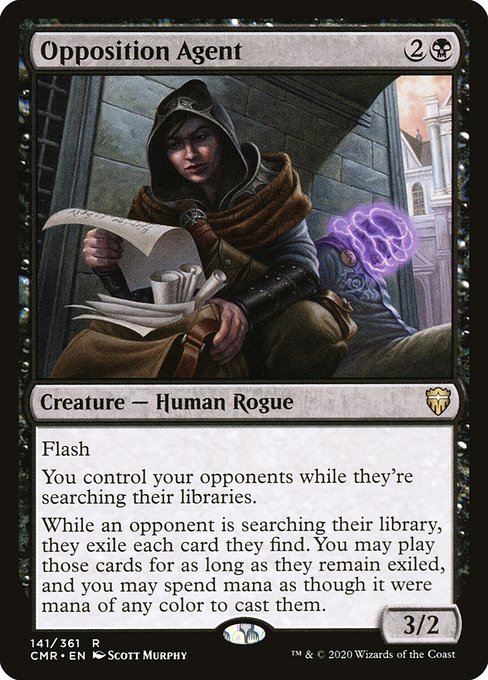
Image courtesy of Scryfall.com
Understanding Opposition Agent: How Wording Shapes Decision-Making
Templating in Magic: The Gathering isn’t just about what a card does, but how its words invite you to read a scenario aloud in your head. When a card like Opposition Agent slides into a pod of players mid-game, the exact phrasing can tilt decisions, sequencing, and even the tempo of a match. This 3/2 rare from Commander Legends arrives with Flash, a lean mana cost of {2}{B}, and a tricksy set of abilities that make you stretch your mental library as you plan your next move 🧙♂️🔥. The way its text is written—and the color identity baked into its mana cost—matters as much as its power and toughness, especially in chaos-filled formats where everyone is packing interaction and surprise outcomes ̶ a perfect canvas for discussing how templating shapes understanding 💎⚔️.
Templating in Practice: What the Card Actually Says
- Flash is the doorway. Opposition Agent can appear at instant speed, seizing the moment when an opponent most expects to smooth out a library search. That single word changes the pace of the turn, turning a potential draw-go moment into a sudden pivot. In templating terms, Flash creates a continuous dynamic: you’re allowed to respond to an action with your own action, and the card’s timing becomes a crucial part of the outcome 🎲.
- You control your opponents while they're searching their libraries. This line sounds cinematic, but it’s a rules-as-written mechanism: the Agent interrupts the normal flow of an opponent’s search and asserts control in the exact window of the search. The wording intentionally keeps control conditional and time-bound, which can be surprising to players who assume “control” means a longer, broader benefit. Reading this line carefully helps you understand when you actually influence the other players and when you simply observe the search in progress 🧭.
- While an opponent is searching their library, they exile each card they find. Here’s where templating shines. The cards they discover during the search are exiled by the effect, not in the normal course of play. That means you’re not just stopping info from hitting the stack; you’re creating a new set of potential plays outside the standard flow. The phrase “they exile each card they find” uses a reflexive voice that binds the action to the opponent’s search, clarifying that it’s the opponent performing the exile under Opposition Agent’s influence, not you hand-picking targets mid-stream 🔮.
- You may play those cards for as long as they remain exiled. This is a rare permission baked into templating: it recognizes that exile is normally a temporally limited zone with its own rules. Opposition Agent flips that script, granting you access to play those exiled cards for as long as they stay out of the library. The nuance isn’t merely “play” versus “cast”—it’s a permission tied to the exile zone, which can drastically affect how you sequence combat and resource management during a game that thrives on precision 📚.
- You may spend mana as though it were mana of any color to cast them. The color of the mana you spend ceases to be a barrier for those exiled cards, which is a potent templating flourish. It means you can bypass color restrictions when paying for those spells, effectively broadening your toolset as you Flash in Opposition Agent and steer a turn toward unexpected wins. The wording makes this a continuous, color-agnostic opportunity, a classic example of templating that unlocks deeper strategic space 💎.
Why Wording Matters for Strategy and Understanding
In multiplayer formats, templating becomes a shared language. The precise verbs—“exile,” “play,” “spend mana”—and their conditions determine what players think is possible in a given moment. Opposition Agent shows how a single card can radiate complexity: it isn't only about stealing information or disrupting a plan, but about reframing every subsequent decision through a carefully constructed sentence structure. When you read its text, you aren’t just summarizing an effect; you’re predicting a chain of interactions that can ripple across the entire turn and beyond 🧙♂️🎨.
“When we talk about templating, we’re really talking about the rules engine wearing a poet’s coat.”
From a gameplay design perspective, Commander Legends leaned into the feel of misdirection and flexible power. The set’s “draft_innovation” frame and the card’s flashy, multi-layered text invite players to explore how language creates new lines of play. The card’s color identity—black—hints at disruption and control, while the creature type (Human Rogue) nods to a long-standing MTG tradition of cunning schemers who blend intelligence with opportunistic manipulation. The result is a card that looks elegant on a surface read but explodes with edge-case potential in practice 🔥.
Deckbuilding Angles: How to Maximize Value (and Humor) with Opposition Agent
In a commander table, Opposition Agent acts as a disruptive tempo piece that can swing games by turning opponents’ searches into a resource pool for you. Build around the idea that you aren’t just denying information; you’re creating a parallel stream of options from exile. Pair it with counters, blink effects, or stax-style engines to force adversaries into awkward choices. The card’s potency lies in the alignment of its templated text with your broader strategy—a reminder that the finest MTG moments come from reading the spell text aloud and then watching it resolve in unexpected ways 🧙♂️⚔️.
Collector Value and Historic Footprint
Opposition Agent sits at a notable value point in CM R rarity, with a robust foil market and consistent demand among players who love control-heavy builds. Card data shows solid prices in the mid-teens USD and rising foil values; a testament to how long the card has remained relevant in both casual and competitive circles. Its art by Scott Murphy is a highlight on most table displays, and the dynamic templating adds another layer to why collectors and players alike appreciate a well-worded card that rewards careful reading 💎.
As you explore templating in your own games, Opposition Agent serves as a reminder that card text is not mere flavor—it's a rules-based, play-scale mechanic that can bend the arc of a match. The synergy between its Flash timing, library interaction, exile mechanics, and color-flexible casting creates a template for discussing how language governs choice in MTG. And between matches, you can swing by the shop to grab a practical accessory—like the Phone Click-On Grip Portable Phone Holder Kickstand—so you can read rulings on the fly while you queue up the next duel. 📱🎲
Phone Click-On Grip Portable Phone Holder KickstandMore from our network
- https://blog.crypto-articles.xyz/blog/post/nft-data-monkey-biz-1095-from-monkey-business-collection-on-magiceden/
- https://crypto-acolytes.xyz/blog/post/nft-stats-investoor-1188-from-icm-investor-center-cult-collection/
- https://crypto-acolytes.xyz/blog/post/nft-stats-roguesdead180-from-rogues-dead-collection/
- https://blog.digital-vault.xyz/blog/post/a-21-kpc-blue-white-giant-sheds-light-on-dr3-handling/
- https://blog.rusty-articles.xyz/blog/post/horizon-zero-dawn-evolved-through-post-launch-updates/
Opposition Agent
Flash
You control your opponents while they're searching their libraries.
While an opponent is searching their library, they exile each card they find. You may play those cards for as long as they remain exiled, and you may spend mana as though it were mana of any color to cast them.
ID: 086f97e9-8b62-44f3-b467-149c2ac5ca78
Oracle ID: 1f438b8f-fe23-4f3b-ab2e-f6c33676c462
Multiverse IDs: 497661
TCGPlayer ID: 226314
Cardmarket ID: 510070
Colors: B
Color Identity: B
Keywords: Flash
Rarity: Rare
Released: 2020-11-20
Artist: Scott Murphy
Frame: 2015
Border: black
EDHRec Rank: 445
Set: Commander Legends (cmr)
Collector #: 141
Legalities
- Standard — not_legal
- Future — not_legal
- Historic — legal
- Timeless — legal
- Gladiator — legal
- Pioneer — not_legal
- Modern — not_legal
- Legacy — legal
- Pauper — not_legal
- Vintage — legal
- Penny — not_legal
- Commander — legal
- Oathbreaker — legal
- Standardbrawl — not_legal
- Brawl — legal
- Alchemy — not_legal
- Paupercommander — not_legal
- Duel — legal
- Oldschool — not_legal
- Premodern — not_legal
- Predh — not_legal
Prices
- USD: 17.87
- USD_FOIL: 23.65
- EUR: 22.15
- EUR_FOIL: 26.09
- TIX: 8.02
More from our network
- https://wiki.digital-vault.xyz/wiki/post/pokemon-tcg-stats-audino-card-id-sv105b-074/
- https://transparent-paper.shop/blog/post/color-magnitude-diagrams-trace-stellar-ages-in-scorpius/
- https://crypto-acolytes.xyz/blog/post/game-developers-as-central-banks-rethinking-in-game-economies/
- https://blog.digital-vault.xyz/blog/post/zodiac-snake-shines-in-kitchen-table-casual-formats/
- https://wiki.digital-vault.xyz/wiki/post/pokemon-tcg-stats-onix-card-id-xy12-61/