
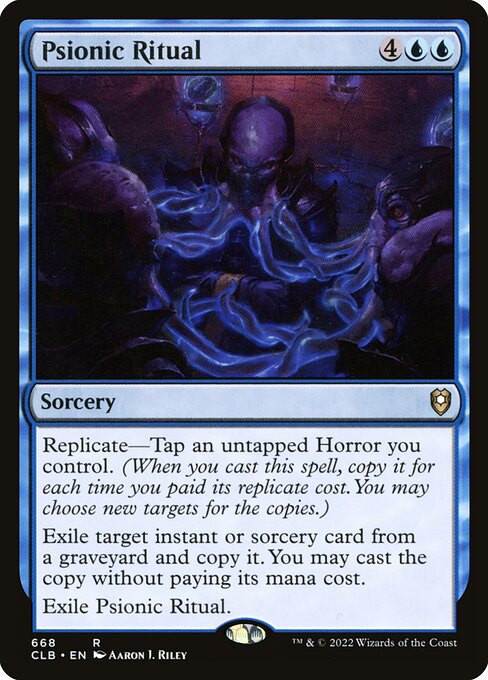
Image courtesy of Scryfall.com
Balancing Complexity and Accessibility with Psionic Ritual
In the grand tapestry of Magic: The Gathering, blue has always stood at the crossroads of intellect and theater—where every spell is a puzzle and every puzzle asks, “What’s the right move, and how many steps ahead can you see?” Psionic Ritual, a Rare from Commander Legends: Battle for Baldur’s Gate, is a perfect microcosm of that tension. It costs a substantial six mana (4 generic and 2 blue), but its payoff isn’t merely “I get a bigger spell.” It invites you to think about tempo, resource density, and the kinds of lines you’re willing to walk to squeeze extra value out of the graveyard. 🧙♂️🔥💎
Let’s unpack what makes Psionic Ritual both alluring and intimidating. The card’s text is a layered beast: Replicate—Tap an untapped Horror you control. When you cast this spell, copy it for each time you paid its replicate cost. You may choose new targets for the copies. Then, exile a target instant or sorcery card from a graveyard and copy it. You may cast the copy without paying its mana cost. Finally, exile Psionic Ritual itself. In short: you can chain copies, yank a spell from a graveyard, recast it for free, and you’ve just spent your Horror-tax on a blue spell with graveyard recursion baked in. It’s the kind of multi-step interaction that makes players grin—and reach for a clean, accessible mental model a little later in the day. 🎲
“Blue isn’t just about counterspells; it’s about curating possibilities. Psionic Ritual tests your ability to orchestrate a small orchestra of decisions—how many horrors you’ve tapped, which graveyard spell you fetch, and when you choose to unleash a free copy.”
From a design perspective, Psionic Ritual sits at an interesting nexus. Its replicating mechanic is flashy enough to feel iconic, but not so absurd that it becomes a spammable win condition on every board state. The requirement to tap an untapped Horror to pay the replicate cost gates the spell behind a creature-based constraint. In practical terms, that means you need a board with the right mix of Horror creatures and untapped liquidity to maximize value. This is a deliberate design choice: it nudges players toward a tempo-friendly path rather than a one-card lockdown. It acknowledges both the thrill of explosive plays and the discipline of resource management. ⚔️🎨
Strategies for getting the most out of Psionic Ritual
- Horror gateway and tempo. Build your blue shell with a core of Horror creatures that you’re comfortable tapping when the opportunity arises. Psionic Ritual rewards you for having an available Horror on the battlefield to unlock replication. It’s not about amassing a humongous board; it’s about cultivating a reliable “tap for value” economy over several turns. 🧙♂️
- Graveyard synergy. The exile-and-copy clause invites you to curate a graveyard with instants and sorceries that you’d love to replay for free. Target a flexible spell—think removal, cantrips, or a game-finisher—then copy it for value that scales with the number of copies you generate. This is blue’s sweet spot: control, recursions, and inevitable inevitabilities. 🔮
- Planning the replicates. Each replicate copies the entire Psionic Ritual, including the graveyard interaction. That means more exiled spells and more free casts, but also more opportunities for missteps if you aren’t careful about sequencing. Keep a mental note of what you’ve exiled and what you’ve copied; the math can get wild in the heat of a big turn. 🧠
- EDH-proof curve. In Commander, Psionic Ritual shines in longer games where late-game stabilizers and graveyard shenanigans become pivotal. It’s not a standard-restrictive card, but it finds a comfortable home in slower blue-heavy pods that enjoy complex decision trees and multi-step wins. ⚡
- Counterplay and balance. Because it relies on a horror you control to pay for replication, opponents can pressure your board state to restrict your ability to replicate. The card rewards patience and careful timing, which is precisely the kind of tug-of-war that keeps multiplayer formats lively and interactive. 🏹
From a teaching perspective, Psionic Ritual is a fantastic conversation piece about how complexity can be layered into a single card without pushing players away. It demonstrates that accessibility isn’t about dumbing down mechanics; it’s about presenting a high-leverage option that invites thoughtful decisions rather than rote execution. A well-timed replicate of Psionic Ritual can feel like solving a mini-puzzle on the fly, and that’s a core thrill in MTG fandom. 🎨
Flavor, art, and the magic of design
Aaron J. Riley’s artwork for Psionic Ritual captures the sense of mindscapes colliding with arcane power. The swirling energy, the sense of control slipping through one’s fingers, and the cool-blue glow align with blue’s flavor: intellect as accident and inevitability as strategy. The card’s flavor text remains elusive in the actual rules text, but its thematic core—pulling power from the mind and bending it into a replicable spell—resonates with players who love both the lore and the mechanics of the color spectrum. This is one of those cards where the art and the function reinforce each other, making the choice to play blue feel deliberate and stylish. 🧠💎
In terms of accessibility vs. complexity, Psionic Ritual offers a manageable but rich decision tree. It isn’t so dense that casual players will feel overwhelmed, but it gives seasoned players plenty of room to experiment with timing, target selection, and the way they sequence their combos. If you’re curious about the broader design language, CLB’s Commander set continues to explore how blue can push the envelope—without abandoning the everyday player’s sense of fun and strategic control. 🎲
For collectors and players who love seeing unique card design in action, Psionic Ritual is a nice mix of rarity and utility. While the market price sits modestly around a few dollars, its value isn’t just in raw numbers—it’s in the *experiential value* of resolving a carefully constructed replicate line and pulling a well-chosen spell out of the graveyard at just the right moment. With a few Horror creatures on deck and a well-timed exiled spell, you’re looking at a memorable sequence that blends strategy, flavor, and a dash of chaos. 🔥
As you explore how to balance complexity and accessibility in your own games, Psionic Ritual serves as a polished reminder that great design often lives at the intersection of robust mechanics and elegant restraint. It’s a spell that rewards thoughtful play, invites creative deck-building, and keeps the dream of blue magic alive and thriving in the halls of Baldur’s Gate. 🧙♂️⚔️
Magsafe Phone Case with Card Holder — Polycarbonate Matte or GlossMore from our network
- https://blog.crypto-articles.xyz/blog/post/nft-data-nuddies-1320-from-nuddies-collection-on-magiceden/
- https://crypto-acolytes.xyz/blog/post/nft-stats-poketardio-2049-from-poketardio-collection/
- https://wiki.digital-vault.xyz/wiki/post/pokemon-tcg-stats-rabsca-card-id-sv02-099/
- https://donation.digital-vault.xyz/donation/post/donate-to-keep-the-open-web-as-public-infrastructure/
- https://blog.crypto-articles.xyz/blog/post/nft-data-nuddies-1619-from-nuddies-collection-on-magiceden/
Psionic Ritual
Replicate—Tap an untapped Horror you control. (When you cast this spell, copy it for each time you paid its replicate cost. You may choose new targets for the copies.)
Exile target instant or sorcery card from a graveyard and copy it. You may cast the copy without paying its mana cost.
Exile Psionic Ritual.
ID: 9eb36d21-0136-4fee-a348-92a99b7c5305
Oracle ID: 1c3e6980-97fe-4e15-93a0-368280da8608
Multiverse IDs: 567233
TCGPlayer ID: 273527
Cardmarket ID: 661294
Colors: U
Color Identity: U
Keywords: Replicate
Rarity: Rare
Released: 2022-06-10
Artist: Aaron J. Riley
Frame: 2015
Border: black
EDHRec Rank: 8781
Set: Commander Legends: Battle for Baldur's Gate (clb)
Collector #: 668
Legalities
- Standard — not_legal
- Future — not_legal
- Historic — not_legal
- Timeless — not_legal
- Gladiator — not_legal
- Pioneer — not_legal
- Modern — not_legal
- Legacy — legal
- Pauper — not_legal
- Vintage — legal
- Penny — not_legal
- Commander — legal
- Oathbreaker — legal
- Standardbrawl — not_legal
- Brawl — not_legal
- Alchemy — not_legal
- Paupercommander — not_legal
- Duel — legal
- Oldschool — not_legal
- Premodern — not_legal
- Predh — not_legal
Prices
- USD: 0.28
- EUR: 0.24
- TIX: 0.39
More from our network
- https://blog.crypto-articles.xyz/blog/post/nft-data-bmb-community-season-2-7038-from-bmb-community-airdrop-season-2-collection-on-magiceden/
- https://blog.rusty-articles.xyz/blog/post/system-shock-remake-cosplay-highlights-best-builds-and-props/
- https://blog.crypto-articles.xyz/blog/post/nft-data-solgod-1636-from-solgods-collection-on-magiceden/
- https://crypto-acolytes.xyz/blog/post/nft-stats-nft-216-from-fingy-collection/
- https://blog.zero-static.xyz/blog/post/red-alert-2-ending-theories-explored-what-actually-happened/