

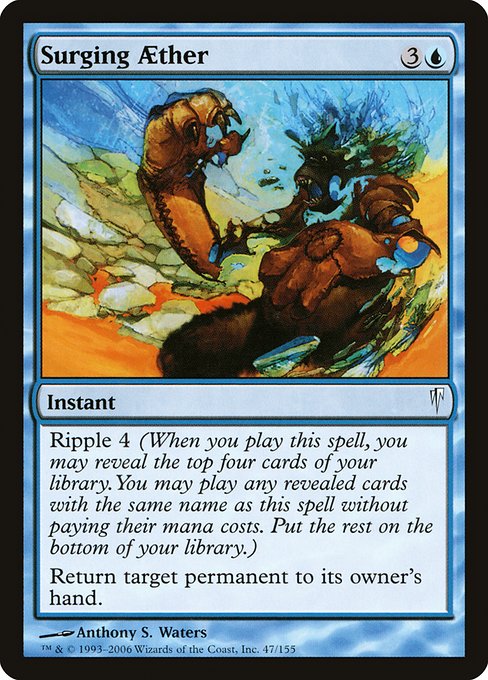
Image courtesy of Scryfall.com
Ripple Through Time: How Surging Aether Shaped the Way Fans Read Magic
Magic: The Gathering has always invited players to read the tea leaves of a card’s text and predict what the future would hold for strategy, lore, and the community at large. Some cards age like fine wine, others like silver foil that’s already tarnished in the sun. Surging Aether, an Instant from the Cold Snap era, sits somewhere in the middle—modest in cost, rich in potential, and forever a touchstone for how fans interpret mechanics that bend the rules of play. Released on July 21, 2006, this blue spell is a reminder that creativity in interpretation can outpace a card’s face value 🧙♂️🔥.
At first glance, Surging Aether is a tempo tool: for {3}{U}, you bounce a permanent and gain a little card-selection help with Ripple 4. The ripple ability—reveal the top four cards of your library, cast spells with the same name as Surging Aether from among those revealed cards for free, and then put the rest on the bottom—transformed how fans thought about “free” spells. It wasn’t just about cheap copies or a one-off discount; it was about shaping a moment where you could glimpse the top of your deck and write a small story of what the next four turns might look like. The art by Anthony S. Waters adds to that sense of quick, electric possibility—the moment you draw energy from the Aether and steer the game’s tempo with a single instant ⚡️.
Over time, fans learned to reinterpret Ripple not as a one-card cheat sheet but as a narrative device—an invitation to discuss deckbuilding psychology. In those early days, Ripple felt like a dare: would you risk exposing four cards to potentially pull a critical answer or a graceful set of plays? As the game matured, communities around Modern, Legacy, and Commander built a vocabulary around Ripple’s cadence—how often to count on the top of your library, what you might find there, and how to sequence plays to maximize both the bounce effect and your hand advantage. The discussion shifted from “Can we pull off a miraculous free spell?” to “How does this ripple frame your turn economy? How does the next card from the top change your options?” It’s a microcosm of fan theory evolution: from surface-level tricks to a deeper, time-spanning appreciation of how a card’s architecture pushes people to reexamine what “value” really means in a game where tempo, control, and chance dance together 💎⚔️.
“Ripple isn’t just about discovering spells for free; it’s about reading lines of play that aren’t obvious until someone asks, ‘What if I swap a single risk for a cascade of possibilities?’”
The card’s color identity—blue—anchors the broader narrative: blue’s love affair with information, timing, and manipulation. Surging Aether is a friendly face in a long blue tradition of tempo and control, yet the Ripple mechanic invites players to engage with the top of the library as if it were a second stack of decision points. In this sense, fans have treated Surging Aether as a gateway card—a reminder that even a common rarity instant from a snow-flavored set can spark rich, divergent interpretations about how information theory itself can tilt the board 🧭🎲.
The design, the lore, and the community lens
Design-wise, Surging Aether embodies a philosophy that forever threads past and present: a simple text box, a crisp mana cost, and a mechanic that rewards reading ahead. Its Ripple 4 is a compact engine for “what-if” scenarios. The flavor of the name—Aether as a volatile, radiant essence—pairs with the idea of surging, energetic potential waiting to be unleashed. This pairing invites fans to imagine a battlefield where a single instant can redraw the arc of a game, not merely by blow-for-blow damage but by a cognitive shift: the top four cards might contain your next answer, your next threat, or your next turn entirely undone or redefined 🔮💡.
In collector culture and casual play alike, Surging Aether is appreciated for its accessibility. It’s a common, affordable cornerstone that demonstrates how a card’s power can be more about flexibility than brute force. Today, you can find it in Modern, Legacy, Pauper, and many casual Commander tables, a testament to Blue’s enduring appeal and to Ripple’s evergreen fascination. The card’s market snapshot—roughly $0.08 in nonfoil, $0.19 foil—speaks to its role as a thoughtful investment in playstyle rather than a slam-dunk staple, which in turn fuels ongoing discussions about reprints, deckbuilding options, and how nostalgic design elements stay relevant across generations of players 🎨🔥.
Fan interpretations continue to evolve as new printing philosophies, streaming meta, and digital deck builders change how we value top-of-library manipulation. Surging Aether invites players to reframe “value” as a dialogue between card text and the player’s imagination. It’s less about winning on the spot and more about inviting a narrative where every Ripple reveals a story, and every bounce draws another line in the lore of your game night 🧙♂️🎲.
From budget controls to bold tempo plays
For modern players looking to spice up a blue-based tempo shell, Surging Aether remains a useful reference point. Its combination of return-to-hand utility and top-of-library manipulation made it a blueprint for “low-cost, high-variance” options that reward careful sequencing. The card’s era—Coldsnap, with its snow theme—also reminds us that MTG’s history is a tapestry of cross-cutting motifs: ice and electricity, restraint and risk, nostalgia and innovation. When fans debate ripple strategies, they’re not just arguing about a single spell; they’re exploring a lineage of design philosophy that has animated countless formats—from the earliest Eternal Masters conversations to today’s VOD-driven theory crafting. And yes, the meme-ready flavor of an instant that could steal tempo while flirting with free spellcasting never dies. It merely migrates, evolves, and resurfaces in new forms with every new card that excerpts the same kind of spark ⚔️.
As you swirl through your own collection and the community’s threads, consider the ripple as a social mechanism as much as a gameplay one: a prompt for discussion, a lure for theory-crafting enthusiasts, and a reminder that fan interpretation is an ever-adapting practice. Surging Aether is a compact exemplar: a blue instant that asks you to look beyond the immediate impact and into the ripple of possibilities that the top four cards may offer. That is where fan theory grows—one card, one turn, one conversation at a time 🧙♂️💎.
Phone Stand for Smartphones 2-Piece Wobble-Free Desk DecorMore from our network
- https://wiki.digital-vault.xyz/wiki/post/pokemon-tcg-stats-fidough-card-id-sv07-066/
- https://wiki.digital-vault.xyz/wiki/post/pokemon-tcg-stats-chatot-card-id-a3b-060/
- https://crypto-acolytes.xyz/blog/post/nft-stats-lil-chiller-418-from-lil-chillers-collection/
- https://transparent-paper.shop/blog/post/build-digital-products-that-solve-real-world-problems/
- https://crypto-acolytes.xyz/blog/post/nft-stats-whale-1696-from-entropy-acolytes-collection/
Surging Aether
Ripple 4 (When you cast this spell, you may reveal the top four cards of your library. You may cast spells with the same name as this spell from among those cards without paying their mana costs. Put the rest on the bottom of your library.)
Return target permanent to its owner's hand.
ID: bfba9fc2-8746-4693-bb75-01b5d78f7fee
Oracle ID: 060b1a76-22a4-48a5-a353-4d0501367956
Multiverse IDs: 122052
TCGPlayer ID: 14127
Cardmarket ID: 13734
Colors: U
Color Identity: U
Keywords: Ripple
Rarity: Common
Released: 2006-07-21
Artist: Anthony S. Waters
Frame: 2003
Border: black
EDHRec Rank: 30063
Penny Rank: 16902
Set: Coldsnap (csp)
Collector #: 47
Legalities
- Standard — not_legal
- Future — not_legal
- Historic — not_legal
- Timeless — not_legal
- Gladiator — not_legal
- Pioneer — not_legal
- Modern — legal
- Legacy — legal
- Pauper — legal
- Vintage — legal
- Penny — legal
- Commander — legal
- Oathbreaker — legal
- Standardbrawl — not_legal
- Brawl — not_legal
- Alchemy — not_legal
- Paupercommander — legal
- Duel — legal
- Oldschool — not_legal
- Premodern — not_legal
- Predh — legal
Prices
- USD: 0.08
- USD_FOIL: 0.19
- EUR: 0.05
- EUR_FOIL: 0.24
- TIX: 0.03
More from our network
- https://blog.rusty-articles.xyz/blog/post/investing-in-meloetta-market-trends-for-pokemon-tcg-collectors/
- https://wiki.digital-vault.xyz/wiki/post/pokemon-tcg-stats-electivire-card-id-sv05-054/
- https://crypto-acolytes.xyz/blog/post/streaming-vs-owning-games-which-is-more-worth-it/
- https://blog.crypto-articles.xyz/blog/post/nft-data-hiney-monster-120-from-hiney-kin-of-horror-collection-on-magiceden/
- https://crypto-acolytes.xyz/blog/post/nft-stats-tardio-258-from-tardio-collection/