
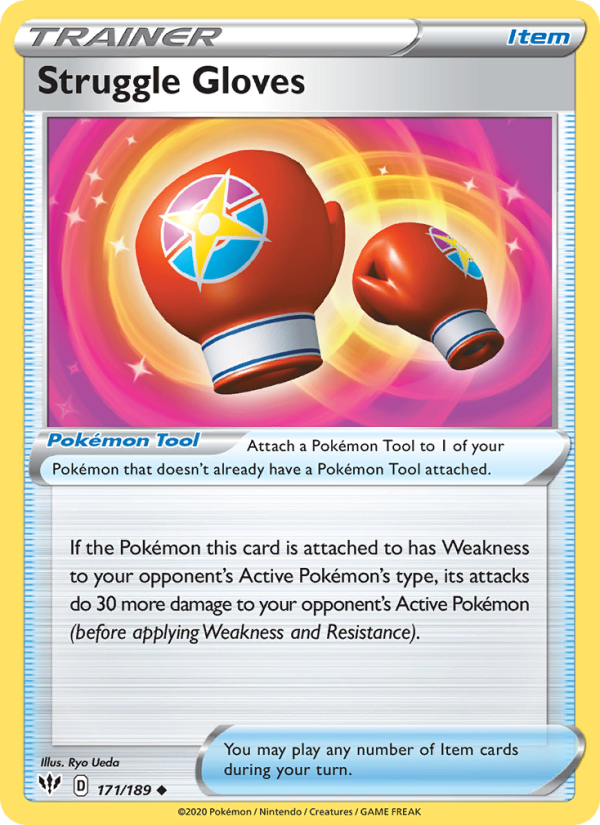
Image courtesy of TCGdex.net
Factors Driving the Market Value of Struggle Gloves
In Pokémon TCG circles, the value of a card often rests on more than raw power. Struggle Gloves—an Uncommon Trainer Tool from Darkness Ablaze (swsh3), illustrated by Ryo Ueda—embodies a compelling blend of practicality, format relevance, and binder-worthy art. While it won’t turn a match on a single play, its effect creates a measurable edge when the math aligns with your plan. The card’s clean design and straightforward rule text make it beginner-friendly, while its strategic potential attracts seasoned players who like to layer options in Expanded formats. ⚡
From a collector and investor perspective, Struggle Gloves sits in a tier of low-cost staples that can appreciate if meta shifts or if Expanded-era decks find new life. The card’s market visibility is shaped by its rarity, legality, and the evergreen appeal of any tool-type trainer that interacts with weaknesses. The artwork by Ryo Ueda adds a subtle premium on the shelf, and the overall package is exactly the kind of piece collectors seek when they’re building diverse, cross-era binders. 💎
What the card actually does and why it matters
- Category & type: Trainer — Tool. This means it attaches to a single non-basic Pokémon, turning a body slot into a flexible offensive option.
- Set & rarity: Darkness Ablaze (swsh3), Uncommon. A set with iconic chase cards, but Struggle Gloves remains accessible for casual players and serious collectors alike.
- Illustrator: Ryo Ueda. The crisp linework and moody palette in Darkness Ablaze are part of what makes the card aesthetically appealing to fans who love well-drawn trainer cards as much as the Pokémon themselves.
- Regulation & legality: Regulation Mark D. officially indicates Expanded-legal status, not Standard. For investors, that means continued demand in the long tail of formats will hinge on Expanded play, not rotation-driven Standard meta shifts.
- Effect: If the attached Pokémon has a Weakness to your opponent's Active Pokémon's type, its attacks do 30 more damage to the opponent's Active Pokémon (before applying Weakness and Resistance).
That final line is the heart of its investment thesis. It’s a simple, clean incentive to pair two key ideas: exploit weakness matchups and add a reliable damage kicker without requiring a dedicated energy or bulky setup. In practice, it nudges deck builders toward selecting attackers whose weaknesses line up with common opponent types—an angle that can become surprisingly potent when you’re cycling multiple threats in Expanded formats. For players, this translates into tempo and plan-B options that don’t demand a high-energy investment. For collectors, it means more copies in various conditions could gradually find buyers who want consistent, playable tools to round out their collections. 🔥
Pricing signals and what they imply for investors
Current data paints a picture of a low-risk, low-cost entry with potential upside if the right conditions align. Here’s a snapshot of the financials that matter to investors and speculators alike:
- Cardmarket (EUR): avg around 0.05 EUR for non-holo copies, with lows near 0.02 EUR. Holo copies tend to sit higher, with averages around 0.35 EUR and occasional spikes as collectors chase near-mint condition holo examples. The holo market shows a more visible upward trajectory when high-grade copies surface in auctions or bundles.
- TCGplayer (USD): for standard (non-holo) copies, the low is around 0.01 USD, mid around 0.11 USD, and high up to about 1.49 USD. Reverse-holo variants run higher, with low around 0.14, mid around 0.25, and highs near 2.00 USD. That gap between non-holo and holo/reverse-holo reflects a familiar pattern: condition and variant matter a lot for price.
- Trend context: The data shows a steady, if modest, appetite for trainer tools in Expanded ecosystems. The appeal isn’t as flashy as the big chase cards, but it has staying power for players who want consistent, affordable add-ons that still offer practical value on the table.
For an investor, the key takeaway is balance: Struggle Gloves remains a very accessible entry point, with downside risk capped by its low price, and upside potential tied to format health, deck-building creativity, and any future reprints or rebalances that boost demand for trainer tools in Expanded play. The card’s current numbers suggest a “buy and patience” approach rather than a quick flip, but the ecosystem around Darkness Ablaze and the ongoing interest in weakness-based dynamics keeps Struggle Gloves relevant. 🎴
Art, lore, and the collector’s eye
Beyond the numbers, the card represents a taste of the broader Darkness Ablaze era. Ryo Ueda’s illustration work provides a cohesive aesthetic thread across many trainer tools, making Struggle Gloves not just a functional asset but a piece a collector can enjoy sleeve-watching and binder-collecting. The Darkness Ablaze set itself carries a moody, Ember-lit vibe, which makes even small tools pop when displayed among a sea of more prominent chase cards. The art’s understated elegance aligns with the card’s practical nature—quiet, dependable, and ready for action when the moment calls. 🎨
For players, the flavor matters too. The tool’s effect speaks to a classic design philosophy: reward the right condition, not just raw power. When two or three pieces of a weakness-based strategy click, Struggle Gloves can feel like the quiet engine behind a louder attack. It’s a reminder that in Pokémon TCG, small edges can ripple outward into meaningful, game-changing turns. ⚡
Practical takeaways for collectors and players
- Format viability: Expanded-legal status makes it a stable long-term hold for binder completeness and for players who enjoy historical decks and non-Standard strategies. Keep an eye on rotation schedules and any reprint chatter that might nudge demand.
- Condition matters: As with most Trainer Tools, mint or near-mint copies command more interest, especially holo or reverse-holo variants. A well-preserved copy can outpace a heavily played one in some markets.
- Strategic value: The +30 damage is situational but not rare in competitive decks. If you anticipate your opponent frequently fields a type that your attached Pokémon weak to, you can extract outs by pairing with attackers that benefit from that exact weakness dynamic.
- Artistic and collection interest: The card’s artwork and set identity enhance its appeal for collectors who appreciate the era’s design language and the artist’s portfolio.
- Risk vs reward: The price floor is very approachable, but investors should watch for shifts in Expanded meta and potential future reprints that could affect price stability.
More from our network
- https://crypto-acolytes.xyz/blog/post/giko-1150-giko-neko-nft-stats/
- https://blog.zero-static.xyz/blog/post/explosive-derailment-collector-edition-value-vs-regular/
- https://crypto-acolytes.xyz/blog/post/nft-stats-rtb-868-from-retarted-bonks-collection/
- https://wiki.digital-vault.xyz/wiki/post/pokemon-tcg-stats-magnemite-card-id-pl3-111/
- https://crypto-acolytes.xyz/blog/post/nft-stats-it-kids-03958-from-it-kids-collection/
Struggle Gloves
Set: Darkness Ablaze | Card ID: swsh3-171
Card Overview
- Category: Trainer
- HP:
- Type:
- Stage:
- Dex ID:
- Rarity: Uncommon
- Regulation Mark: D
- Retreat Cost:
- Legal (Standard): No
- Legal (Expanded): Yes
Description
Pricing (Cardmarket)
- Average: €0.05
- Low: €0.02
- Trend: €0.05
- 7-Day Avg: €0.03
- 30-Day Avg: €0.04
Support Our Decentralized Network
Donate 💠More from our network
- https://crypto-acolytes.xyz/blog/post/giko-1150-giko-neko-nft-stats/
- https://blog.zero-static.xyz/blog/post/explosive-derailment-collector-edition-value-vs-regular/
- https://crypto-acolytes.xyz/blog/post/nft-stats-rtb-868-from-retarted-bonks-collection/
- https://wiki.digital-vault.xyz/wiki/post/pokemon-tcg-stats-magnemite-card-id-pl3-111/
- https://crypto-acolytes.xyz/blog/post/nft-stats-it-kids-03958-from-it-kids-collection/