

Image courtesy of Scryfall.com
Storytelling as Balance in the Multiverse
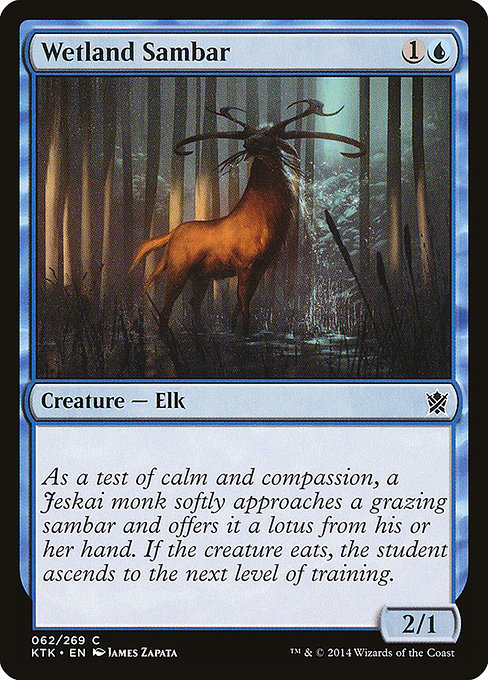
Blue in Khans of Tarkir often leans on tempo and precision, andWetland Sambar is a slim, dependable piece that embodies how a single creature can anchor a plan without shouting its intentions. For a two-mana blue Elk with a 2/1 frame, the math is modest, but the storytelling potential is not. With a mana cost of {1}{U}, Wetland Sambar invites you to pace your plays, to weave decisions into the fabric of the game. It’s the kind of card that rewards a calm, deliberate approach—the moment when you choose to advance a plan while leaving room for the unexpected. 🧙♂️🔥
As a test of calm and compassion, a Jeskai monk softly approaches a grazing sambar and offers it a lotus from his or her hand. If the creature eats, the student ascends to the next level of training.
The flavor text is more than lore fluff; it’s a design statement. Wetland Sambar operates as a quiet bridge between blue’s early aggression and the late-game tempo plays that define the Jeskai philosophy. The monk’s lotus is a storytelling device: a decision point that nudges the narrative from mere tempo into a moment of moral choice. Do you encourage balance by letting the creature eat, or do you hold back and reserve the lotus for a more decisive moment? This is storytelling as balance—a gentle nudge that transforms a simple two-drop into a narrative beat, a micro-story that returns value to both players as they recount the tale in their heads. 🧠🎨
From a gameplay perspective, Wetland Sambar is a practical cornerstone for blue decks that crave early stability. Its power of 2 and toughness of 1 may look modest, but in the right environment it becomes a reliable tempo piece. It asks only that you invest in the right tempo—two mana on turn two with a clear plan for the next few turns. You’re not chasing game-ending bliss here; you’re building a rhythm, a cadence that lets you untap, draw, and answer while the story of your battlefield unfolds. The card’s rarity—a common with foil and nonfoil finishes—helps players experiment without breaking the bank, a welcome feature for budget-minded builders who still want to tell a big tale on the table. The Khans of Tarkir frame, with its five clan-theme crossover, reinforces the sense that every play is part of a broader saga—a saga where balance is earned, not granted. 💎
Art, design, and the push toward balance
James Zapata’s illustration for Wetland Sambar presents a quiet, almost meditative scene: a calm elk, a hint of blue mana energy, and a sense that restraint can be a strategic virtue. In MTG, art often reinforces what the card does in words, and this piece is no exception. The image invites you to imagine the moment before a decisive clash—when a monk considers offering a lotus, when a passerby chooses patience over impulse. It’s a reminder that sometimes the most powerful plays are those that shape the story as it’s being told rather than simply ending it. The flavor of Tarkir’s Jeskai echoes through the image: discipline, mastery, and the recognition that balance is a craft, not a shortcut. 🧙♂️🎲
Design-wise, Wetland Sambar embodies a deliberate choice: reward patience without rewarding entitlement. Its presence in a blue deck signals a blend of tempo and inevitability—enough presence to pressure your opponent, enough depth to keep options open for the long game. The card’s modern-legal status across MTGO and Arena keeps it accessible to new players while retaining charm for veteran collectors who appreciate a well-placed, story-forward piece in a budget-friendly slot. The occasional glow of foil prints adds a collectible sparkle that pairs nicely with the lore behind the lotus and the monk’s ascent. ⚔️
Deckbuilding ideas and storytelling moments
- Tempo anchor: Play Wetland Sambar on turn 2 to threaten damage while you set up countermagic and draw spells for the next two turns.
- Budget blue shells: As a common, it’s a friendly slot for players building around a lean blue curve with cheap cantrips and removal—proof that good stories don’t require a treasure chest to tell.
- Narrative framing: Use the card’s flavor to craft a micro-story in your head about a monk guiding a creature toward balance; this mental narrative can influence decisions about when to trade, when to conserve resources, and when to push for a more dramatic turn.
In the end, Wetland Sambar is less about a flashy payoff and more about a steady heartbeat in a blue deck. It’s a card that teaches patience, rewards careful narrative pacing, and reminds us that balance—whether in a temple or at a kitchen table—often appears in the smallest, most deliberate choices. For collectors, players, and story lovers alike, it’s a tiny gateway into a much larger conversation about how we tell stories with cards when the board clears and the players lean in to listen. 🧙♂️💎
Custom Rectangular Mouse Pad 9.3x7.8in White Cloth Non-SlipMore from our network
- https://blog.digital-vault.xyz/blog/post/dr3-reshapes-milky-way-stellar-catalogs-with-a-blue-hot-beacon/
- https://rusty-articles.xyz/tmpd7t_k7on/8805c227.html
- https://blog.crypto-articles.xyz/blog/post/nft-data-hero-1425-from-soul-gate-heroes-collection-on-magiceden/
- https://blog.rusty-articles.xyz/blog/post/fallout-2-best-pc-settings-for-smooth-gameplay-on-pc/
- https://wiki.digital-vault.xyz/wiki/post/pokemon-tcg-stats-nincada-card-id-dp6-108/
Wetland Sambar
ID: f71a86e0-d15a-4fba-94f6-bfbaade8d837
Oracle ID: 8a50b8f7-1af8-4e00-9734-66a87e05cc6f
Multiverse IDs: 386721
TCGPlayer ID: 93216
Cardmarket ID: 269463
Colors: U
Color Identity: U
Keywords:
Rarity: Common
Released: 2014-09-26
Artist: James Zapata
Frame: 2015
Border: black
EDHRec Rank: 28611
Penny Rank: 15366
Set: Khans of Tarkir (ktk)
Collector #: 62
Legalities
- Standard — not_legal
- Future — not_legal
- Historic — legal
- Timeless — legal
- Gladiator — legal
- Pioneer — legal
- Modern — legal
- Legacy — legal
- Pauper — legal
- Vintage — legal
- Penny — legal
- Commander — legal
- Oathbreaker — legal
- Standardbrawl — not_legal
- Brawl — legal
- Alchemy — not_legal
- Paupercommander — legal
- Duel — legal
- Oldschool — not_legal
- Premodern — not_legal
- Predh — not_legal
Prices
- USD: 0.06
- EUR: 0.03
- EUR_FOIL: 0.16
- TIX: 0.04
More from our network
- https://articles.digital-vault.xyz/blog/post/exposed-cut-copper-slab-build-ideas-with-other-blocks/
- https://articles.digital-vault.xyz/blog/post/halo-infinite-unwritten-rules-for-fair-multiplayer-etiquette/
- https://blog.crypto-articles.xyz/blog/post/nft-data-jellylore-club1028-from-jellylore-club-collection-on-magiceden/
- https://blog.zero-static.xyz/blog/post/ml-driven-doran-decks-siege-tower-optimization/
- https://blog.digital-vault.xyz/blog/post/data-driven-mana-efficiency-for-consuming-bonfire/