

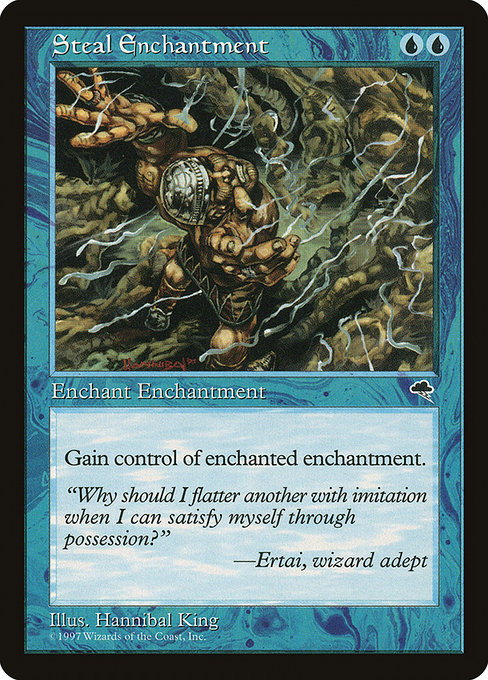
Image courtesy of Scryfall.com
Decade-by-decade MTG art trends
Magic: The Gathering has always been a visual conversation between artists, fans, and designers. As the multiverse expanded, so did the ways we picture magic. When we look at a blue aura like Steal Enchantment, we’re not just seeing a spell—we’re seeing a snapshot of how an entire era imagined “control” and “mystery” on the battlefield. 🧙♂️ The artwork by Hannibal King for Tempest (1997) is a perfect case study: a high-res scan that carries the inked grit of the late 90s, framed in the classic black borders that defined the era. The card’s flavor and composition give us a window into a time when magic was increasingly about subversion and cunning, not only raw power. 🔵💎
1990s: painterly realism and fantasy grandeur
The Tempest block arrived with a lush, painterly approach. Art leaned into dramatic lighting, fine linework, and a tactile sense of texture—think stone, water, and glass refracting light. Steal Enchantment, a blue aura that enchants another enchantment and lets you control the enchanted enchantment, embodies that era’s love of clever, almost jewel-like details. The blue palette feels cool and collected, matching the flavor of a school of thought that prized intellect and manipulation over sheer force. The from-the-studio vibe is unmistakable: art that looks hand-painted, with intricate borders and a sense of depth that invites a long stare. ⚔️🎨
2000s: digital brushstrokes and cinematic lighting
As illustrators transitioned to digital tools, MTG art began to lean toward smoother gradients, more dynamic lighting, and a cinematic tempo. Enchantments like Steal Enchantment still played with the idea of possession and control, but the visuals could push the eye toward the interplay of light on water and glass, or the shimmer of arcane energy. The color identity stayed true to blue—cool tones, crisp highlights, and a sense of calm calculation—while the composition started to feel more staged for a card game’s readability, without sacrificing the mood. The result was art that could be as legible on a table as it was stunning in a gallery frame. 🧭🔥
2010s: macro detail and narrative focus
By the 2010s, MTG art embraced macro detail and a stronger sense of narrative within a single frame. The best pieces tell a story at a glance: the aura’s glow, the illusions of control, and the moment of transfer—literally, the enchantment moving from one artifact or enchantment to another. For blue enchantments such as Steal Enchantment, the emphasis on reflective surfaces, foggy atmospherics, and layered textures reinforced the idea that magic is a chemistry of perception and power. The flavor text—Why should I flatter another with imitation when I can satisfy myself through possession?—became a quiet nod to Ertai, wizard adept, and the lore of cunning wizards who pierce defenses with wit as much as will. 🧙♂️💎
2020s and beyond: diversity, experimentation, and global influences
Recent decades have seen a broadening of artists, palettes, and styles. The blue aura motif continues to evolve—more gradient-driven energy, bolder contrasts, and graphic design influences that feel at home in a digital era while still honoring the tactile joy of the card’s original print. Steal Enchantment stands as a bridge between past and present: a reminder that blue’s core strength lies in bending the field, nudging outcomes, and asserting intellectual dominance—not by brute force, but by the art of turning an obstacle into an advantage. The Tempest-era aura remains a touchstone for fans who love a little retro flavor with their modern meta. 🧊🎲
For collectors and players, the card’s uncommon rarity, its nonfoil print in Tempest’s black-bordered frame, and Hannibal King’s evocative art make it a thoughtful homage to the era’s design language. The flavor text embodies the period’s fascination with possession and cleverness—the kind of line that makes you pause, lean in, and consider your next play. If you ever wonder how a single enchantment can be both a strategic tool and a cultural artifact, Steal Enchantment is a perfect primer. Enchantment on enchantment is a neat trick, but the story behind it is even more compelling. 🔮
- Card basics: Enchantment — Aura; UU; you control enchanted enchantment; set Tempest (1997); rarity uncommon; artist Hannibal King; frame 1997; black border; nonfoil.
“Why should I flatter another with imitation when I can satisfy myself through possession?” — Ertai, wizard adept
If you’re building or exploring a blue-centric deck that thrives on hijacking your opponent’s ideas, Steal Enchantment stands as a crisp reminder of how far MTG art and strategy have come. It’s not just about the steal; it’s about the elegance of the method, the polish of the presentation, and the way a single card can spark conversations across decades. 🧙♂️💎
More from our network
- https://blog.crypto-articles.xyz/blog/post/nft-data-solidskulls-1873-from-solidskulls-collection-on-magiceden/
- https://wiki.digital-vault.xyz/wiki/post/pokemon-tcg-stats-raichu-gl-card-id-pl2-31/
- https://transparent-paper.shop/blog/post/mass-from-dr3-refines-stellar-evolution-models-for-a-distant-blue-giant/
- https://blog.digital-vault.xyz/blog/post/amonkhet-raceway-cosplay-desert-race-armor-and-flair/
- https://wiki.digital-vault.xyz/wiki/post/pokemon-tcg-stats-mewtwo-card-id-lc-29/
Steal Enchantment
Enchant enchantment
You control enchanted enchantment.
ID: 734be7fa-0998-4771-9b97-4989b3fc1471
Oracle ID: 567a3fa7-5ca9-4812-b81d-4953c401c83d
Multiverse IDs: 4729
TCGPlayer ID: 5753
Cardmarket ID: 8825
Colors: U
Color Identity: U
Keywords: Enchant
Rarity: Uncommon
Released: 1997-10-14
Artist: Hannibal King
Frame: 1997
Border: black
EDHRec Rank: 6795
Penny Rank: 9155
Set: Tempest (tmp)
Collector #: 90
Legalities
- Standard — not_legal
- Future — not_legal
- Historic — not_legal
- Timeless — not_legal
- Gladiator — not_legal
- Pioneer — not_legal
- Modern — not_legal
- Legacy — legal
- Pauper — not_legal
- Vintage — legal
- Penny — not_legal
- Commander — legal
- Oathbreaker — legal
- Standardbrawl — not_legal
- Brawl — not_legal
- Alchemy — not_legal
- Paupercommander — not_legal
- Duel — legal
- Oldschool — not_legal
- Premodern — legal
- Predh — legal
Prices
- USD: 14.25
- EUR: 5.35
- TIX: 0.39
More from our network
- https://articles.zero-static.xyz/blog/post/warframe-analysis-of-player-freedom-and-loadout-variety/
- https://crypto-acolytes.xyz/blog/post/nft-stats-gib-2557-from-gib-collection/
- https://crypto-acolytes.xyz/blog/post/nft-stats-alchemist-2262-from-e-lander-alchemist-collection/
- https://crypto-acolytes.xyz/blog/post/nft-stats-degen-skull-8-from-degen-skulls-collection/
- https://crypto-acolytes.xyz/blog/post/nft-stats-ryujin-3068-from-ryujin-collection/