
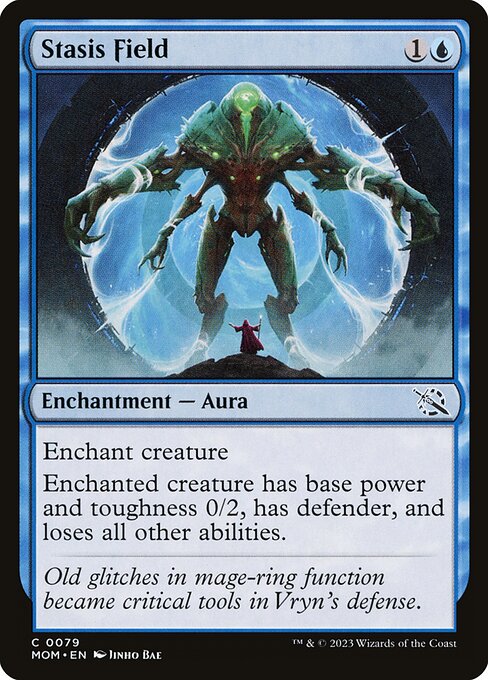
Image courtesy of Scryfall.com
Condition-Based Pricing in Magic: The Gathering
If you’ve ever chased MTG cards for a living room-grade collection or a tournament-ready binder, you already know that price often travels on the tide of condition. A common card with a few handling marks can drift far from a pristine copy that’s straight out of a wrapper. The market weighs not just how rare a card is, but how well it wears and how complete its presentation remains. In the case of a blue aura like Stasis Field, the conversation between gameplay utility and physical condition becomes doubly interesting, because its value is shaped by both cardboard realities and player demand 🧙♂️💎.
Stasis Field is a creature-enchanting aura from March of the Machine ( MOM). With a mana cost of {1}{U}, it grants an enchanted creature a surprisingly stubborn tax on aggression: the enchanted creature becomes 0/2, gains defender, and loses all other abilities. It’s a quintessential blue stall tool, enabling control players to slow down waves of attackers while they set up counterplay. That utility matters for pricing because it’s a playable piece in multiple formats—even though it’s a common rarity, not a flashy rare or mythic. The value you see in a near-mint copy isn’t just about the card’s power; it’s about how proudly you can showcase it in a binder or a display case, and how much of the card’s surface integrity remains intact 🔎🎨.
What the numbers tell us—and what condition does to them
On a snapshot of the market, Stasis Field is a nice case study. The card’s listed values show a nonfoil USD price around 0.06 and a foil price around 0.18, with EUR equivalents just a touch higher for nonfoil and foil variants. In practical terms, that means a foil copy commands roughly triple the nonfoil baseline in this price tier, all else being equal. It’s a reminder that condition isn’t just about aesthetics; it’s the practical gatekeeper for these numbers. A Near Mint copy will fetch a premium relative to a heavily played version, and even minor surface flaws or whitening around the edges can shave cents or dollars off the value—especially for a card with a dedicated blue-collar following in casual and EDH circles 🧙♂️⚔️.
For a card like Stasis Field, a few concrete pricing levers emerge when you consider condition:
- Foil vs. nonfoil: Foil copies tend to ride a higher premium curve, because foil finishes catch the eye and are coveted by players who prize display-worthy cards. In the Stasis Field example, foil copies are about three times the nonfoil baseline in USD terms, though regional pricing and market flux can tilt that ratio.
- Printing and year: MOM marks a recent enough print that condition matters as much as the presence of any gloss—foil integrity, centering, and corner wear all influence the perceived value. Older, heavily circulated cards might have a broader gap between NM and MP, while newer prints tend to compress the range a bit.
- Grading and accents: For common cards, professional grading isn’t typically cost-effective at the lowest tiers. Yet, for collectors who want a pristine showpiece, certified NM or near-perfect examples can hold and even grow their value more reliably, especially when paired with a striking display or rare art variations.
How condition affects strategy and collecting philosophy
From a gameplay angle, Stasis Field’s enchant ability is straightforward: you attach it to an opponent’s creature to blunt their aggression while you assemble counterspells or win conditions. But in the collector’s realm, condition becomes a strategy in itself. A minty copy not only plays well on a table but also reads as an artifact of a moment in the game’s ongoing story—the flavor text about “Old glitches in mage-ring function” nods to the lore behind Vryn’s defense, a meta story that resonates with players who remember more experimental blue decks and puzzle-box combinations 🔮. The card’s art by Jinho Bae, while not a chase illustration, still carries resonance for fans who appreciate MOM’s theme of clever — sometimes chaotic — magecraft. When collectors discuss condition, they’re also weighing the card’s mobility in formats that matter to them. In casual Pioneer or Modern, where a blue control shell can feature this aura, the card remains approachable and practical—but the condition multiplier matters, especially when someone is building a pristine deck with perfectly aligned sleeves, pristine edges, and crystal-clear artwork. The market rewards clean, well-centered copies with good surface texture, and price data supports that intuition—small improvements in condition can yield meaningful returns, particularly for foil and near-mint examples 🧙♂️💎.
Tagging your collection with value rather than volume
Smart collectors think not just in terms of cards owned, but price-per-card in top condition. Stasis Field serves as a perfect reminder: a blue aura that denies aggression can be part of a larger control strategy, but its market value still sits in the lower tier of MTG economics. That means you can invest more in the condition of standout cards (perfectly centered, crisp borders, clean backs) and still keep your overall collection accessible. And as you fine-tune your inventory, don’t forget practical niceties—like a reliable phone case with a card holder for your daily carry. Speaking of which, if you’re shopping for gear that blends form and function, consider the Neon Phone Case with Card Holder MagSafe Polycarbonate Glossy Matte from the shop linked below. It’s a stylish companion for a tournament night or a casual lunch break, and it’s a small nod to the same care you put into card grading and storage 🧙♂️🎲.
Neon Phone Case with Card Holder MagSafe Polycarbonate Glossy MatteMore from our network
- https://blog.crypto-articles.xyz/blog/post/nft-data-trololol-257-from-trololols-collection-on-magiceden/
- https://crypto-acolytes.xyz/blog/post/nft-stats-chubby-ape-gen2-1741-from-chubby-ape-gen2-collection/
- https://crypto-acolytes.xyz/blog/post/minecraft-harry-potter-mods-a-wizarding-world-adventure/
- https://wiki.digital-vault.xyz/wiki/post/pokemon-tcg-stats-ambipom-g-card-id-pl2-56/
- https://blog.zero-static.xyz/blog/post/oji-the-exquisite-blade-uncommon-planeswalker-interactions/
Stasis Field
Enchant creature
Enchanted creature has base power and toughness 0/2, has defender, and loses all other abilities.
ID: 38211d78-ebac-4150-ac11-7613a0e9e1bc
Oracle ID: 83633ea1-a8d5-4351-9047-625d6905386d
Multiverse IDs: 607108
TCGPlayer ID: 491751
Cardmarket ID: 704778
Colors: U
Color Identity: U
Keywords: Enchant
Rarity: Common
Released: 2023-04-21
Artist: Jinho Bae
Frame: 2015
Border: black
EDHRec Rank: 11410
Penny Rank: 11501
Set: March of the Machine (mom)
Collector #: 79
Legalities
- Standard — not_legal
- Future — not_legal
- Historic — legal
- Timeless — legal
- Gladiator — legal
- Pioneer — legal
- Modern — legal
- Legacy — legal
- Pauper — legal
- Vintage — legal
- Penny — not_legal
- Commander — legal
- Oathbreaker — legal
- Standardbrawl — not_legal
- Brawl — legal
- Alchemy — not_legal
- Paupercommander — legal
- Duel — legal
- Oldschool — not_legal
- Premodern — not_legal
- Predh — not_legal
Prices
- USD: 0.06
- USD_FOIL: 0.18
- EUR: 0.12
- EUR_FOIL: 0.19
- TIX: 0.03
More from our network
- https://crypto-acolytes.xyz/blog/post/nft-stats-lil-chiller-1453-from-lil-chillers-collection/
- https://crypto-acolytes.xyz/blog/post/nft-stats-drifella-iii-112-from-drifella-iii-collection/
- https://blog.digital-vault.xyz/blog/post/optimizing-evs-and-ivs-in-miraidon-low-power-mode/
- https://crypto-acolytes.xyz/blog/post/nft-stats-topu-inc-8527-from-topu-inc-collection/
- https://articles.zero-static.xyz/blog/post/shinx-meme-trends-on-reddit-shake-up-pokemon-tcg/