
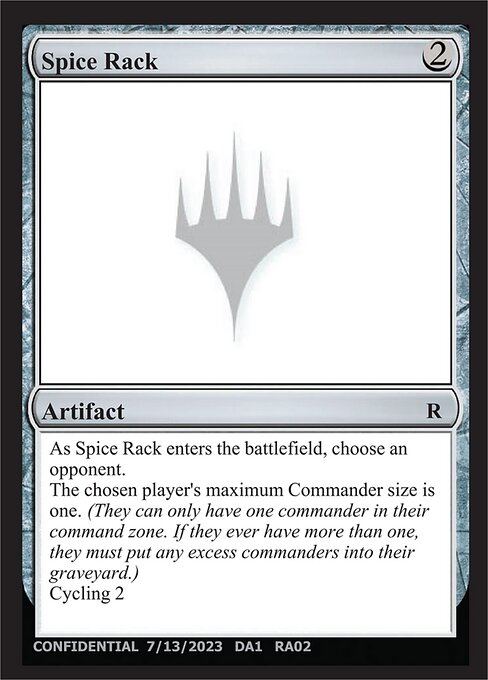
Image courtesy of Scryfall.com
Spice Rack and the Dawn of MTG History
In the attic of Magic: The Gathering lore, there are dusty boxes labeled with scrawled years like “early 1990s,” and then there are the gleaming what-ifs of later days. Spice Rack sits at an enticing crossroads between those eras. A colorless artifact from a playful, little-known set called Unknown Event, Spice Rack reminds us that the game’s earliest charm was its appetite for experimentation. It doesn’t just sit on a shelf; it invites you to negotiate the table, to trade power for tempo, and to savor those tabletop moments when a single artifact reshapes a game’s whole tempo 🧙♂️🔥.
What it does, and why that matters
For a modest mana investment of {2}, Spice Rack enters the battlefield with a promise: you get to shape the social contract of the game. The card text reads plainly but with a sly wink: “As Spice Rack enters the battlefield, choose an opponent. The chosen player's maximum Commander size is one. (They can only have one commander in their command zone. If they ever have more than one, they must put any excess commanders into their graveyard.) Cyclings {2}.” That last part—Cycling—adds a second life to the artifact, letting you pay two mana to discard and draw a fresh card. It’s a tiny engine that fits neatly into the hallways of early, sometimes chaotic multiplayer play 🎲.
Some of the oldest MTG decks were built on a wing and a prayer, with artifacts like Spice Rack turning social dynamics into a strategic resource. The option to curtail a rival’s commander choices feels like a political spell before “political” was a formal mechanic in every multiplayer format.
How Spice Rack plays in practice
Spice Rack isn’t about flashy combos or neon finishers; it’s about the micro-dynamics of a table. Here are core takeaways for modern players who want to appreciate its pedigree without losing track of the game’s current pace:
- Mind the social contract. When you enter a multiplayer game, choosing an opponent subtly signals what kind of political ally or adversary you want at the table. That choice can tilt early trades, border-pine decisions, and who accepts a peace treaty after a heated exchange.
- Commander constraints as a tug-of-war. The card’s standout line about the maximum Commander size being one for the chosen player creates a stark, tactical constraint. It isn’t about banning a commander outright; it’s about limiting the number of top-tier options available to that player in their command zone. If they already have a leading commander, Spice Rack makes room for you to press pressure on other strategies—or to bait them into riskier plays.
- Tempo via cycling. The {2} cycling allows you to weather rough draws. If your board stalls, you can churn through your deck, finding removal or a different plan. It’s a reminder that even artifacts from quirky sets can have practical rhythm in a meta that prizes pace and planning.
- Value in noncombat and politics. In casual or even some Commander games, this artifact becomes a tool for negotiating truces, swapping favors, or setting up a late-game plan where you steer a near-free cycle into a decisive moment.
Design through the lens of Unknown Event
Spice Rack hails from a “funny” set named Unknown Event, printed in a 2015 frame. The rarity is listed as rare, and the card exists as a playful nod to the era when designers were still discovering the wide spectrum of artifact identity and commander dynamics. The decision to give a colorless artifact a strong social effect—paired with a cycling option—feels distinctly early-Magic: a design intent to reward clever table politics as much as raw power. The art, the flavor, and the way it sits in the set ecosystem all echo a certain nostalgia: Magic as a community game that thrives on shared moments, even when the rules occasionally bend for a joke or a wink 🧙♂️⚔️.
In the grand arc of MTG design history, Spice Rack is a taste of the “what if” era—an artifact that doesn’t just sit on a board but stirs the pot, nudging players to consider what the board state means for different hands, different plans, and different levels of risk. The Unknown Event set—though not a standard-legal powerhouse in modern formats—acts as a tribute to the early days when every new card could tilt the balance of power and provoke lively conversations at the table. The card’s 2-mana cost and cycling capability evoke the same nimble efficiency that made early artifacts feel like clever experiments rather than mere mana rocks 🧙♂️💎.
Collector’s eye and cultural resonance
From a collector’s perspective, Spice Rack sits in a curious niche: a rare artifact with a quirky, nonstandard set name and a rule text that invites discussion about how games evolve in social settings. The Unknown Event branding—paired with the card’s live playability in a casual context—creates a conversational piece for MTG fans who love to reminisce about the early “anything can happen” vibe, while still appreciating the modern-era polish of the 2015 frame. Even if you aren’t chasing a top-tier meta, Spice Rack is the kind of card that becomes a story: a reminder of when people gathered around kitchen tables to swap stories as much as spells 🔥🎨.
And of course, there’s the thrill of discovery: a card that invites you to learn, debate, and share with fellow fans. If you’re building a nostalgia-driven deck or curating a display of artifacts that changed how we think about multiplayer power, Spice Rack earns its place in the conversation, even as it remains a playful detour from the main timeline of MTG history ⚔️.
Neon Clear Silicone Phone Case: Slim, Flexible ProtectionMore from our network
Spice Rack
As Spice Rack enters the battlefield, choose an opponent.
The chosen player's maximum Commander size is one. (They can only have one commander in their command zone. If they ever have more than one, they must put any excess commanders into their graveyard.)
Cycling {2}
ID: d163817f-d7ff-4c73-bf6c-df29dffe0d11
Oracle ID: ee86a65f-047d-44cc-b78e-3aa932f6cb7d
Colors:
Color Identity:
Keywords: Cycling
Rarity: Rare
Released: 2023-07-29
Artist:
Frame: 2015
Border: black
Set: Unknown Event (unk)
Collector #: RA02d
Legalities
- Standard — not_legal
- Future — not_legal
- Historic — not_legal
- Timeless — not_legal
- Gladiator — not_legal
- Pioneer — not_legal
- Modern — not_legal
- Legacy — not_legal
- Pauper — not_legal
- Vintage — not_legal
- Penny — not_legal
- Commander — not_legal
- Oathbreaker — not_legal
- Standardbrawl — not_legal
- Brawl — not_legal
- Alchemy — not_legal
- Paupercommander — not_legal
- Duel — not_legal
- Oldschool — not_legal
- Premodern — not_legal
- Predh — not_legal
Prices
More from our network
- https://blog.crypto-articles.xyz/blog/post/nft-data-clippys-1203-from-clippies-collection-on-magiceden/
- https://crypto-acolytes.xyz/blog/post/nft-stats-buly-582-from-buly-collection/
- https://blog.zero-static.xyz/blog/post/convulsing-licid-art-reprints-across-sets/
- https://articles.digital-vault.xyz/blog/post/how-mismagius-drives-energy-acceleration-in-pokemon-tcg-decks/
- https://blog.digital-vault.xyz/blog/post/rune-of-sustenance-predicting-rotations-impact-on-standard/