
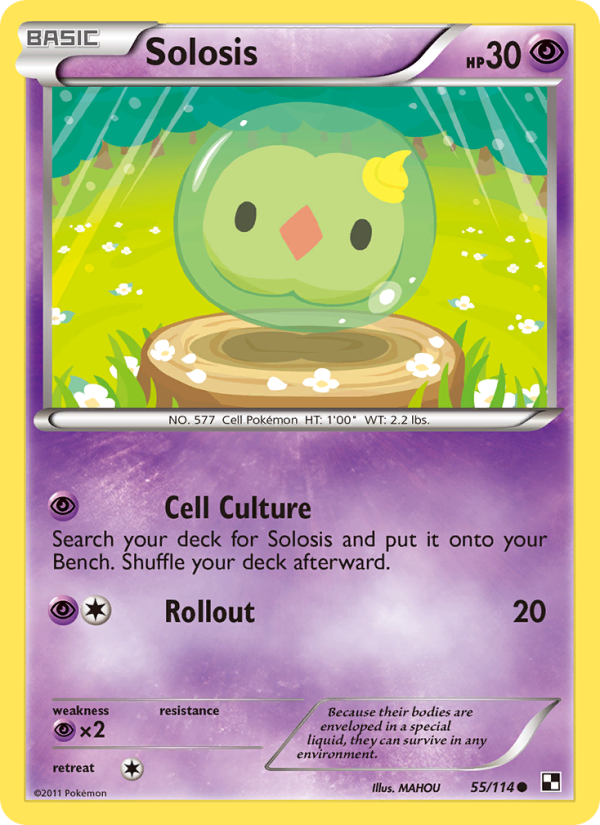
Image courtesy of TCGdex.net
Understanding Grading’s Role in Solosis Value
For collectors and players alike, grading is a formal way to certify a card’s condition and authenticity. When it comes to a BW1 Solosis, a tiny Psychic Basic with modest HP and economical appeal, grading often sparks questions: does a grade really move the needle for a common card, and how does that interplay with the card’s rarity and print variations? The short answer is yes—grading can influence value—but the degree of impact hinges on the card’s variant, market interest, and the grade itself. ⚡
Solosis sits in the Black & White era, cataloged as bw1-55, with a charming, minimalist illustration by MAHOU. The card exists in several variants: a standard non-holo, a reverse-holo, and a holo print. Each variant carries its own energy in the marketplace. While the base card is listed as Common with HP 30 and two attacks—Cell Culture (search your deck for Solosis and bench it) and Rollout (20 damage) —the true grading conversation centers on the holo and reverse-holo versions where condition and surface polish have visibly more impact on value. The set’s design, the hollow foil’s surface, and even centering nuances are all part of what a grading service evaluates when assigning a score from 1 to 10. 🎴
What grading actually measures for a Solosis card
- Centering: A Solosis with clean borders that sits evenly within the card’s frame tends to grade higher, especially for holo prints where edge wear can distract from the foil’s sheen.
- Edges and corners: Sharp corners and unblemished edges are crucial—any whitening or chipping reduces the grade and can dampen the perceived premium of a graded copy.
- Surface foil and gloss: For holo Solosis cards, the condition of the holo foil’s surface—no scratches, flaking, or scuffing—drives the final grade and the card’s glare when viewed in a slab.
- Authentication and rarity alignment: Grading confirms authenticity, which is especially important for investors or collectors building complete sets that include holo or reverse-holo variants.
The market paints a practical picture: non-holo Solosis cards, even in top condition, are appreciation-light compared with the holo and reverse-holo versions. Cardmarket shows an average price around €0.13 for standard copies, while the holo variant sits at a higher average—about €2.2—reflecting both demand for the holo foil and the rarity of that print in the BW1 era. On TCGPlayer, normal copies fetch a low around $0.01, a mid around $0.30, and a high around $5, with reverse-holo variants sometimes tracking higher still, given their collectability. These data points illustrate the potential uplift from grading, but also set expectations: a common card’s strongest gains come from desirable variants and pristine condition rather than from bulk grading alone. 🔥
A practical view: grading scenarios for Solosis
- Ungraded non-holo Solosis: Typically the most accessible price point, hovering near market averages (roughly €0.13 on Cardmarket). A graded copy of a non-holo Solosis might see a modest premium if it achieves a high grade, but the lift is generally small because of its inherent common rarity.
- Ungraded holo Solosis: This is where the value lift is most palpable. The holo variant’s average sits around €2.2, representing a meaningful premium over the non-holo baseline, thanks to foil rarity and display appeal.
- Graded holo Solosis (PSA/BGS 9 or 10): The grade can bring a further lift beyond the raw holo price, especially for a pristine slab with a clean surface and perfect centering. Expect a notable, but not astronomical, premium—more about the collector’s desire for a complete BW1 holo set and the reassurance of a well-preserved, authenticated piece.
: The premium here tends to be smaller; a high-grade non-holo is interesting for completeness but typically doesn’t command the same level of excitement as graded holo copies in the same set.
For players who are considering how to invest or trade, the key is alignment: are you chasing completion in a holo-centric collection, or are you chasing raw play value for a deck that includes basic Psionics? Solosis’ modest HP and straightforward attacks mean it’s not a powerhouse in gameplay in modern formats, but in nostalgic formats or casual play, its value as a collectible can still shine when graded properly. The art adds to the allure—the piece’s identity, with MAHOU’s distinctive style, is part of why collectors gravitate toward high-grade holo versions. 🧪💎
Grading mindset: tips for Solosis owners
- Protect and prep: If you’re aiming for a high-grade holo Solosis, keep it in a high-quality sleeve and a secure top loader or card saver before sending to a grading service. Any handling can introduce micro-scratches that affect surface quality.
- Inspect for edge wear: Solosis’ holo surface can reveal minor edge wear more easily than a non-holo, so inspect in bright light for perfect edges before submission.
- Choose the right service level: For a common card with moderate price, you may weigh the cost of a higher-grade tier against the expected premium. For holo prints, a 9 or 10 can noticeably lift value if the card is otherwise flawless.
- Market timing matters: Graded Solosis cards may benefit from last-year collection drives or new BW1 reprint discussions. Stay aware of niche collector trends and set-wide interest shifts, especially around complete BW1 holo sets.
As you weigh the decision, remember that Solosis’ charm isn’t solely in its mechanics but in its place within the Black & White era and its MAHOU artwork. The card’s basic nature doesn’t diminish its appeal to collectors who savor the era’s color and design language. And while a grade can unlock a new tier of desirability, the best outcome is a well-preserved copy that captures the nostalgia and playfulness of early Pokémon TCG days. 🎨🎮
Phone Click On Grip Back of Phone Stand HolderMore from our network
- https://wiki.digital-vault.xyz/wiki/post/pokemon-tcg-stats-palafin-card-id-sv045-124/
- https://blog.rusty-articles.xyz/blog/post/gradient-bubble-column-palettes-for-minecraft/
- https://wiki.digital-vault.xyz/wiki/post/pokemon-tcg-stats-tapu-fini-card-id-smp-sm203/
- https://blog.zero-static.xyz/blog/post/un-set-chronicles-fae-flights-whimsical-origins/
- https://wiki.digital-vault.xyz/wiki/post/pokemon-tcg-stats-greninja-gx-card-id-sm6-133/
Solosis
Set: Black & White | Card ID: bw1-55
Card Overview
- Category: Pokemon
- HP: 30
- Type: Psychic
- Stage: Basic
- Dex ID: 577
- Rarity: Common
- Regulation Mark: —
- Retreat Cost: 1
- Legal (Standard): No
- Legal (Expanded): Yes
Description
Attacks
| Name | Cost | Damage |
|---|---|---|
| Cell Culture | Psychic | |
| Rollout | Psychic, Colorless | 20 |
Pricing (Cardmarket)
- Average: €0.13
- Low: €0.02
- Trend: €0.13
- 7-Day Avg: €0.14
- 30-Day Avg: €0.16
Support Our Decentralized Network
Donate 💠More from our network
- https://wiki.digital-vault.xyz/wiki/post/pokemon-tcg-stats-palafin-card-id-sv045-124/
- https://blog.rusty-articles.xyz/blog/post/gradient-bubble-column-palettes-for-minecraft/
- https://wiki.digital-vault.xyz/wiki/post/pokemon-tcg-stats-tapu-fini-card-id-smp-sm203/
- https://blog.zero-static.xyz/blog/post/un-set-chronicles-fae-flights-whimsical-origins/
- https://wiki.digital-vault.xyz/wiki/post/pokemon-tcg-stats-greninja-gx-card-id-sm6-133/