
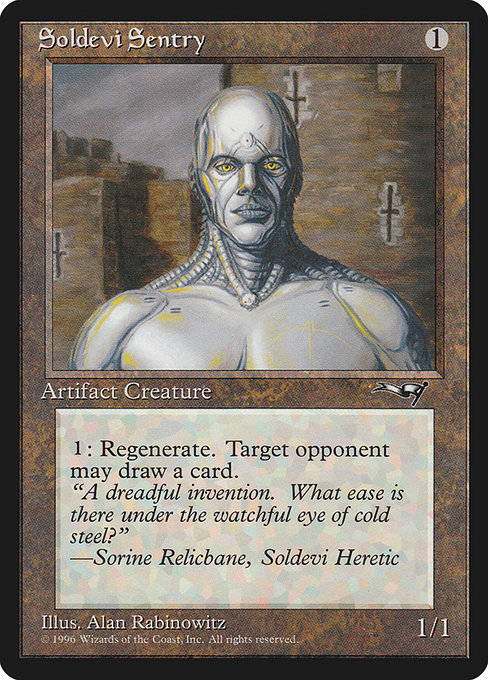
Image courtesy of Scryfall.com
Soldevi Sentry and the Evolving Lore of Its Notable Ability
In the lineage of Soldevi artifacts, Soldevi Sentry stands as a quiet, almost paradoxical guardian. Priced at {1}, this colorless attacker is a humble 1/1 Artifact Creature — Soldier that wears its paradoxes on its sleeve. Its ability, built into a single mana press, reads like a thought experiment: “{1}: Choose target opponent. Regenerate this creature. When it regenerates this way, that player may draw a card.” It’s the kind of line that invites both players to lean in and negotiate the social texture of the game as much as the battlefield. 🧙♂️🔥
The card’s design sits squarely in the Alliances era (1996), a time when Wizards of the Coast was weaving political tapestries through artifacts and colorless guardians. The Sentry’s mana cost is deliberately modest, but its impact isn’t simply about board presence. Regeneration is a defensive tool, yet here it comes with a subtle, if counterintuitive, public-good twist: a potential card draw for your opponent. The result is a dynamic where you pay to protect yourself, while an opponent—if they want the draw—benefit from your expense. It’s a game within the game, a micro-choosing of risk and reward that mirrors the era’s fascination with a watchful, mechanized Soldev that never sleeps. ⚔️
“A dreadful invention. What ease is there under the watchful eye of cold steel?” — Sorine Relicbane, Soldevi Heretic
That flavor text isn’t just mood; it anchors the Sentry in a broader Soldevi saga. The line hints at a society where technology and governance fuse, where even a simple sentinel can become a lever in a larger plot. The Sentry’s existence in Alliances also foreshadows later cycles where artifacts and colorless bodies push into the political dimension of multiplayer formats. The 1/1 frame is modest, but the lore around it—solidity, surveillance, and the moral tension of “free” card access—gives this creature a surprising narrative weight. 💎
From a gameplay perspective, Soldevi Sentry invites a distinctive kind of tempo play. Paying 1 to nudge regeneration unlocks a safety net: if someone tries to remove the Sentry or swing through for a quick strike, regenerating can buy a moment of parity while the opponent contemplates whether to take the card offered by regeneration. The ability’s construction—“Choose target opponent. Regenerate this creature. When it regenerates this way, that player may draw a card”—also creates a built-in ladder for misdirection and diplomacy. In a multiplayer table, you can nudge a desperate player toward a draw that might push them closer to a win, or conversely, you can set up timing tricks where your own engine pauses until the moment a rival extends a hand (or a card) in your direction. 🧙♂️🎲
Artistically, Alan Rabinowitz captures the feel of a midnight workshop guarding fragile futures. The Sentry’s silhouette—metallic, unyielding—fits the set’s motif of iron and policy, where artifacts aren’t just tools but narrators. Its black-border frame and the common rarity emphasize its role as a perennial, usable piece rather than a flashy finisher. Yet the card’s utility and the story it sparks make it a favorite for story-first players who love tracing a line from a rule text to a narrative thread. The Sentry’s simple stat line and its one-mana cost make it approachable in draft and casual play, while its lore invites deeper conversations about the nature of control and consequence in the Soldevi metropolis. 🧩
For deck builders, Soldevi Sentry is a narrative anchor rather than a go-to staple. In any format that allows colorless or artifact creatures, its ability tempts you to think about how you want to shape the pace of the game. Do you curate a tableau where regeneration is a common thread, weaving in cards that care about opponents drawing or cards that manipulate life totals and draws? Or do you lean into the political aspect, structuring your board so that an opponent’s draw feels like a negotiated concession rather than a pure advantage? Either way, the Sentry seeds evolving storytelling in which artifacts become active players in the wheel of fate at the table. ⚔️🎨
Collectors may also appreciate the card’s place in history. Alliances introduced a world where artifacts and colorless influence grew into a nuanced story about power, surveillance, and mutual dependence. Soldevi Sentry’s rarity as common makes it accessible for those building a nostalgic relic theme or simply exploring the early days of artifact design. Its price point, often reflective of its plebeian status in today’s market, belies the value of its lore and the conversation it sparks at the table. It’s a reminder that even the most modest creature can be the pivot in a larger, evolving saga about a city-state’s invention-driven guardianship. 🧠💬
Gameplay notes and practical takeaways
- Mana cost: {1} and colorless—easy to slot into almost any deck that respects artifact or colorless synergies.
- Type: Artifact Creature — Soldier; a reliable body for early pressure or a tempo anchor.
- Ability: Pay 1 to regenerate the Sentry; the regeneration triggers an opponent draw option. This creates a social dynamic: you invest to shield yourself, while your opponent may choose to draw—altering the table’s momentum.
- Strategic use: Consider how regeneration interacts with enemy removal and sweep effects. In some situations, forcing a draw can tilt a race or fuel a loop of tactical decisions.
- Flavor connection: The card’s text and flavor text tie into Soldevi lore, enriching your storytelling at the table. 🧙♂️
As you think about Soldevi Sentry, you’re really tracing a thread through MTG history: how a small, almost anonymous guardian can spark a cascade of decisions—policy, power, and play—across a table. The evolving storytelling tied to its unique ability invites you to imagine a Soldev where even a 1/1 sentinel with a clever line can influence outcomes in ways that extend beyond the battlefield. And that, in the end, is the magic of this era—a reminder that every card has a story waiting to be told, sometimes through a single, well-timed draw. 🧙♂️💎
On a practical desk-note for fans who love to pair MTG immersion with tactile gear: a neon gaming mouse pad is a perfect companion for long sessions spent plotting political plays and tracking draws. It’s a playful nod to how the game’s world-building can spill into our own playspaces, where the vibe of a Soldevi enclave meets the glow of neon and stitched edges. Ready to upgrade your battle station? Neon Gaming Mouse Pad 9x7 — Custom Neoprene, Stitched Edges brings the glow you want with the resilience you need. 🔥
Neon Gaming Mouse Pad 9x7 - Custom Neoprene, Stitched EdgesMore from our network
- https://wiki.digital-vault.xyz/wiki/post/pokemon-tcg-stats-ariados-card-id-a4-111/
- https://wiki.digital-vault.xyz/wiki/post/pokemon-tcg-stats-max-potion-card-id-bw9-121/
- https://crypto-acolytes.xyz/blog/post/nft-stats-solzilla-175-from-solzillas-collection/
- https://blog.rusty-articles.xyz/blog/post/proper-motion-clues-for-galactic-rotation-from-a-blue-giant/
- https://blog.digital-vault.xyz/blog/post/task-automation-with-python-scripts-a-practical-guide/
Soldevi Sentry
{1}: Choose target opponent. Regenerate this creature. When it regenerates this way, that player may draw a card.
ID: 85976b5c-4eed-4cf9-b2b0-a8421a97ab2a
Oracle ID: d2a61132-d881-4c80-92f1-a151d835832a
Multiverse IDs: 3060
TCGPlayer ID: 81846
Cardmarket ID: 8028
Colors:
Color Identity:
Keywords:
Rarity: Common
Released: 1996-06-10
Artist: Alan Rabinowitz
Frame: 1993
Border: black
EDHRec Rank: 20680
Set: Alliances (all)
Collector #: 132a
Legalities
- Standard — not_legal
- Future — not_legal
- Historic — not_legal
- Timeless — not_legal
- Gladiator — not_legal
- Pioneer — not_legal
- Modern — not_legal
- Legacy — legal
- Pauper — legal
- Vintage — legal
- Penny — not_legal
- Commander — legal
- Oathbreaker — legal
- Standardbrawl — not_legal
- Brawl — not_legal
- Alchemy — not_legal
- Paupercommander — legal
- Duel — legal
- Oldschool — not_legal
- Premodern — legal
- Predh — legal
Prices
- USD: 0.18
- EUR: 0.12
More from our network
- https://blog.zero-static.xyz/blog/post/grim-poppet-simulations-reveal-probability-based-triggers/
- https://articles.zero-static.xyz/blog/post/locust-miser-protection-and-evasion-strategies-for-mtg/
- https://blog.zero-static.xyz/blog/post/marble-chalice-memes-spark-mtg-community-reactions/
- https://blog.crypto-articles.xyz/blog/post/ancient-diorite-builds-for-medieval-castles/
- https://wiki.digital-vault.xyz/wiki/post/pokemon-tcg-stats-pichu-card-id-dp2-93/